A 2019 ICMI survey found that among centers supporting phone, email, and chat, roughly one-third to nearly half monitored just 1%-3% of interactions for quality. That's not a coverage gap. That's a blind spot.
This article gives you a practical call center QA checklist and template: the categories to score, the methods to apply them, how to read results without overreacting or underreacting, and the mistakes that quietly wreck scoring reliability. One caveat before you dive in—no scorecard works as a one-size-fits-all document. Adapt it to your interaction type, customer segment, regulatory exposure, and business goals.
Key Takeaways
- Score the full interaction lifecycle—from opening and discovery through resolution, compliance, and close
- Separate critical-fail items from coaching items so one weak score never masks serious risk
- Calibrate evaluators and pilot the scorecard before full rollout
- Use QA data to drive coaching and process fixes, not just agent rankings
- Expand coverage with technology that still keeps human review in the loop
What You Need to Check in a Call Center QA Program
A checklist is only useful if it turns customer experience standards and operational goals into things an evaluator can actually observe: specific behaviors, documented evidence, and a defined next step. Vague criteria like "good attitude" don't survive contact with a real scorecard.
Checklist Categories and Sample Evaluation Questions
Structure your scorecard around the flow of a typical interaction:
- Opening and verification — Did the agent greet the customer appropriately, state the purpose of the contact, and complete required authentication or consent steps?
- Discovery and listening — Did the agent ask relevant questions, avoid repeating the same question, and accurately clarify what the customer actually needed?
- Communication and soft skills — Was the tone professional, pacing appropriate, and the explanation free of jargon? Did the agent keep control of the conversation without unnecessary interruptions?
- Resolution and process accuracy — Did the agent give correct information, follow the approved workflow, and either resolve the issue or set a clear next step?
- Compliance and risk controls — Were required disclosures made, was customer data handled properly, and were escalation triggers hit or prohibited statements avoided?
- Closing and confirmation — Did the agent summarize the resolution, confirm next steps, ask if anything else was needed, and end professionally?
ICMI's quality framework separates "foundation" items (name stated, opening and closing steps followed) from "finesse" items graded on a scale, such as listening and empathy on a difficult call. That two-tier split keeps pass/fail requirements distinct from scored judgment calls.
Suggested Template Fields
A usable template needs more than a score box. Build it with these fields:
| Field | Purpose |
|---|---|
| Interaction ID, date, channel | Traceability and filtering |
| Agent and evaluator | Accountability |
| Contact reason, scorecard version | Context and consistency over time |
| Category scores, critical-fail status | Separates coaching signal from risk |
| Evidence or timestamp | Supports the score with proof |
| Coaching priority, owner, follow-up date | Turns the score into an action |
For each question, lock in a defined response format:
- Yes / no
- Not applicable
- Scaled rating
- Evidence note
- Required action
Treat not applicable carefully: it should never auto-score as perfect. An agent who never faced an escalation opportunity did not handle escalation well; they simply were not tested on it.
Evidence, critical-fail flags, and coaching-owner fields also make the same rubric usable at scale, whether a human evaluator or an AI scoring workflow applies it.
Document weighting and governance before you roll the scorecard out:
- Why compliance outweighs tone
- Who approves scorecard changes
- How often you review the form against policy and customer feedback
Without that layer, weights drift and teams stop trusting the scores.
Methods to Apply the Checklist
No single method covers every need. The right combination depends on interaction volume, risk exposure, evaluator capacity, and how much of your channel mix you actually need to see.
Manual Call Monitoring and Sampling
This is the classic approach: an evaluator listens to a recorded or live interaction, scores it against the checklist, and writes feedback.
What you need:
- Recordings or transcripts
- An approved scorecard
- Call metadata
- CRM context where relevant
- A secure place to document findings
How it works:
- Select a documented sample across agents, teams, contact reasons, shifts, and channels, not just the calls that are easiest to grab.
- Review start to finish, mark each criterion against observable evidence, and note timestamps for anything significant.
- Deliver feedback as a coaching conversation, agree on an action, and schedule a follow-up review.

Pros:
- Brings human judgment and context automated tools can miss
Cons:
- Slow and expensive to scale
- Prone to inconsistent interpretation between evaluators
That inconsistency is exactly why the next method exists.
Calibrated Scorecards and Quality Reviews
Calibration is the process of catching disagreement before it becomes a habit. Multiple evaluators score the same interactions independently, then compare notes.
What you need:
- A shared scorecard
- Evaluator guidance
- Representative sample interactions
- A change log for scorecard revisions
How it works:
- Evaluators score the same set of calls independently before discussing.
- Compare item-level differences, review the evidence together, and agree on the standard.
- Update wording, weighting, or guidance, then retest before wider rollout.
This isn't a nice-to-have. COPC's 2022 benchmarking found that 89% of surveyed executives reported having a calibration process in place. That figure is a strong signal that scoring consistency doesn't happen by accident.
Calibration improves fairness and agent trust, but it takes protected time and someone who owns it. Skip it, and your scorecard becomes whatever each evaluator personally believes is "good."
AI-Assisted and Comprehensive QA
AI-assisted QA analyzes a much larger share of calls, chats, and emails, applies consistent criteria, and flags interactions that need a human look.
What you need:
- Interaction recordings or text
- Transcription and conversation analysis
- Configurable scoring rules
- Red-flag alerts and access controls
- A human review step for disputed or high-risk findings
How it works:
- Define your evaluation criteria and test automated findings against a reviewed sample before using them for coaching or formal decisions.
- Configure alerts for compliance risks, missed steps, customer friction, and recurring coaching themes.
- Use trends and flagged calls to prioritize human review and scorecard updates.
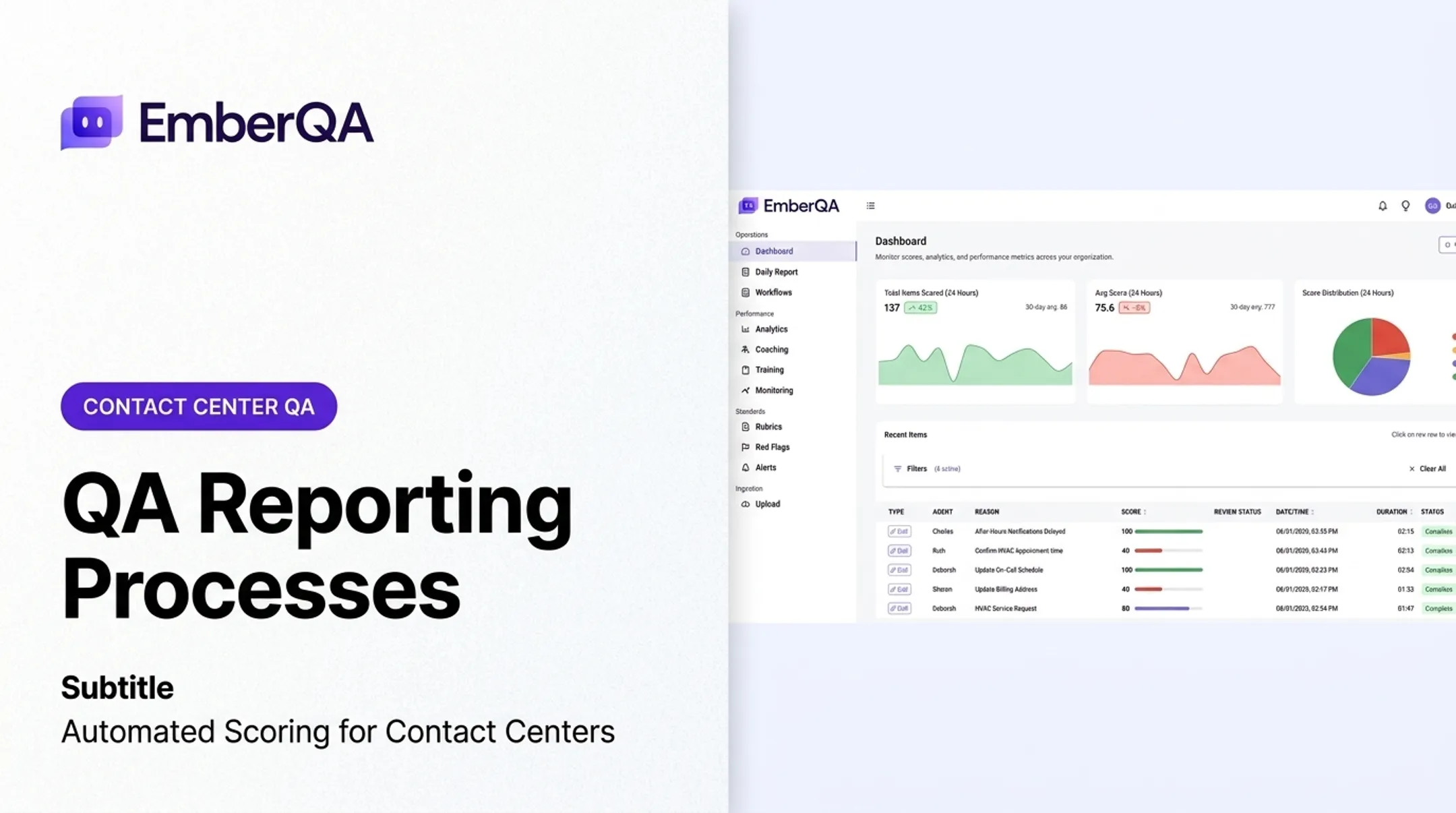
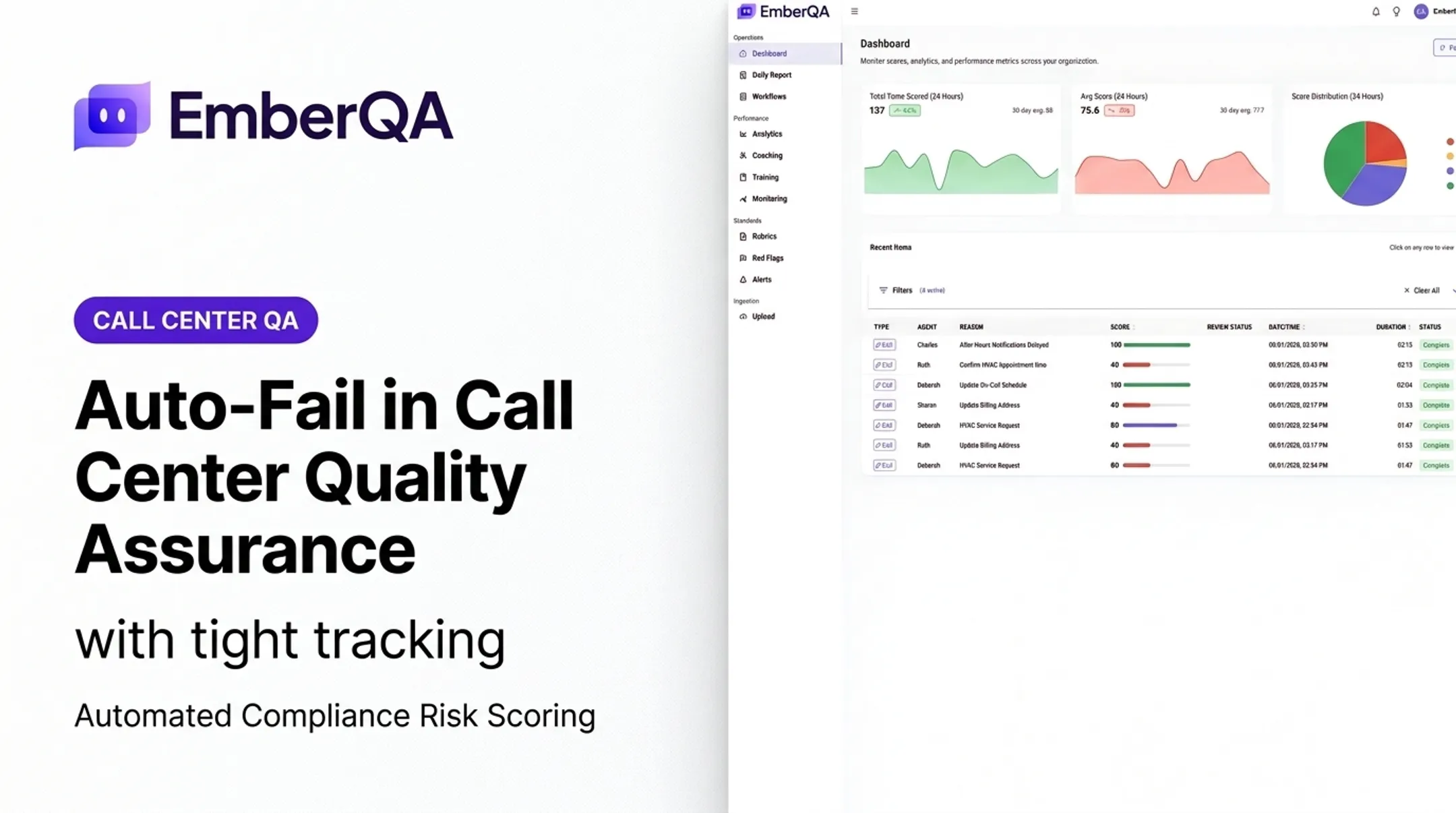
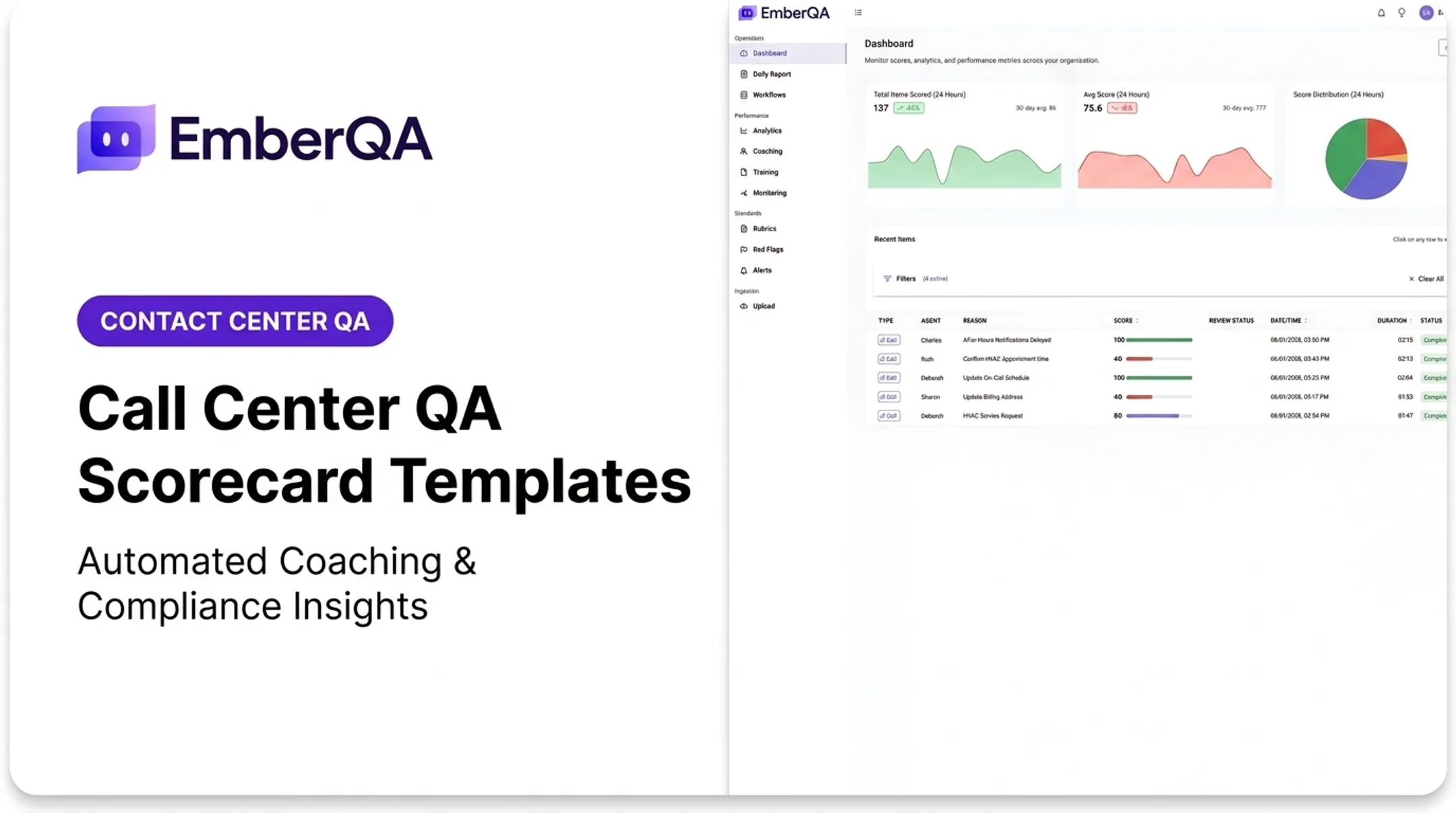
This is where EmberQA fits for teams outgrowing manual sampling. It scores every recorded interaction against a custom rubric, not a random slice, and surfaces red-flag behaviors such as hostile conduct, privacy violations, and escalation risk in real time.
ECA Telephone Answering Solutions used this approach to move from reviewing under 1% of calls to scoring 100% of them, freeing up roughly 30 hours a week previously spent manually replaying recordings.
Pros:
- Coverage and consistency rise sharply
- Repetitive manual review work drops
Cons:
- Automation still needs governance
- Rule-based items (disclosures) are easy to measure; resolution and trust are harder
- Disputed findings still need a human decision
How to Interpret the Results
A score means nothing without evidence and a defined next step. One number is never the whole story. COPC's own Centera example showed an 86% overall quality score sitting alongside just 60% customer-critical accuracy. The composite score was masking real customer-impacting errors. Don't let a high average hide a critical gap.
Normal/Acceptable Results
An acceptable interaction meets compliance and process standards, resolves the customer's need accurately, and is documented completely. The right move here is simple: recognize the behavior, log the result, and keep monitoring for consistency. Don't manufacture corrective action where none is needed.
Minor Issues or Coaching Opportunities
These are isolated, low-risk deviations: weak probing, an unclear explanation, avoidable hold time, or a missed chance to confirm understanding. Convert each finding into targeted coaching:
- Cite the specific example from the call
- Show the preferred behavior
- Assign a practice activity
- Set a follow-up review date
Out-of-Spec or Critical-Fail Results
Watch for inaccurate information, missing disclosures, privacy failures, unauthorized promises, mishandled escalations, or an unresolved customer need. Verify the applicable policy before labeling anything a critical fail. Not every uncomfortable call is a violation. When it is, act immediately:
- Preserve the interaction evidence
- Notify the responsible manager or compliance owner
- Correct the customer-impacting issue where possible
- Document the decision and assign remediation

Trend and Program-Level Interpretation
A single score tells you about one call. A trend tells you about your process. Compare results by agent, team, contact reason, channel, and time period to figure out whether you're looking at an individual coaching need or a broken script, policy, or system. Pair QA scores with operational metrics like repeat contacts, escalations, and customer feedback. First-contact resolution shows why that pairing matters. SQM's 2024 benchmark put the average FCR rate at 69%, ranging from 43% to 88% across industries. If your internal QA scores look strong but customer-reported resolution sits well below that range, the gap is telling you something your scorecard alone won't catch.
Common Errors and Best Practices
Even a well-designed checklist fails if the scoring process around it is sloppy. Watch for these patterns:
Scoring pitfalls:
- Vague criteria like "good attitude" that different evaluators interpret differently
- Overlapping questions that double-count the same behavior
- Overweighting speed at the expense of accuracy
- Sampling only easy interactions and skipping complex ones
- Changing standards without version control, so teams can't tell which scorecard applied when
Evaluator discipline:
- Score from evidence, not memory
- Don't guess intent. Score what was said and done
- Don't penalize an agent for a system outage or policy gap outside their control
- Don't treat customer sentiment alone as proof of agent quality; an angry customer is not always a poor agent performance
Data and governance safeguards:
- Restrict recording and transcript access by role
- Follow applicable federal and state requirements. Recording consent rules differ by state, so one policy rarely covers every location
- Document retention rules and get legal review for industry-specific obligations
Set a stable review cycle and revisit it whenever policy, product, or channel changes:
- Scorecard calibration
- Evaluator training
- Sample design
- Critical-fail review
Tools like EmberQA can surface recurring red flags across a much larger sample of interactions. Automated findings still need validation, with an accountable human reviewer signing off on anything high-risk.

Conclusion
A working call center QA checklist turns customer and business standards into observable behaviors, consistent scoring, documented evidence, and a clear next step. Used well, it becomes a decision-making tool for coaching and process fixes.
Get there by combining a well-designed template, calibrated evaluators, and enough interaction coverage to actually see your risk. Then use the findings to coach agents and fix processes, not just to rank people.
Start with a focused scorecard. Test it against real interactions. Expand it as you learn which signals actually predict customer outcomes and compliance risk.
Frequently Asked Questions
What is quality assurance in a call center?
Call center QA is the structured evaluation of customer interactions against a scorecard, covering agent performance, process adherence, compliance, and customer experience. It drives coaching, calibration, and trend analysis rather than a one-time check.
What does a QA do in a call center?
A QA reviews interactions against an approved scorecard, documents evidence, and flags risks or coaching opportunities. They also support calibration sessions and report recurring process issues to management.
What is a QA/QC checklist?
A QA/QC checklist lists the required quality and control criteria for an interaction, giving evaluators a consistent method rather than a single arbitrary score. It records results, supporting evidence, and any corrective action assigned.
What are the 5 P's of quality assurance?
Common versions cite People, Process, Product, Performance, and Purpose (some frameworks swap in Policy). There's no single fixed industry standard. Adapt whichever framework fits your organization's QA goals.
What is the 80/20 rule in call centers?
The 80/20 rule, or Pareto principle, suggests that a small share of causes (certain contact reasons, error types, or behaviors) often drives a disproportionate share of outcomes. It's a prioritization method, not a guaranteed benchmark for every center.