Introduction
Contact centers generate mountains of data every day. Calls, chats, emails, support tickets, reviews, and CRM notes pile up fast, and no QA team can manually review it all.
That's the gap AI customer intelligence platforms are built to close. These tools turn raw interactions and behavioral signals into searchable insights: sentiment patterns, risk alerts, quality scores, and recommended next actions.
Gartner projects a 16% increase in customer-service interaction volume between 2024 and 2028, driven largely by digital engagement and online purchasing. That growth means manual sampling (reviewing a handful of calls per agent each month) covers less and less of what actually happens with customers.
This guide compares leading platforms by use case, AI capability, data coverage, integrations, scalability, security, and fit for US organizations. Whether you need contact-center QA, CRM-native intelligence, or voice-of-customer analysis, you'll find a clearer starting point below.
Key Takeaways
- AI customer intelligence platforms spot patterns and predict behavior so teams can make faster, better decisions.
- Platforms specialize: profiles and activation, feedback, web behavior, or contact-center conversations.
- Evaluate data coverage, AI accuracy, workflow integration, and governance — not just AI feature count.
- EmberQA fits contact centers that need automated scoring, red-flag detection, and coaching at scale.
Overview of AI Customer Intelligence Platforms in the US Market
An AI customer intelligence platform pulls customer data from multiple sources (CRM records, calls, chats, surveys, support tickets, websites, and reviews), then applies AI to turn that raw material into actionable insight.
Typical outputs include:
- Unified customer or account views
- Sentiment and theme analysis
- Intent detection and churn/risk indicators
- Predictive scores and automated alerts
- Recommended next actions and performance reporting
How This Differs From a CRM or CDP
It's easy to lump these tools together, but the categories serve different jobs. Gartner defines CRM as relationship-management software supporting sales, marketing, and service.
A customer data platform (CDP), by contrast, unifies data from multiple sources into persistent, governed profiles for segmentation and activation.
Customer intelligence platforms sit on top of that data to explain what it means and what to do next. And within this category, there's a further split:
- Profile-based tools unify customer records for segmentation and marketing activation.
- Interaction-based tools, including AI quality assurance platforms, focus on conversations, agent behavior, compliance, and service outcomes.
Forrester's Q1 2025 conversation intelligence landscape for contact centers treats these as their own product category, distinct from broader CDPs.
This distinction matters most for US contact centers, BPOs, insurers, financial services teams, answering services, and multi-site operations. These organizations handle high interaction volumes and need consistent insight across every location, channel, and agent.
The best platform depends on your data sources, customer journey, operating model, and regulatory exposure. The comparison below breaks those factors down.

Best AI Customer Intelligence Platforms
Each platform below gets evaluated on data coverage, AI analysis quality, actionability, integrations, security, scalability, and use-case fit. None of these are interchangeable, since the right pick depends on what you're actually trying to solve.
EmberQA
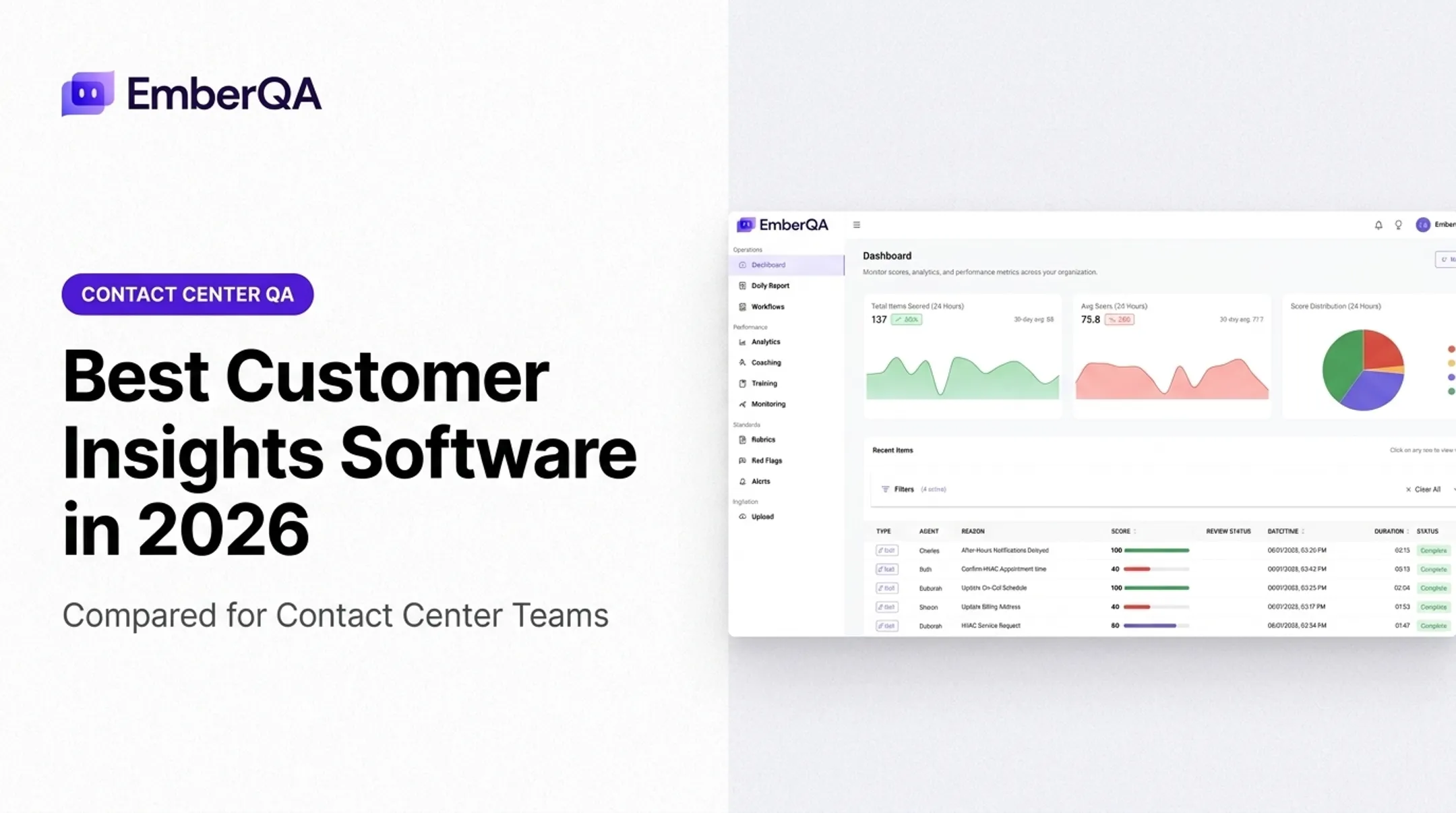
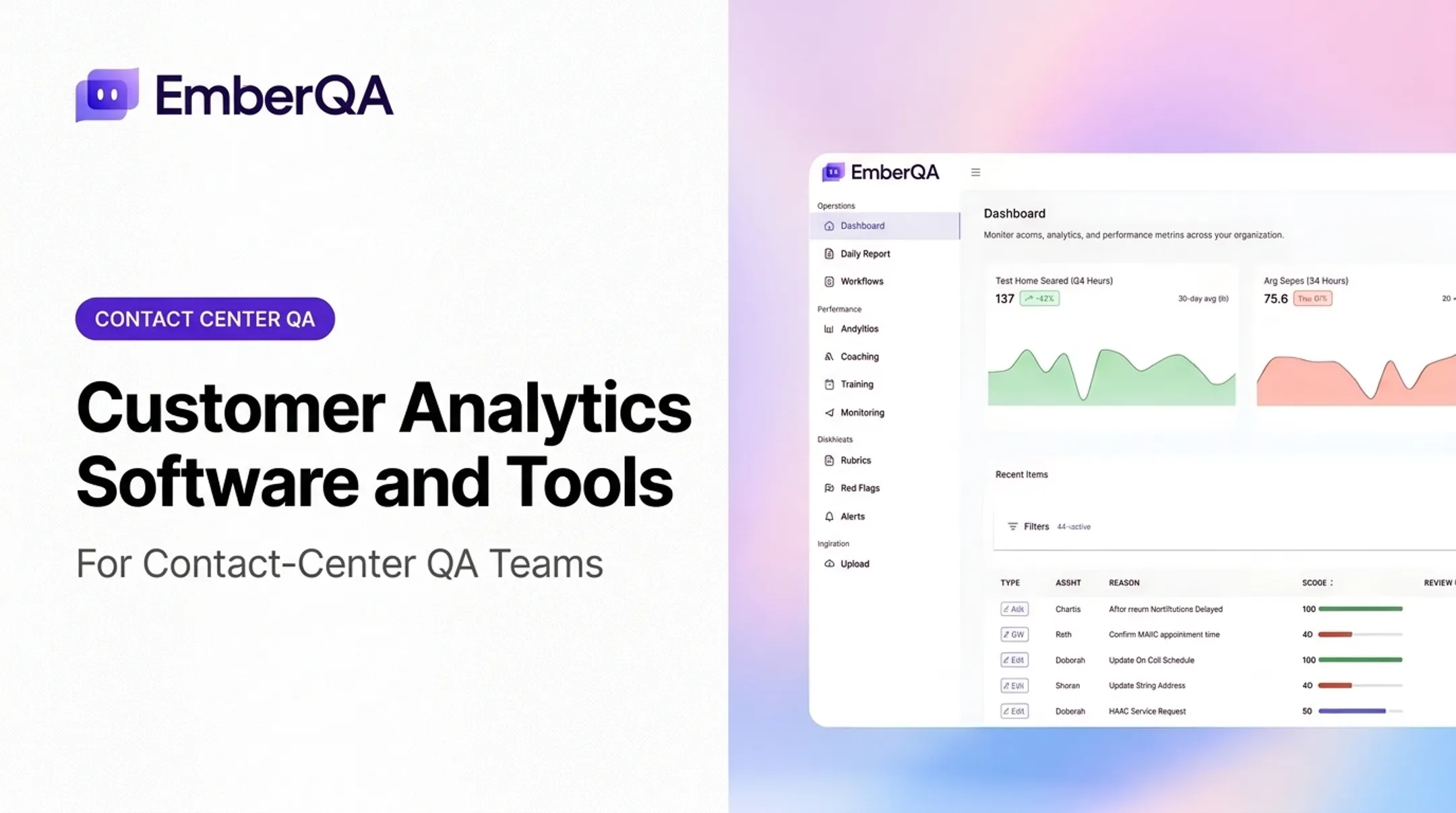
EmberQA is an AI-powered quality assurance and interaction-intelligence platform built specifically for contact centers and customer-facing teams. Instead of sampling a small percentage of calls, it scores every interaction (calls, SMS, emails, and documents) against custom scorecards.
The platform detects red flags like hostile behavior, privacy violations, improper advice, and escalation risks, then routes alerts to supervisors automatically. It also compares call content against CRM records to catch gaps between what was said and what got logged.
Why it stands out: Outsourced BPOs, insurance and financial services call centers, regulated collections teams, and enterprise multi-site operations need broader QA coverage without hiring more reviewers. EmberQA closes that gap by making 100% coverage the default, not the exception.
| Category | Details |
|---|---|
| Best for | Contact-center QA, interaction intelligence, compliance monitoring, agent coaching |
| Key capabilities | Automated scoring of every interaction, red-flag detection, searchable recordings, custom rubrics and weighted metrics, CRM data verification, office-specific workflows |
| Pricing | Essentials: $49/agent/month. Pro: $89/agent/month (adds red-flag alerts, coaching, AI roleplay training, white-glove onboarding) |
| Implementation | Unlimited usage on included features, no overage charges; only scored agents count toward billing |
EmberQA isn't trying to be a full enterprise CDP or a marketing activation suite. It's a focused tool for teams whose primary problem is interaction quality, compliance risk, and agent coaching rather than customer segmentation.
Salesforce Customer 360 with Einstein
For organizations already running on Salesforce, Customer 360 and Einstein extend the CRM with AI-assisted summaries, predictions, segmentation, and workflow activation, all tied directly to existing sales and service data.
Salesforce's AI tools generate conversation summaries, suggested replies, case classification, and case routing, drawing on customer history and knowledge articles. Its Data 360 layer adds record matching, unification, and segment activation for teams that need broader data consolidation.
| Category | Details |
|---|---|
| Best for | Salesforce-centric enterprises wanting CRM-native intelligence and AI-assisted activation |
| Key capabilities | Unified customer profiles, predictive insights, case summaries, segmentation, automated routing, third-party integrations |
| Pricing | Service Cloud Enterprise: $175/user/month. Service Cloud Unlimited: $350/user/month. Agentforce for Service: $125/user/month (billed annually) |
| Implementation | Data 360 credits/profiles priced separately; check edition eligibility before adding AI features |
The tradeoff: pricing adds up quickly once you layer Data 360 credits or Agentforce packages on top of a base Service Cloud license. Budget for the full stack, not just the entry price.
Microsoft Dynamics 365 Customer Insights
Dynamics 365 Customer Insights suits organizations already invested in Microsoft's CRM, analytics, and business application ecosystem. It combines data from multiple sources into unified profiles and segments, then connects those insights to marketing, sales, and service actions through journey orchestration.
Microsoft's platform includes Copilot-supported audience segments and KPI analysis, but its documented strengths lie in journey and profile intelligence rather than contact-center QA scoring.
| Category | Details |
|---|---|
| Best for | Microsoft-focused organizations needing data unification and journey intelligence |
| Key capabilities | Profile unification, segmentation, journey orchestration, consent/privacy controls, predictive modeling |
| Pricing | $1,700/tenant/month (paid yearly), including 100,000 Unified People and 10,000 Interacted People |
| Implementation | Additional people-capacity purchases don't increase allowances for segments or scheduled refreshes — plan capacity carefully |
One named Microsoft customer, Parana Banco, reported an eight-month implementation and 55% higher engagement after deploying Customer Insights alongside Power Automate. That's one case study, not a guaranteed timeline. Actual results vary based on data complexity and source count.
Qualtrics XM
Qualtrics XM approaches customer intelligence from the feedback side. It combines surveys, text analysis, and sentiment scoring with interaction data from calls, chat, and email to build a picture of customer perception across NPS, CSAT, and CES metrics.
Its quality management module advertises automated interaction scoring using NLP to evaluate empathy, script adherence, and sentiment, functionality that overlaps with contact-center QA, though the platform's core strength remains structured voice-of-customer programs.
| Category | Details |
|---|---|
| Best for | Enterprise voice-of-customer programs, experience management, feedback-led decisions |
| Key capabilities | NPS/CSAT/CES tracking, survey orchestration, sentiment and theme analysis, dashboards, predictive analytics |
| Pricing | Quote-based; no published standard enterprise price. Sentiment analysis requires Advanced Text client tier |
| Implementation | Contact-center analytics and quality management sold as separate modules within the CX suite |
Qualtrics fits best when feedback and experience measurement drive the roadmap. It's a weaker fit when interaction QA and compliance monitoring are the primary goal.
Zendesk
Zendesk turns support tickets, chats, and help-center activity into customer intelligence within its existing helpdesk workflow. Its AI features classify requests by topic, sentiment, and language, then suggest response drafts inside the agent workspace.
As of May 2025, ticket-lifecycle tracking of predicted sentiment and intent became available for customers with the Copilot add-on, a meaningful upgrade for support teams already living inside Zendesk's ecosystem.
| Category | Details |
|---|---|
| Best for | Support teams wanting customer intelligence inside an omnichannel helpdesk |
| Key capabilities | Ticket analytics, AI triage, sentiment/intent classification, knowledge-base reporting, service dashboards |
| Pricing | Support Team: $19/agent/month. Suite Team: $55/agent/month. Suite Professional: $115/agent/month. Copilot add-on: $50/agent/month |
| Implementation | AI-agent usage billed separately via Automated Resolutions once plan allowances are exceeded |
Zendesk works well when your intelligence needs live entirely within ticket-based support. It's less suited to voice-heavy compliance monitoring or dedicated QA scoring across recorded calls.

How We Chose the Best AI Customer Intelligence Platforms
We assessed each platform on practical business outcomes and use-case fit, not marketing language or an "AI" label. We checked product documentation and independent customer feedback instead of taking vendor claims at face value.
Data Coverage and Intelligence Quality
- Does the platform support your key sources: calls, chats, emails, tickets, CRM records, surveys, reviews, or web behavior?
- Can its AI identify themes, sentiment, intent, risk, compliance issues, and next-best actions with explainable outputs and human review controls?
- Can you audit how scores are produced, sample edge cases, and measure coverage across 100% of interactions rather than a thin manual sample?
A tool that only handles tickets won't help if most of your volume comes through voice.
Workflow Integration and Actionability
Dashboards alone rarely change outcomes. Insights need to reach the systems your team already uses:
- Destination systems: Does data flow to your CRM, helpdesk, QA workflow, or coaching process?
- Alert mechanisms: Are there real-time alerts, routing rules, or automatic case creation?
- Closed-loop measurement: Can you track whether an action taken actually improved the outcome?

Security, Governance, and Scalability
US privacy and consent laws add real complexity. California's CCPA/CPRA grants consumers rights to know, delete, correct, and limit use of personal data. Colorado's Privacy Act, effective July 2023, adds similar access and opt-out rights.
Recording consent also varies by state. California and Florida both require all-party consent for confidential communications, which affects how call recordings get stored and analyzed.
The FCC's 2024 ruling on AI-generated voices confirmed that TCPA restrictions on prerecorded calls extend to AI-generated voices. Outbound AI voice campaigns need prior express consent.
Beyond legal fit, confirm the platform can enforce role-based access, retention controls, and audit logs, and that it scales across sites, vendors, and rising interaction volume without rework.
Common selection mistakes to avoid:
- Choosing a platform that doesn't cover your primary channel
- Treating AI-generated scores as unquestionable without human review
- Overlooking data quality issues that skew every downstream insight
- Buying overlapping tools that duplicate the same function
- Skipping defined success metrics before implementation starts
Conclusion
No single AI customer intelligence platform fits every organization. The right choice depends on your data sources, customer journey, and regulatory exposure.
Different teams prioritize different capabilities:
- Unified customer profiles and activation
- Voice-of-customer feedback loops
- Interaction QA and compliance monitoring
Before signing anything, run each shortlisted platform against real sample data and actual workflows. Compare accuracy, adoption speed, integration depth, and total cost, not just the price on the pricing page.
If your priority is analyzing every customer interaction, catching urgent compliance risks, standardizing QA scoring, and coaching agents with real data instead of guesswork, EmberQA is worth a closer look. It's built specifically for contact centers and customer-facing teams that have outgrown manual sampling.
Frequently Asked Questions
What is a customer intelligence platform?
A customer intelligence platform collects and analyzes customer data (calls, tickets, surveys, CRM records) to surface patterns, predictions, risks, and recommended actions. Unlike a basic CRM, it interprets data rather than just storing it.
What is the difference between a customer intelligence platform and a customer data platform?
A CDP primarily unifies customer data into persistent profiles for segmentation and marketing activation. A customer intelligence platform analyzes that data to produce insights, alerts, and recommendations. The two categories often overlap in practice.
How do AI customer intelligence platforms help contact centers?
They transcribe and analyze interactions for sentiment and intent, automate QA scoring, flag compliance risks, surface coaching opportunities, and trigger workflow alerts, replacing manual call sampling with full coverage.
What features should I look for in an AI customer intelligence platform?
Look for relevant data connectors, accurate AI analysis, searchable interaction views, predictive scoring, CRM/helpdesk integrations, real-time alerts, security controls, and human review options.
How much does an AI customer intelligence platform cost?
Pricing depends on seats, data volume, channels, AI usage, and contract terms. Published starting points range from roughly $19/agent/month for basic helpdesk plans to $1,700/tenant/month for enterprise data unification. Request a quote based on your specific use case.
How long does it take to implement an AI customer intelligence platform?
Timelines vary widely. Focused interaction-analysis tools can deploy in weeks, while enterprise projects involving data unification and governance may take several months. Ask any vendor for a documented implementation plan before committing.