Introduction
Picture a customer-service agent mid-call: a customer is frustrated about a billing error, and the agent is toggling between four browser tabs, a CRM screen, and a printed script binder. Many contact centers still run this way—agents context-switch across tools while the customer waits on the line.
Agent assist is AI-powered software that supports human agents during live customer interactions by surfacing relevant information, response recommendations, and workflow guidance in real time.
This article covers how agent assist works, what it can actually do, where it helps and where it falls short, and how it differs from customer-facing chatbots and AI-powered quality assurance platforms like EmberQA.
Key Takeaways
- Agent assist is a human-in-the-loop AI copilot, not a replacement for customer-service agents
- Core capabilities cover knowledge retrieval, response suggestions, transcription, summaries, sentiment, and compliance prompts
- Results depend on accurate knowledge, reliable integrations, agent adoption, and ongoing measurement
- Live interactions get real-time support; QA platforms like EmberQA evaluate them afterward for coaching and risk detection
What Is Agent Assist?
Agent assist (sometimes called AI agent assist) is technology that gives customer-service representatives relevant help while they're on a call, chat, email, or other customer interaction. It doesn't talk to the customer. It talks to the agent.
This is the human-in-the-loop model: the AI recommends information or a next step, and the agent decides whether to use it, how to phrase it, and how to handle the customer's actual emotional state. The software suggests. The person decides.
Three categories get mixed up in buying conversations:
- Agent assist — works behind the scenes to help a human representative
- Customer-facing chatbot — interacts directly with the customer, no human intermediary
- Autonomous AI agent — completes tasks with limited human intervention, sometimes none at all
For agent assist specifically, tools interpret the live voice, chat, or email thread and push answers, guidance, and workflow prompts into the rep's workspace. Cresta's guide to agent assist frames that same agent-only delivery model in more depth.
Who typically uses it? Teams that need consistent service at volume, including:
- BPOs and answering services
- Insurance and financial-services contact centers
- Collections teams
- Enterprise operations running multiple sites
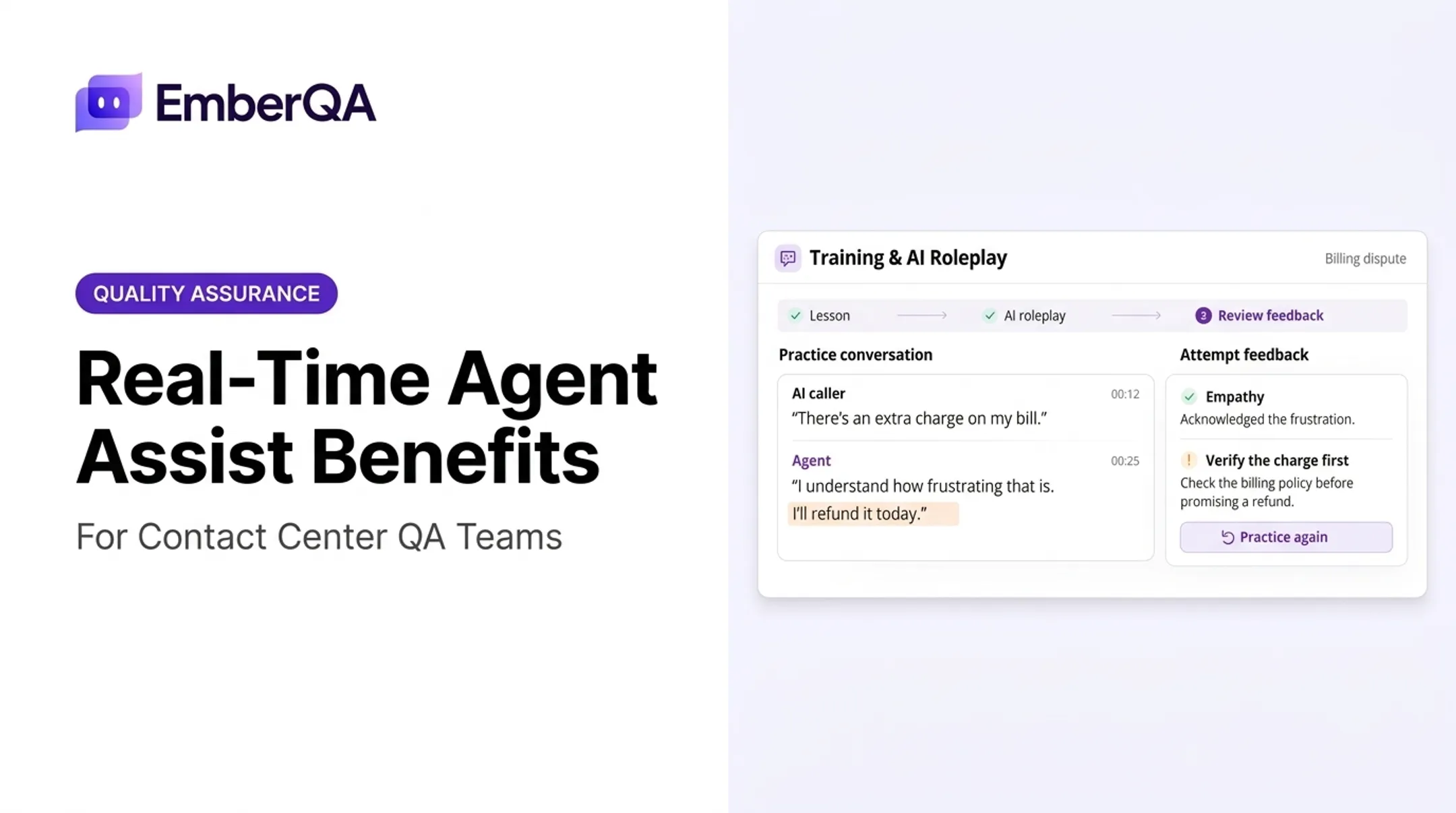
Here's a simple example: an agent takes a call about a billing dispute. Agent assist recognizes the topic, pulls up the relevant policy article, suggests an empathetic opening line, and flags the next-step workflow, all without the agent leaving their existing workspace.
How Does Agent Assist Work?
Agent assist follows the same basic sequence on voice and text channels.
- Capture — Voice or text input from the conversation is collected as it happens.
- Transcribe — For voice, speech is converted to text in real time; text channels skip this step.
- Interpret — The system analyzes language and intent to understand what the customer needs.
- Retrieve — Relevant guidance is pulled from knowledge bases, CRM records, past support content, and internal procedures.
- Surface — Suggestions appear in the agent's workspace as prompts, articles, or recommended actions.

Google's documentation on Agent Assist knowledge document best practices describes the same pattern. The system matches the live conversation to approved knowledge documents or FAQ answers, then shows snippets the agent can review before using them.
Context shapes everything. What the agent sees depends on factors such as:
- The customer's specific issue
- Account history
- Sentiment in the conversation
- Compliance requirements tied to the topic
- Where the interaction sits in the broader service workflow
Consider a frustrated customer reporting a repeated billing problem for the third time. Agent assist identifies the topic and flags escalation risk based on the repetition. The agent receives a specific policy reference, an empathy-focused opening line, and a clear escalation path, all before they've finished reading the customer's complaint.
One important caveat: treat every suggestion as a draft the agent still owns. Agents and supervisors need a way to review recommendations, correct errors, and escalate when confidence is low or the situation is ambiguous.
What Can Agent Assist Do?
Agent assist supports agents during live conversations and in the wrap-up work that follows. Most platforms combine some mix of the capabilities below.
Surface relevant knowledge in real time
Instead of an agent searching three different systems, agent assist presents approved articles, policies, scripts, and troubleshooting steps based on what's actually being said on the call. This only works if the underlying knowledge source is current. A tool connected to outdated or fragmented documentation will surface outdated or fragmented answers.
Suggest responses and next-best actions
This includes AI-generated reply drafts, smart compose for chat and email, and context-aware next-step prompts. CX Today's overview of agent-assist use cases describes this as next-best-action guidance paired with response drafting pulled from approved knowledge sources. Agents should still check suggestions for tone, accuracy, and compliance before using them.
Provide transcription, summaries, and after-contact support
Live transcription makes conversations searchable and supports accessibility. Automated summaries capture the issue, actions taken, resolution, and any follow-up needed, cutting down on repetitive wrap-up work. Agents should still verify key details before a summary becomes the permanent record.
Guide agents through scripts, workflows, and compliance steps
Dynamic checklists remind agents to:
- Verify identity
- Ask required disclosure questions
- Document outcomes
- Follow escalation steps
This matters most in regulated environments such as insurance, financial services, and collections, where guidance has to match approved policy language, not just sound reasonable.
Detect sentiment, intent, and escalation signals
Language patterns, tone, and specific keywords can signal frustration, urgency, churn risk, or a need for a supervisor. Google's documentation on analyzing message sentiment confirms these are computed scores based on conversation context. Treat them as directional signals agents should weigh alongside the full conversation.

Agent Assist Benefits, Limitations, and Implementation
Benefits for contact centers and agents
Faster access to information produces real gains, and the size of that gain depends on agent experience. A 2023 NBER study tracking 5,179 support agents found conversational AI assistance associated with a 14% average increase in issues resolved per hour. Novice agents saw gains as high as 34%; experienced agents saw minimal change.
In another deployment, Google Cloud reports that TTEC's use of Knowledge Assist cut average handle time by 11%, with 18% stronger performance among new hires. Treat that as a vendor-reported benchmark, not a universal outcome.
Beyond speed, agent assist also helps with:
- Reducing repetitive after-contact work through auto-generated summaries
- Supporting faster onboarding for new agents following guided workflows
- Keeping experienced agents consistent across high call volumes
- Surfacing recurring customer issues and knowledge gaps for managers to act on
Limitations and risks to address
Agent assist isn't risk-free. Speech recognition accuracy can vary widely by speaker. A 2020 PNAS study found average word error rates of 0.35 for Black speakers versus 0.19 for white speakers across five commercial speech systems. Test that gap against your own call audio before rollout.
Other risks worth watching:
- Outdated or hallucinated recommendations if knowledge sources aren't maintained
- Alert fatigue from too many prompts competing for agent attention
- Latency that delivers the right answer just a beat too late to matter
- Privacy and access-control gaps when the system touches recordings, transcripts, or sensitive account data
Agent assist should augment human judgment, not replace it, especially during complaints, vulnerable-customer interactions, or complex regulated decisions where a wrong automated suggestion carries real consequences.
How to evaluate and implement agent assist
Before shopping for a vendor, assess your actual pain points:
- Are agents spending too long searching for information mid-call?
- Are scripts and disclosures inconsistent across agents or sites?
- Is after-contact work eating into productive time?
- Is your knowledge base outdated, scattered, or hard to search?
When evaluating platforms, weigh CRM and contact-center integration, knowledge-source controls, supported channels, latency, auditability, security, and vendor support.
Start with a staged rollout: one workflow or agent group, clear training, active agent feedback, and defined success metrics such as handle time, first-contact resolution, quality scores, and adoption rate.
How agent assist works with AI-powered QA
Agent assist and QA solve different problems on different timelines. Agent assist helps during the conversation. QA platforms evaluate interactions after or across conversations against scorecards and surface patterns agents and supervisors can't see in the moment.
The two reinforce each other well. QA findings can reveal exactly where prompts or knowledge content need fixing; agent-assist usage data can add context to performance trends QA teams are already tracking.
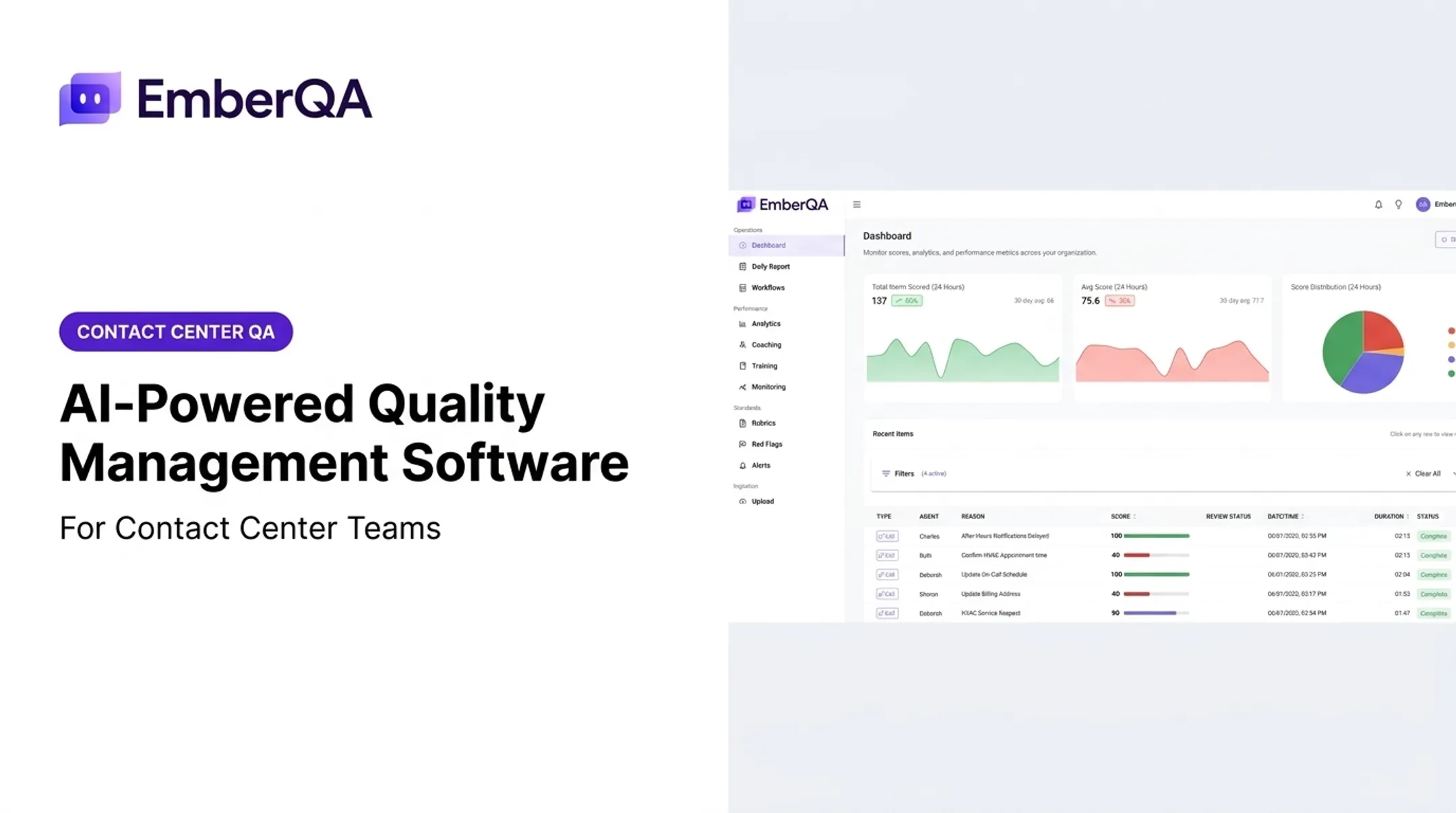
This is where EmberQA fits. It is an AI-powered QA platform that analyzes every recorded interaction (calls, SMS, emails, chat transcripts, and documents) against custom scorecards. It flags compliance risks such as improper advice or hostile behavior, then turns recurring patterns into targeted coaching.
EmberQA is not a live agent-assist tool. It is the evaluation layer that shows whether your live-assist strategy, scripts, and coaching are actually working.

Conclusion
Agent assist works best as an AI copilot: it gives human agents timely context and automation while keeping people accountable for the actual customer relationship.
Getting real value depends on a few fundamentals:
- Accurate, current knowledge
- Solid integrations with your stack
- Human oversight of AI suggestions
- Responsible data handling
- Real agent adoption
- Consistent measurement of customer and operational outcomes
If you're already running an agent-assist strategy, the next question is whether it's actually working. That answer depends on QA visibility. EmberQA helps contact centers and customer-facing teams score every interaction instead of a small manual sample, catch compliance risks early, and turn recurring patterns into coaching that sticks.
Reach out at hello@emberqa.com to see how it fits alongside your agent-assist tools.
Frequently Asked Questions
What does agent assist do?
Agent assist supports human representatives with real-time information, response suggestions, workflow prompts, and conversation summaries during live interactions. The agent stays in control throughout.
What is an assist agency?
"Assist agency" isn't a standard industry term for this technology. It likely refers to agent assist, and shouldn't be confused with a customer-service agency or outsourcing provider that staffs contact centers.
How is agent assist different from a chatbot?
A chatbot communicates directly with customers, often without human involvement. Agent assist works behind the scenes, feeding suggestions to a human representative who decides how to respond.
How does agent assist work?
Agent assist captures voice or text, transcribes speech when needed, and interprets customer intent. It then retrieves relevant knowledge and shows recommendations in the agent's workspace as prompts, articles, or suggested actions.
What are the benefits of agent assist for contact centers?
Contact centers get faster access to information, more consistent service, less repetitive after-contact work, stronger support for new agents, and better customer outcomes.
Is agent assist the same as AI-powered quality assurance?
No. Agent assist helps agents during a live interaction. AI-powered QA, like EmberQA, evaluates interactions afterward for scoring, compliance risk detection, trend analysis, and targeted coaching.