Most US organizations juggle this exact problem. A customer complains on a call, praises the brand in a survey, then vents on social media — and no one connects the dots. Customer experience management (CXM) platforms exist to fix that gap.
These tools don't just store customer records like a CRM does. They collect feedback, analyze interactions, and push insights into workflows that actually change how teams operate. The right platform depends on your channels, industry, team size, and existing tech stack. There's no single "best" option — only the best fit for your operation.
This guide breaks down five leading platforms, explains how to evaluate them, and shows where a dedicated QA layer fits alongside a broader CXM strategy.
Key Takeaways
- CXM platforms connect feedback, journey data, analytics, and action workflows into one system.
- Enterprise XM suites, contact-center platforms, CRMs, and help desks solve overlapping but distinct problems.
- Compare vendors by use case, data sources, integrations, and total cost — not just feature lists.
- Always verify pricing, compliance claims, and current capabilities directly with vendors before signing.
Overview of Customer Experience Management Platforms in the US Market
A CXM platform is software that helps organizations understand customer interactions and improve experiences across web, mobile, email, chat, social, surveys, and voice channels. It's a category built for insight and action, not just record-keeping.
How CXM differs from adjacent tools:
- CRM systems organize relationship, sales, and commercial data.
- Survey tools collect feedback but rarely connect it to operational systems.
- Help desks manage individual service cases.
- Contact-center platforms manage live conversations and routing.
- CXM platforms tie insight, measurement, and action together across all of the above.
For US organizations, that connection matters. It means faster identification of friction points, more consistent experiences across channels, and tighter alignment between CX teams and the operations leaders who actually fix problems.
Why This Matters Right Now
The pressure to get this right is real.
Forrester's 2024 US Customer Experience Index, based on responses from more than 98,000 US customers across 223 brands, found that CX quality declined at 39% of the US brands it tracked. That decline is a warning sign that legacy approaches to feedback collection aren't keeping pace.
On the listening side, Qualtrics' 2025 study gathered responses from 27,146 US consumers across seven channels, underscoring how fragmented channel experiences have become the norm rather than the exception.

The platforms below take different approaches to solving this. Evaluate each "best for" label against your own customer journey, team structure, and technology stack, not just the vendor's marketing page.
Best Customer Experience Management Platforms
We evaluated these platforms using consistent criteria: feedback and interaction coverage, analytics depth, journey visibility, workflow automation, integrations, usability, scalability, and privacy controls. Pricing and feature details change often, so verify specifics against current vendor documentation before you commit.
Qualtrics
Qualtrics positions itself as an enterprise experience management platform spanning customer, employee, product, and brand programs. Its current lineup includes XM for Customer Experience, XM for Employee Experience, and XM for Strategy & Research.
It's a strong fit for organizations running structured experience research: large-scale survey programs, segmentation, and enterprise-grade reporting. The platform includes AI-guided frontline dashboards and dynamic segmentation, plus marketplace integrations (including one that pushes response data into SAP Service Cloud and Sales Cloud).
Qualtrics doesn't publish pricing publicly. You'll need to request a quote based on planned usage, and costs can vary by industry security requirements. On G2, the platform holds a 4.3/5 rating from 751 reviews, with some users noting flexibility trade-offs against configuration complexity.
Medallia
Medallia's Experience Cloud captures cross-channel signals — customer, digital, employee, and contact-center — then uses AI (branded Athena) to identify themes, sentiment, and predictive patterns. Its contact-center offering ingests audio, transcripts, chat, SMS, and agent notes.
This makes it a solid choice for organizations that need genuine closed-loop action: alerts, cases, and automated workflows triggered by what the analytics find, not just dashboards to look at.
Pricing and compliance details:
- Pricing is based on Experience Data Records (interaction volume), not user seats or survey counts — dollar figures aren't published.
- Text analytics is typically a paid add-on subscription, not a default inclusion.
- Medallia lists SOC 2 Type II and ISO 27001/27017/27018/27701 compliance, plus GDPR/CCPA-related commitments (note: GDPR and CCPA are laws, not certifications — verify current attestations directly).
InMoment
InMoment's Experience Improvement (XI) Platform pulls together surveys, contact-center interactions, social reviews, video, and web sessions into one reporting layer that blends closed-loop feedback with operational data.
It's built for teams that need to turn scattered signals, from reviews to call transcripts, into prioritized action plans. XI includes native-language text analytics, emotion and sentiment recognition, case management, and automated workflows.
InMoment publishes general plan tiers but not an exact subscription price, so a vendor quote is necessary. G2 shows a strong 4.7/5 from 319 reviews, though individual review dates vary in age, so check recency when weighing feedback.
Zendesk
Zendesk is a customer service and engagement platform. It supports CXM-adjacent work through omnichannel case management, self-service, messaging, and interaction history — but it's built for service-led programs, not broad experience research.
Pricing (US, billed annually):
| Plan | Price per agent/month |
|---|---|
| Suite Team | $55 |
| Suite Professional | $115 |
AI agents are available with outcome-based pricing layered on top. One implementation detail matters: Zendesk's routing documentation notes that email and web-form tickets require an auto-routing tag to get the documented assignment behavior — worth testing before rollout. G2 reviewers (4.3/5 from over 7,000 reviews) have flagged occasional friction with tagging and teammate notifications inside tickets.
Genesys Cloud
Genesys Cloud CX is built for organizations whose most important CX data originates in the contact center — voice, chat, messaging, routing, and agent performance.
It covers omnichannel routing, speech and text analytics, and an AI-powered Agent Assist feature that surfaces contextual knowledge during live conversations. Its AppFoundry marketplace adds integration flexibility.
Pricing (US, annual commitment, per user/month):
| Tier | Price |
|---|---|
| CX 1 | $75 |
| CX 2 | $115 |
| CX 3 | $155 |
| CX 4 | $240 |
Some AI features run on token-based usage charges on top of the tier price. Genesys is cloud-first, though it does offer a premises-connected voice option for specific configurations. It documents SOC 2 Type 2 and ISO 27001:2022 compliance, with some regional limitations worth confirming for your deployment.
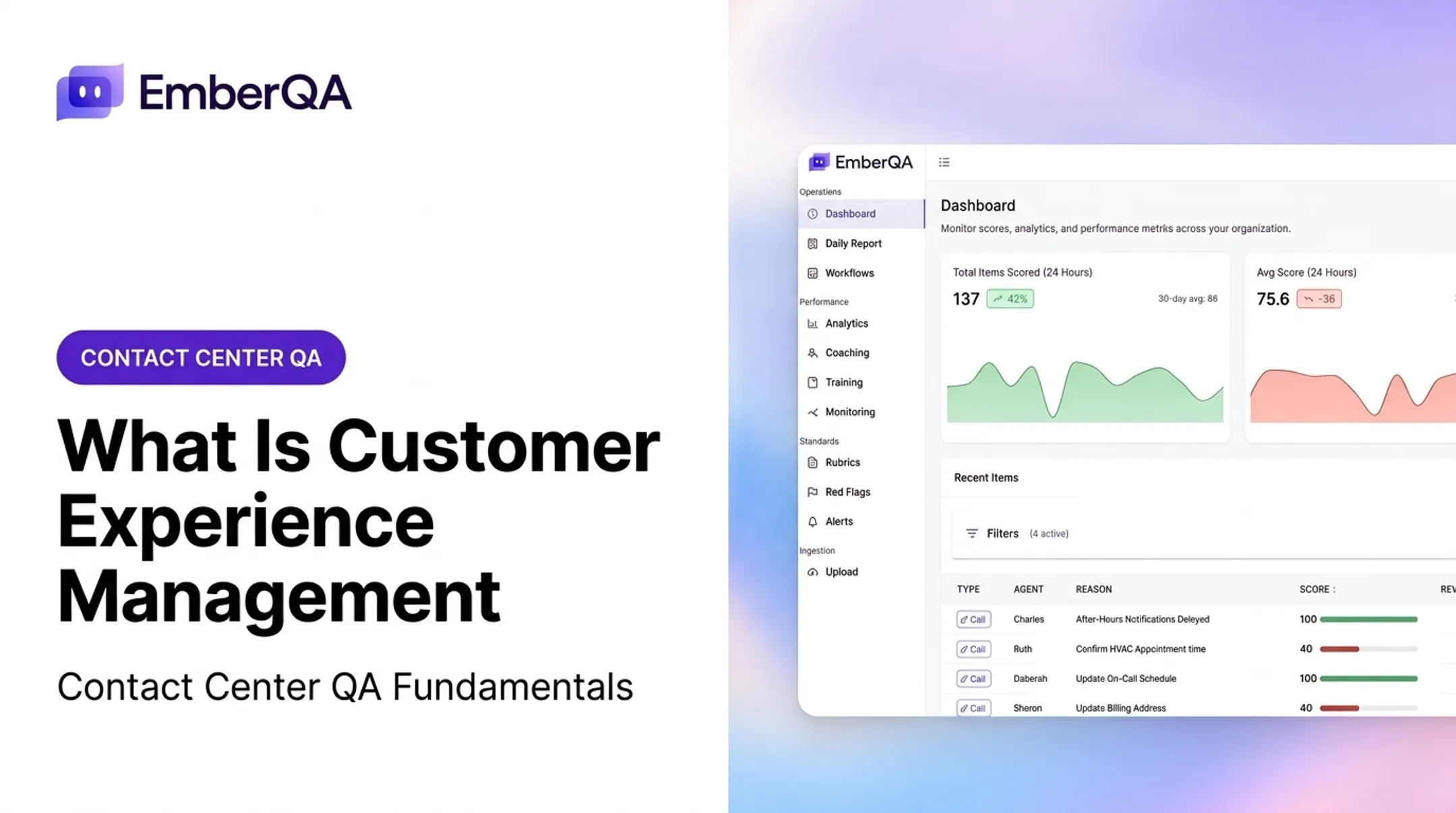
One gap Genesys and similar contact-center platforms leave open: interaction-level quality assurance. Scoring every call for compliance risk, standardizing evaluation across agents, and turning recurring patterns into coaching usually needs a dedicated QA layer beside your CXM stack. EmberQA handles that layer—automated scoring, red-flag alerts, and coaching insights—on the channels you already run.
Quick Comparison
| Platform | Best For | Pricing Basis | Watch For |
|---|---|---|---|
| Qualtrics | Enterprise research & survey programs | Quote-based | Configuration complexity |
| Medallia | Multi-signal analytics with closed-loop action | Per interaction record | Text analytics often costs extra |
| InMoment | Unifying feedback into action plans | Quote-based | Verify plan specifics with sales |
| Zendesk | Service-led CX programs | Per agent/month ($55–$115+) | Routing setup requires configuration |
| Genesys Cloud | Contact-center operations | Per user/month ($75–$240) | AI features may add token costs |

How We Chose the Best Customer Experience Management Platforms
We measured business fit and operational outcomes, not just brand recognition or feature counts. Here's what we checked.
Core functionality:
- Voice-of-customer collection across channels
- Omnichannel data ingestion
- Journey mapping and NPS/CSAT/CES measurement
- Text and sentiment analytics
- Real-time dashboards, alerts, and closed-loop action workflows
Contact-center depth (where relevant):
- Call recording compatibility and interaction analytics
- QA workflows and agent coaching
- Compliance monitoring across teams or sites
Integration architecture:
- CRM, help desk, and marketing systems
- Survey tools and data warehouses
- APIs, webhooks, and identity management
Privacy and compliance:
- Consent management and role-based access
- Audit logs and data residency options
Always verify these claims directly. Vendor marketing pages sometimes blur the line between real certifications and general privacy commitments.
Total cost of ownership:
- Licenses and interaction volume
- Implementation, training, and administration
- Support tiers and professional services
A low sticker price can still cost more once you add integrations and services.
A Practical Buying Process
- Define one primary CX problem you're solving — not five.
- Document baseline KPIs so you can measure improvement.
- Shortlist two to three platforms based on that specific problem.
- Run a limited pilot using representative, real data — not a canned demo.
- Test adoption with frontline users, not just administrators.
- Establish how insights lead to accountable action before you sign anything.

This last step trips up more buyers than any other. A platform that surfaces great insights but has no clear owner for follow-through rarely improves CX outcomes.
Conclusion
The right customer experience management platform connects your most important customer signals to measurable action, not the longest feature list.
Before you sign a contract, pressure-test the shortlist against:
- Data coverage across the channels you actually use
- Integration quality with your CRM and ticketing stack
- Usability for the teams who live in the product daily
- Scalability as interaction volume grows
- Privacy controls and total cost, including implementation and training
If your biggest gap is interaction-level quality assurance (scoring every call, chat, and email against consistent standards instead of sampling a handful each month), a broader CXM suite alone may not close it.
That is where EmberQA fits. It scores every customer interaction across calls, SMS, emails, and documents against custom rubrics, flags compliance and escalation risks in real time, and turns recurring patterns into targeted coaching.
EmberQA connects to existing CRMs and ticketing systems through APIs and webhooks, so QA results and alerts land where your team already works. If a dedicated QA layer is the missing piece in your CX stack, see whether it maps cleanly onto your current workflow.
Frequently Asked Questions
What is experience management (XM)?
Experience management is the coordinated measurement and improvement of customer, employee, product, and brand experiences. XM platforms support this by collecting feedback and operational data, then converting that signal into prioritized improvements across those areas.
What does a CXM company do?
A CXM company builds software or services that help organizations collect customer feedback, analyze interactions and sentiment, manage journeys, and turn those findings into experience improvements. Scope ranges from survey tools to full journey and QA platforms.
What are customer experience solutions?
This category includes feedback and survey tools, journey analytics, contact-center and help-desk systems, CRM-connected workflows, self-service, personalization, and quality assurance platforms. Most organizations run several of these together.
What is customer experience analytics?
CX analytics combines feedback, behavioral data, operational metrics, and interaction data to identify patterns, friction points, and sentiment. The goal is surfacing improvement opportunities that a single data source would miss.
What is CX vs. CRM?
CRM systems organize customer records, relationships, and sales or service activity. CX analysis focuses on how customers actually perceive and experience their interactions across the full journey. They complement each other; neither replaces the other.
What are the different types of experience?
Common categories include customer, employee, product, brand, user, digital, partner, and patient or citizen experience. Which categories matter most depends heavily on your organization and industry.