That model is breaking down. 80% of service decision-makers expect case volume to keep rising, according to Salesforce's State of Service survey. Add inconsistent scoring between reviewers, the same five questions repeated hundreds of times a day, and mountains of transcript data nobody ever mines for patterns, and you get teams flying blind.
Machine learning changes what's possible here. Not as a replacement for agents, but as a way to analyze every interaction, flag what matters, and free people up for the parts of the job that actually need a human. This article walks through the practical use cases, the benefits worth measuring, and what responsible implementation actually looks like.
Key Takeaways
- Machine learning helps teams analyze 100% of interactions instead of a random 1-3% sample
- Chatbots and routing tools handle routine work; humans stay essential for escalations and judgment calls
- Agent-assist tools speed up resolution, especially for newer team members
- Automated QA replaces guesswork with consistent rubrics and searchable evidence
- Every use case still needs human review, clear escalation paths, and ongoing monitoring
What Is Machine Learning in Customer Service?
Machine learning is a subset of artificial intelligence that learns patterns from data to make predictions, classifications, or recommendations. Instead of a programmer writing rules for every possible customer question, the system learns from examples.
The basic workflow looks like this:
- Collect relevant interaction data (calls, chats, emails, CRM records)
- Train or configure a model on that data
- Apply it to new, incoming interactions
- Review the outcomes with human oversight
- Improve the system using that feedback
Untangling the Terminology
These terms get used interchangeably, but they mean different things:
- AI is the broad category — machines performing tasks that typically require human intelligence
- Machine learning is how those systems learn from data rather than fixed rules
- Deep learning is an ML approach using multilayered neural networks
- Natural language processing (NLP) applies computational methods to understand or generate language — this is what powers intent detection and sentiment analysis
- Generative AI produces new content, like a draft reply or a call summary
Three Types of Machine Learning That Matter Here
| Type | How it learns | Customer service example |
|---|---|---|
| Supervised | From labeled examples | Classifying a complaint type or compliance exception |
| Unsupervised | Finds patterns without labels | Clustering emerging reasons customers contact support |
| Reinforcement | Learns through feedback | Refining routing decisions based on outcomes |
Model performance depends on data quality, clear objectives, and consistent human review. More data alone does not guarantee useful or fair results; it can just as easily amplify bad habits already baked into your interaction records. That is why contact-center teams pair ML scoring with defined scorecards and ongoing QA oversight.
Machine Learning Use Cases in Customer Service
Each use case below solves a specific problem, relies on a specific type of data, produces a defined action, and still requires a human somewhere in the loop. That last part isn't optional — it's what keeps these systems accountable.
Intelligent Routing and Prioritization
ML can classify an inquiry by intent, urgency, language, customer history, or likely complexity, then route it to the right queue or specialist automatically. A frustrated long-tenure customer asking about a billing dispute doesn't need to land in the same queue as a first-time password reset.
Predictive prioritization helps teams spot high-risk or time-sensitive interactions before they escalate. That said, a model's prediction isn't a verdict — supervisors still need to weigh in on edge cases the system wasn't trained to recognize.
AI Chatbots and Self-Service
NLP-powered bots recognize customer intent, pull answers from a knowledge base, and handle routine questions without tying up an agent. The catch: only 14% of service issues get fully resolved in self-service, according to Gartner's 2024 research. Most conversations still need a human eventually.
That's why 87% of customers say access to a human agent is essential when a company uses generative AI for service, per Gartner's 2026 survey. A good self-service setup needs:
- A complete, current knowledge base (outdated answers erode trust fast)
- Clear disclosure that customers are talking to AI
- A visible handoff path to a human when confidence is low
- Ongoing monitoring for wrong or stale answers
Agent Assistance and Conversation Summarization
This is where ML supports the agent instead of replacing the conversation entirely. Common assistance features include:
- Suggested replies drafted from intent and knowledge-base matches
- Real-time customer history and CRM context retrieval
- Live translation for multilingual queues
- Automatic conversation summaries for wrap-up and handoffs
Together, these cut time spent on repetitive work.
A 2023 NBER field study of AI assistance in customer support found successfully resolved chats per hour rose 14% on average, with the biggest gains going to less-experienced agents. That's the pattern worth watching: assistance tools tend to help newer team members close the experience gap faster than tenured staff, who already know the shortcuts.
None of this changes who's accountable for the conversation. Agents still own empathy, judgment calls, and the final message that goes out — the tool just clears the clutter around it.
Sentiment, Intent, and Emerging-Issue Detection
By analyzing tone, repeated phrases, and how interactions resolve, ML can flag frustration, escalation risk, or a product issue nobody's noticed yet. One bank's case study reported topic-classification accuracy improving to 93% after moving from a handful of manual post-call surveys per agent to analysis across all interactions. That kind of coverage catches patterns a small manual sample simply can't. If forty customers mention the same billing confusion in a week, a topic cluster surfaces it long before a manager stumbles onto it by chance. The trend still needs a human to confirm it's a real product problem before anyone acts on it.

Predictive and Proactive Customer Service
ML can flag churn risk, predict likely follow-up needs, or recommend relevant help content before a customer even reaches out. Picture a system noticing an unusually high credit card bill and surfacing payment-plan options before the customer calls in frustrated.
Proactive outreach only works when it's:
- Relevant — based on an actual, actionable signal
- Explainable — the reasoning holds up if a customer asks "why did you contact me?"
- Privacy-conscious — using data the customer expects you to have
- Non-intrusive — not guessing at things that feel invasive or wrong
Get this wrong and proactive outreach reads as surveillance, not service.
Automated Quality Monitoring and Compliance Review
ML can evaluate calls, chats, emails, and documents against a defined rubric, then surface missed disclosures, policy deviations, or risk signals for human review. This is the direct answer to a problem that's plagued QA for years: about four in five contact centers randomly sample interactions manually, which means most calls never get reviewed at all.
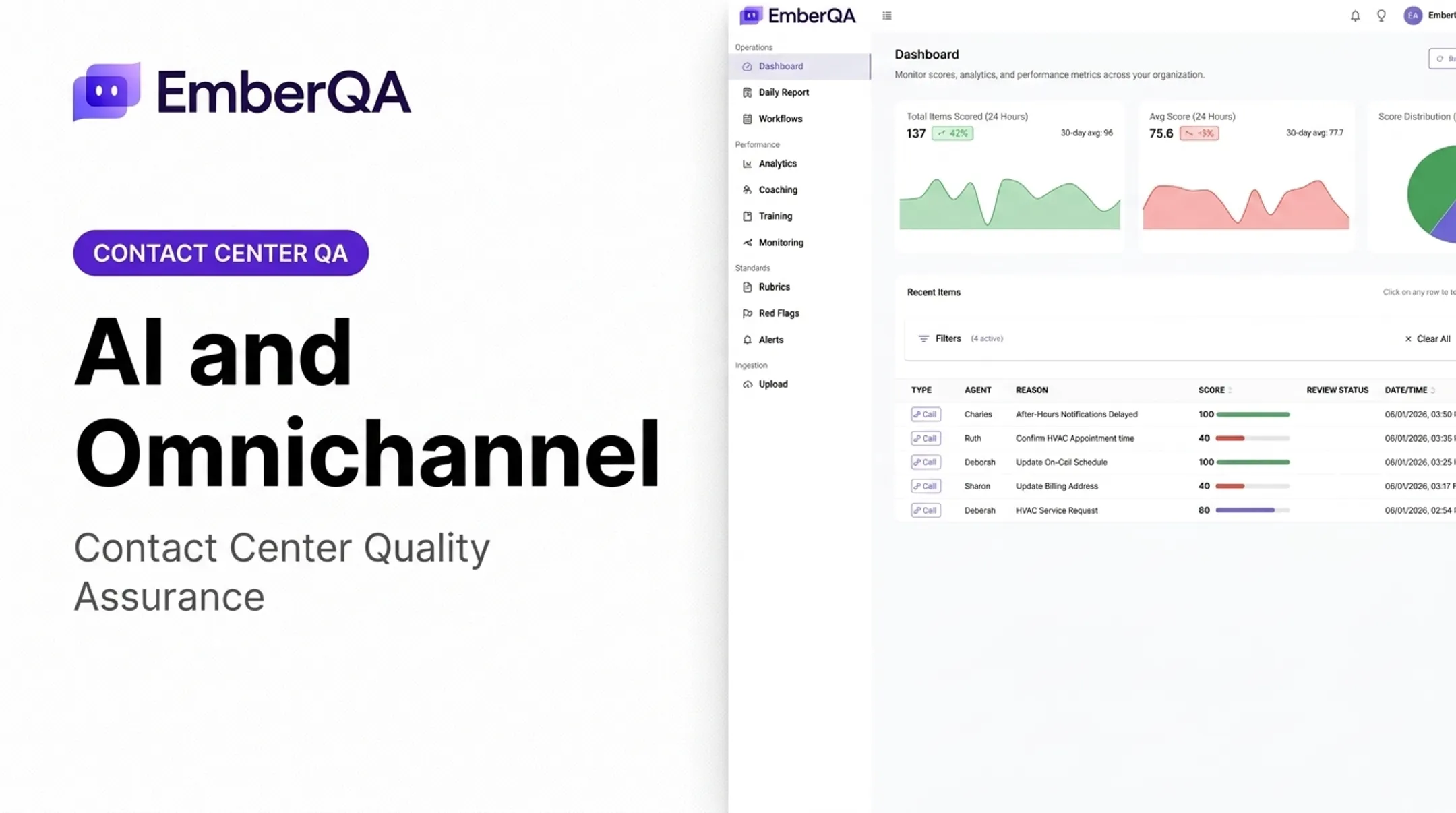
Automated scoring doesn't replace the reviewer — it changes what they spend time on. Instead of hunting for problems, they're confirming flagged ones and coaching based on verified patterns, not hunches. Platforms like EmberQA apply this model by scoring every interaction against your rubric, alerting on compliance and escalation risks, and feeding verified patterns into coaching—so QA covers the full queue, not a random sample.
Key Benefits of Machine Learning in Customer Service
The clearest advantage is coverage. Manual QA samples 1-3% of interactions in many contact centers; ML-based scoring can evaluate every single one, catching issues that a small sample would simply miss by chance.
Beyond coverage, teams typically see:
- Routes inquiries to the right person without manual triage
- Applies the same quality rubric to every interaction
- Cuts repetitive lookup so agents spend more time on resolution
- Shows where knowledge-base content is missing from recurring questions
- Surfaces compliance risks before they compound
On the productivity side, the NBER study cited earlier found a 14% average gain in resolved chats per hour with AI assistance — a documented result in one field setting, not a universal guarantee. The honest takeaway: measure your own baseline before assuming a tool will replicate someone else's number.

Interaction data also feeds better coaching. Instead of a manager guessing which agents need help with de-escalation, patterns across hundreds of scored calls point to specific, recurring gaps a once-a-month spot-check would never reveal.
How to Implement Machine Learning Responsibly
Start with a specific problem, not a vague ambition to "use AI." Are you trying to raise QA coverage, speed up routing, cut repeat contacts, or improve compliance review? Define a baseline before you touch a model, or you won't know if anything actually improved.
Audit Data Readiness
Take stock of what you actually have:
- Call recordings
- Chat logs and emails
- CRM records
- QA scorecards
- Knowledge articles
Then ask whether that data is representative, accurate, and consistently labeled. Incomplete records or biased samples don't just weaken a model. They can bake existing blind spots into every future prediction.
Design Human-in-the-Loop Workflows
Decide upfront when a person must verify a prediction before it becomes an action. Regulated interactions, frustrated customers, and low-confidence predictions all need a clear escalation path, not a vague "someone will notice eventually" plan.
Integrate With Existing Systems
A model working in isolation from your CRM, telephony, and ticketing tools loses context fast. Once customer account data is involved, integration also means locking down:
- Data permissions and access controls
- Retention policies
- Audit trails for recordings and transcripts
Test, Measure, and Improve Continuously
Run a controlled pilot against your existing process. Track more than one headline metric:
- Accuracy, false positives, and false negatives
- Escalation rates
- Agent adoption
Automation rate alone tells you nothing about whether customers are actually getting helped. Revisit the model periodically for drift, since language, policies, and customer needs shift over time.
Maintain Transparency and Accountability
Disclose AI involvement where it's relevant. Document how recommendations get used and make sure customers and employees can still reach a human when it matters. ML should sharpen human judgment in sensitive interactions, not replace it.

Machine Learning for Contact Center Quality Assurance
Manual QA has a structural problem: managers can only review a fraction of calls, scoring drifts between reviewers, and urgent issues can sit buried in interactions nobody ever pulls.
This is the exact gap EmberQA is built to close. The platform applies automated scoring to calls, SMS, emails, and documents using customizable QA scorecards, rubrics, and weights. Every interaction gets evaluated against the same standard, not whatever mood a reviewer happened to be in that day.
That covers:
- Red flag detection for hostile behavior, improper advice, privacy violations, and escalation risk, with immediate supervisor alerts
- Metric-level explanations tied to the actual transcript and recording, so a score isn't a black box
- Searchable, comparable conversations across agents, teams, and locations
- QA workflow automations that push scores and flags straight into CRMs, ticketing systems, and dashboards
Here's what that looks like in practice:
- Define a rubric covering required disclosures and service behaviors
- EmberQA scores every recorded interaction against it
- Supervisors spend limited review time on flagged or low-confidence results instead of random samples
- Coaching builds on verified, recurring patterns—not one bad call that happened to get pulled
The platform doesn't claim to guarantee compliance or a specific savings figure. What it does is turn a 1-3% manual sample into full coverage, so QA teams work from actual data instead of a guess dressed up as a sample.
Turning Customer Service Data Into Better Decisions
The machine learning use cases that matter most solve a specific, measurable problem for both customers and agents. Routing gets faster. Repetitive questions get answered without an agent typing the same reply for the hundredth time. QA coverage stops depending on which calls a manager happened to grab.
None of it works without the fundamentals:
- Representative data
- Clear workflows and defined goals
- A human still accountable for the outcome
Automating everything indiscriminately just moves the guesswork somewhere less visible.
If your QA process is still built on spot-checks and spreadsheets, see what full interaction coverage actually looks like. EmberQA helps contact center and QA leaders replace sampling with analysis of every interaction, turning conversation data into decisions you can actually back up.
Frequently Asked Questions
What is AI-based customer service?
AI-based customer service uses machine learning, natural language processing, automation, and generative AI to assist both customers and agents. Human support remains essential for escalations, judgment calls, and sensitive interactions.
What are the three main types of machine learning models?
Supervised learning trains on labeled examples, like classifying complaint types. Unsupervised learning finds patterns without labels, such as clustering emerging support topics. Reinforcement learning improves decisions through feedback, like refining routing rules over time.
How is machine learning used in customer service?
Common applications include chatbots, intelligent routing, sentiment analysis, agent assistance, predictive outreach, knowledge management, and automated quality assurance. Each addresses a specific bottleneck rather than replacing the entire support function.
What are the benefits of machine learning in customer service?
Benefits include analyzing far more interactions than manual sampling allows, faster and more consistent service, better-targeted coaching, and easier scaling during demand spikes. Documented gains vary by use case, so measuring your own baseline matters.
Can machine learning improve contact center quality assurance?
Yes. Machine learning can evaluate every interaction against consistent rubrics, surface red flags for supervisor review, and surface coaching trends that a small manual sample would miss. Human review still confirms flagged results and drives coaching decisions.
What are the risks of using machine learning in customer service?
Risks include inaccurate predictions, biased outputs, privacy concerns, and over-automation without adequate human oversight. Mitigating these requires representative training data, transparency about AI involvement, and clear escalation paths for edge cases.