Introduction
Most contact centers can teach an agent to read a script. Far fewer can teach one to handle a confused customer, a system glitch, and a compliance requirement at the same time — while staying calm and on-brand.
That gap is expensive. A 2021 survey of 155 U.S. and Canadian contact center training decision-makers found that 55% needed 6 to 12 weeks of training plus nesting before agents were fully ramped, and 42% said true proficiency took 2 to 4 months — not the 3-week onboarding many programs are built around (ProcedureFlow/Call Centre Helper, 2021).
Training that works isn't a single classroom event. It's a connected system: onboarding, guided practice, supervised live work, quality review, coaching, and refreshers. This article shows what that system looks like and how to build one that improves readiness, scoring consistency, and customer outcomes.
Key Takeaways
- Move agents through a staged lifecycle (knowledge, practice, nesting, certification, coaching), not a single onboarding sprint.
- Match each learning method to the skill: role-play for judgment calls, e-learning for facts, live coaching for behavior change.
- Anchor coaching in consistent scorecards and real interaction data, not gut feel alone.
- Track readiness, quality, compliance, and retention metrics, not only course completion rates.
What Contact Center Training Should Cover
A strong curriculum has to cover more than product knowledge. Agents need working fluency across six areas:
- Product and process knowledge — what you offer, how workflows actually run
- CRM and contact center systems — where to log, tag, and escalate
- Communication and soft skills — tone, empathy, active listening
- Problem-solving — diagnosing issues instead of following a flowchart blindly
- Documentation — accurate, audit-ready notes
- Escalation procedures — knowing exactly when and how to hand off
Compliance and Risk Training
This is where gaps get costly. Depending on your operation, agents may need training on:
- Privacy handling
- Recording consent and disclosure
- Payment-data procedures
- Industry-specific rules for insurance, collections, healthcare, and other regulated spaces
Requirements vary by state and call type, and they change. Verify current U.S. requirements with legal counsel before finalizing scripts. This article isn't a substitute for that review.
Knowledge vs. Judgment
Not every skill trains the same way. Product facts and system steps respond well to e-learning and quizzes.
Judgment skills develop through practice. De-escalating an angry customer or spotting a compliance red flag mid-call only comes from role-play, call observation, guided practice, and live coaching. A curriculum that leans entirely on one method will leave the other half undeveloped.

Build a Complete Contact Center Training Lifecycle
Training should move through defined stages, each with an owner, a goal, and a way to prove the agent is ready for the next step.
| Stage | Owner | Objective | Practice Method | Readiness Gate |
|---|---|---|---|---|
| Pre-boarding | HR / Ops | Set expectations, access, policies | Self-paced materials | Completed checklist |
| Foundation training | L&D | Build core knowledge | Instructor-led, knowledge checks | Passing quiz score |
| Shadowing & role-play | L&D / Supervisors | Build judgment | Scenario practice, AI roleplay | Scored practice attempt |
| Nesting | Supervisors | Supervised live work | Limited volume, frequent debriefs | QA score threshold met |
| Certification & coaching | QA / Supervisors | Sustain performance | 1:1 coaching, refreshers | Ongoing calibration |
Shadowing and role-play should cover realistic scenarios agents will face:
- Billing disputes
- Unclear requests
- Vulnerable customers
- Situations where a transfer is the right call
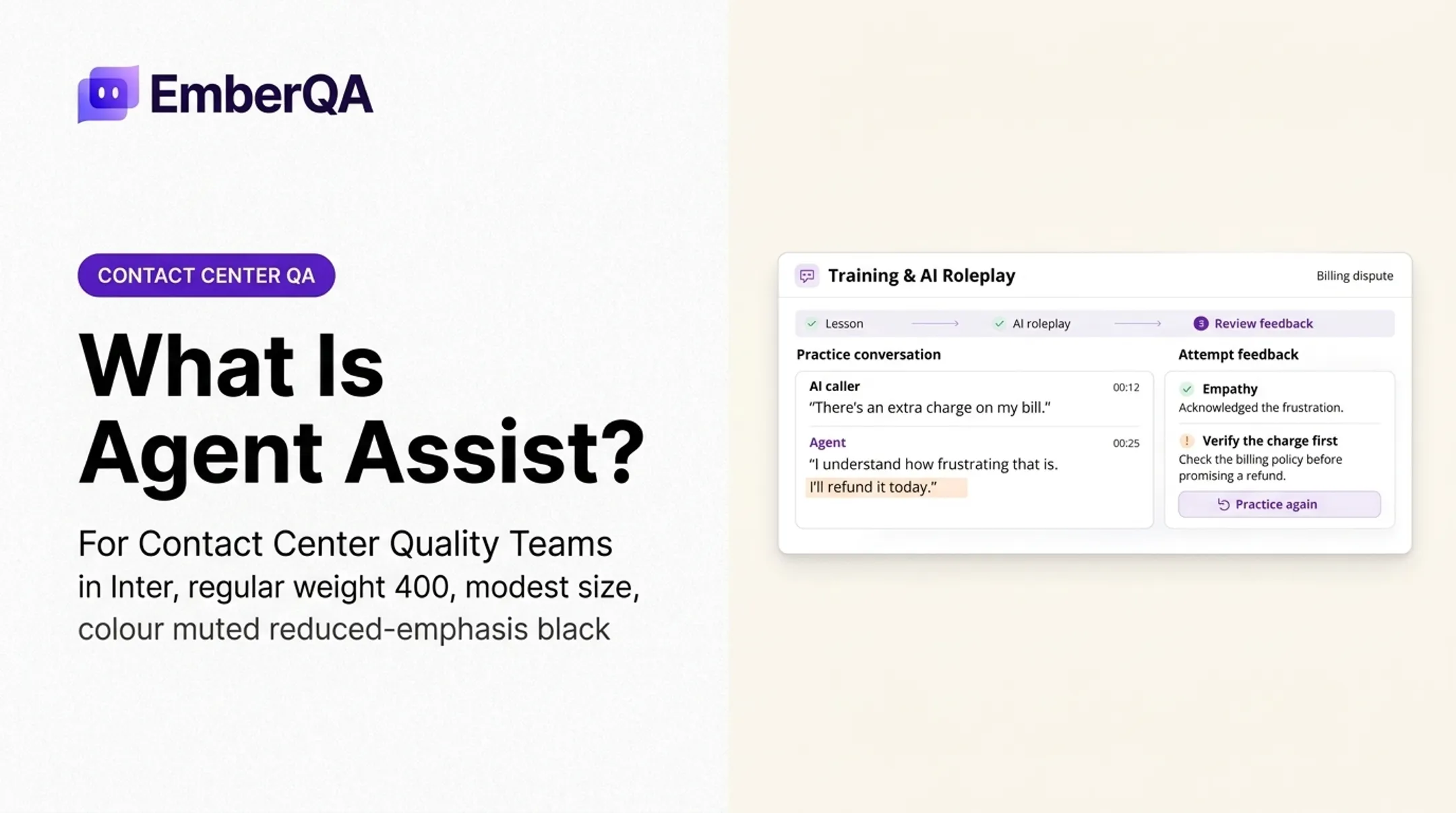
EmberQA's AI roleplay training fits here. Agents practice a billing-dispute conversation with an AI mock caller, get scored on empathy and policy accuracy, and repeat any missed step before they touch a live call.
Nesting is the riskiest stage to rush. Protect new agents by:
- Capping complexity and call volume
- Giving a clear escalation path
- Scheduling debriefs often (daily at first)
Don't move someone to a full workload until QA scores and supervisor sign-off both confirm readiness, not just a calendar date.
Once live, certification, coaching, and scheduled refreshers keep skills current, especially when products, scripts, or compliance rules change.
Contact Center Training Best Practices
Good training design comes down to five habits that separate high-performing teams from the rest.
Build a competency framework. Define observable behaviors for greetings, discovery, active listening, empathy, accuracy, resolution, documentation, escalation, and closing. Vague goals like "be professional" don't give agents anything concrete to practice.
Teach through real scenarios, not feature lists. Use recorded interactions. Pause at key moments, ask the agent what they'd do differently, then compare it against a stronger alternative response. This beats memorizing a features sheet every time.
Make feedback specific. Effective coaching:
- Focuses on one or two behaviors at a time
- Points to the exact interaction moment
- Explains the customer or business impact
- Assigns a concrete practice action
Vague feedback like "be more empathetic" doesn't change behavior. "Here, at 2:14, the customer said they were frustrated and you moved straight to policy — try acknowledging the frustration first" does.
Standardize, then personalize. Common rubrics and calibration keep scoring fair across agents. But coaching plans still need to flex for each agent's experience level, language needs, and recurring gaps.
Protect psychological safety. If every coaching session feels like a disciplinary meeting, agents stop being honest about what they don't know. Recognize improvement, invite questions, and make feedback two-way.
Manual QA sampling has a real blind spot. A 2019 ICMI/NICE report found that 73% of contact centers relied on manually selected random samples for quality review. That means most coaching decisions are based on a small, non-representative slice of interactions, not the full picture.

Platforms like EmberQA that score every interaction automatically close this gap, giving coaches a complete picture instead of a sample.
For remote and multi-site teams, three practices keep coaching consistent:
- Record all permitted instruction for later review
- Centralize current materials in one shared location
- Give every coach, regardless of location, equal access to scoring data
Physical proximity isn't what makes coaching effective; consistent data and clear rubrics are.
Turn Best Practices Into an Operating Program
Best practices only stick if someone owns them. Assign clear responsibility across L&D, operations, supervisors, QA, compliance, and experienced-agent mentors. Otherwise, training gaps get passed between teams and nobody closes them.
Keep one source of truth. Procedures, scripts, scorecards, escalation rules, and policy updates should live in a single, current location, with a review process that removes outdated content promptly.
Run a repeatable training calendar:
- Onboarding cohorts for new hires
- Nesting reviews during ramp-up
- Coaching sessions tied to QA findings
- Calibration meetings for scoring consistency
- Refresher modules on high-risk topics
- Retraining triggers after policy changes or repeated quality failures
Before rolling changes out company-wide, pilot with one team. Document baseline performance, gather learner feedback, and note the supervisor workload it creates before scaling.
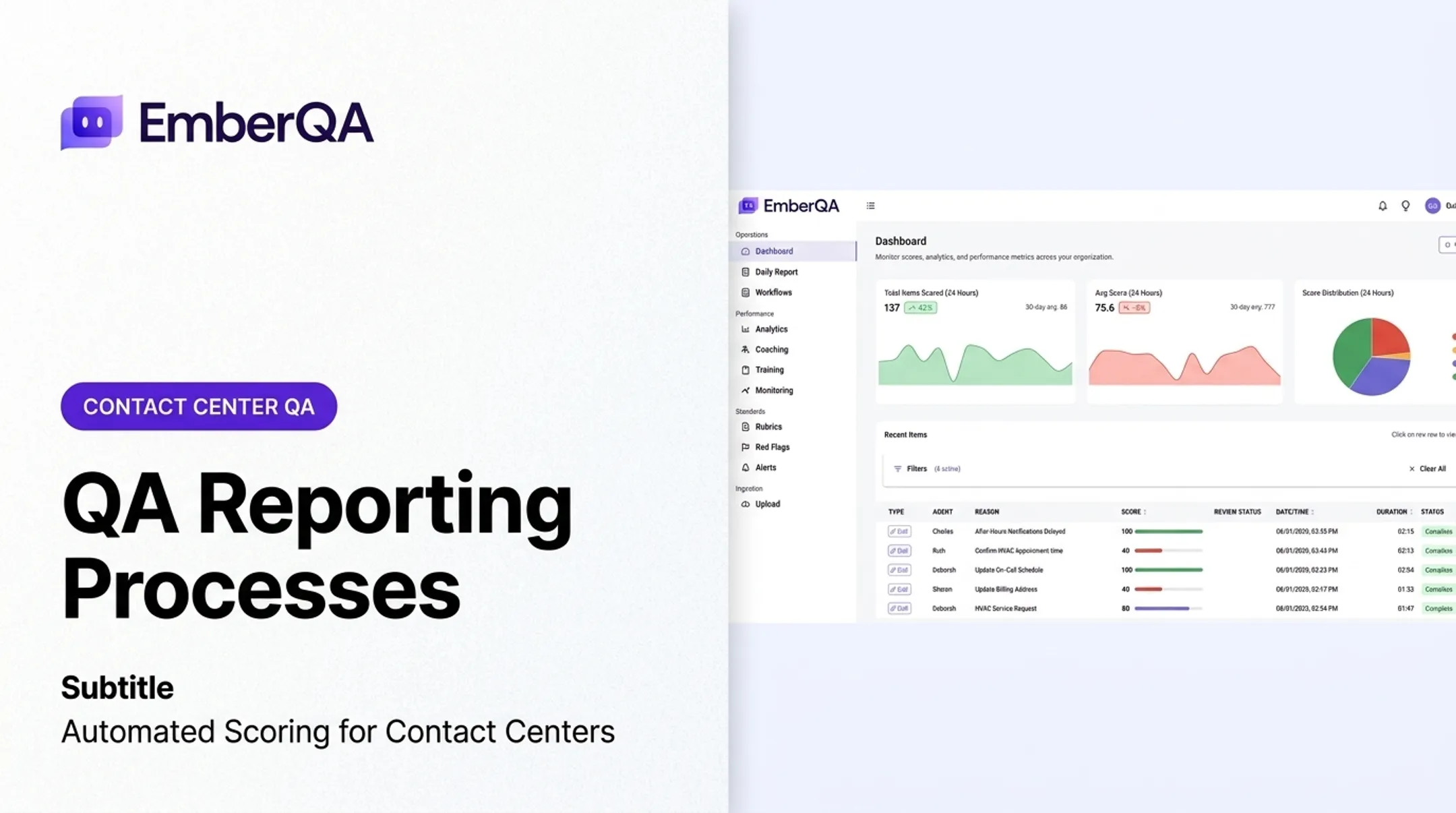
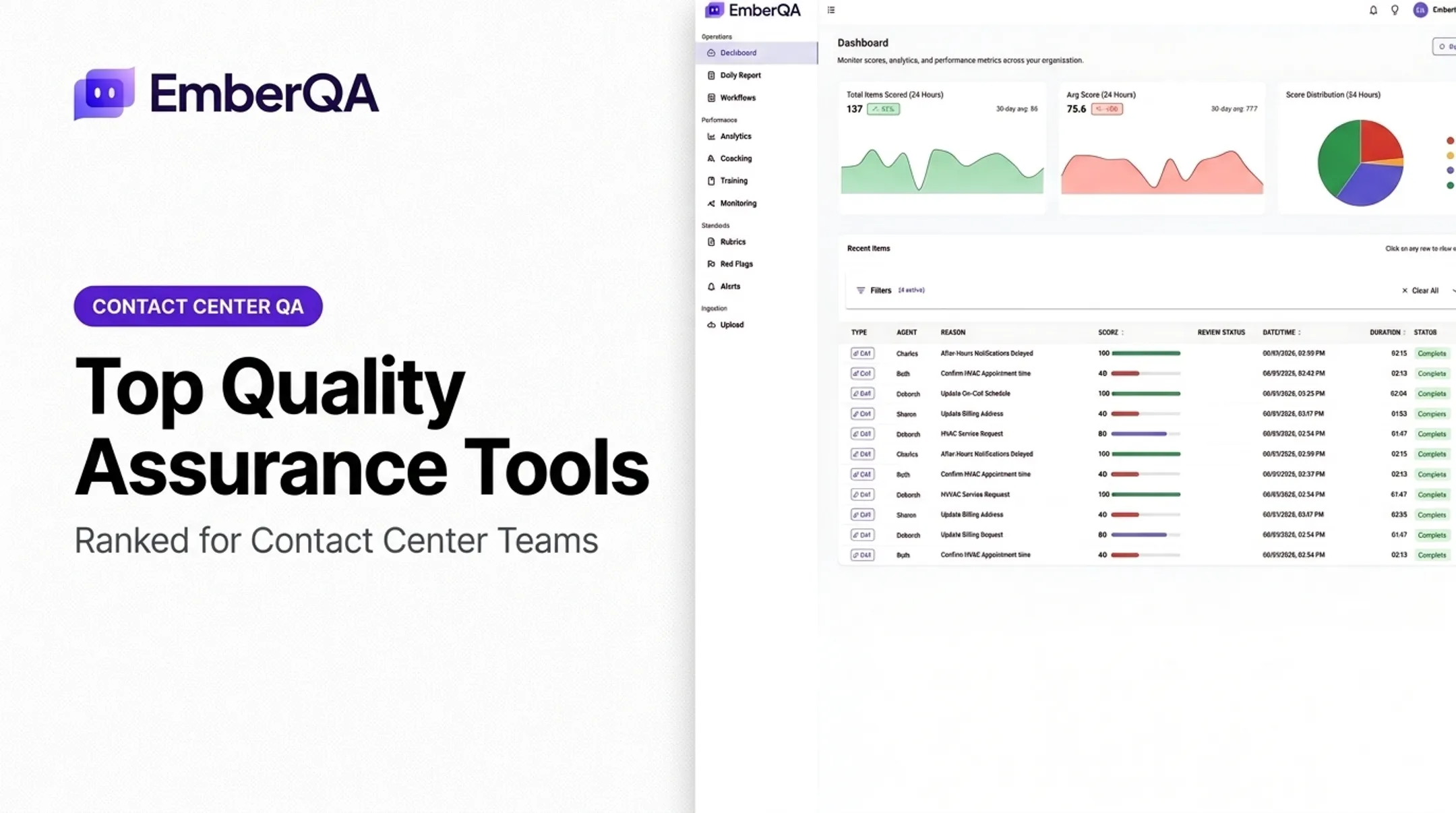
Once the program is running, AI-powered QA helps keep it honest at scale. EmberQA can score every interaction against a shared rubric, surface red flags automatically, and hand managers specific coaching opportunities. Calibration meetings and one-on-ones still supply the human judgment the scores alone cannot.
Measure Training Effectiveness and Improve Continuously
Completion rates tell you an agent finished a course. They tell you nothing about whether the agent can actually perform. Measure across four levels instead:
- Learning readiness — quiz scores, roleplay attempts passed
- On-the-job behavior — QA scores during nesting and beyond
- Customer and operational outcomes — resolution, satisfaction, handle time
- Business and workforce impact — retention, cost per contact, escalation volume
A practical KPI set to build from:
- Quality score and compliance adherence
- First-contact resolution and customer satisfaction
- Repeat contacts, transfer/escalation rate, and average handle time
- Time to proficiency and early attrition
The right mix depends on your center's goals. Don't chase every metric at once.
Benchmarks help set realistic targets, but read them carefully. SQM Group's 2024 North American inbound benchmark put first-contact resolution at 69% on average, ranging from 43% to 88% across industries. That spread is wide enough that a single universal target doesn't make sense for every operation (SQM Group, 2025).

Build a feedback loop: compare assessment results against post-nesting QA scores, look for recurring failure patterns, and determine whether the root cause is knowledge, process, tooling, or coaching before picking an intervention.
Then calibrate evaluators regularly. Have multiple reviewers score the same interactions, discuss disagreements, and document the agreed interpretation.
Manual sampling limits how much of this you can actually see. Interaction-level analysis (reviewing calls, chats, and documents at scale rather than a small sample) closes that gap, provided you handle privacy, access controls, retention, and consent properly.
This is the specific problem EmberQA is built around: scoring every interaction instead of a handful, flagging urgent risks in real time, and turning the resulting patterns into focused coaching plans rather than a spreadsheet nobody acts on.
Frequently Asked Questions
What training is recommended for contact center agents?
A complete program covers product and process knowledge, systems training, communication and soft skills, and compliance. Reinforce it with role-play, shadowing, supervised nesting, and ongoing coaching rather than a single classroom session.
What are the 5 key performance indicators of a contact center?
Commonly used indicators include customer satisfaction, first-contact resolution, service level or response time, average handle time, and quality score. The right combination depends on your specific operation and goals.
What is the 80/20 rule in contact centers?
Most centers use it as a service-level goal: answer 80% of contacts within 20 seconds. Definitions and targets vary by organization, so confirm what your center uses before citing it as a benchmark.
What is the 10 to 10 rule in contact centers?
This term isn't standardized across the industry. If your organization uses it internally, define the specific behavior and thresholds it measures rather than assuming it matches another company's definition.
How long does contact center training take?
It depends on product complexity, compliance requirements, channel mix, and prior agent experience. Many centers need 6 to 12 weeks including nesting, with full proficiency taking 2 to 4 months.
What is the difference between contact center training and coaching?
Training is structured instruction that prepares agents before or during onboarding. Coaching is ongoing, individualized feedback based on actual performance data, delivered continuously after or alongside live work.