Introduction
Most contact centers record every call. Almost none of them review every call.
An ICMI survey found that 73% of responding contact centers rely on supervisors or managers manually selecting random interactions for quality evaluation. That leaves a massive gap between what's said on calls and what actually gets reviewed.
Keyword search tools help, but they only catch what customers say word-for-word. Miss the phrasing, miss the flag.
Neural phonetic speech analytics takes a different approach. Instead of matching exact text, it analyzes the sound patterns of speech itself. That means it can catch a phrase even when a customer says it three different ways.
It's a tool that supports QA decisions. It doesn't replace the human reviewer who has to judge context, tone, and intent.
This article covers how the technology actually works, how it differs from transcription and voice analytics, where it creates real operational value, and what to check before you buy.
Key Takeaways
- Phonetic analytics searches audio at the sound level, catching phrase variations that exact-keyword tools miss
- Accuracy rises when audio quality, model tuning, domain vocabulary, and QA workflow handoff are dialed in
- Track outcomes that matter: coverage, review time, compliance detection, and coaching relevance
- Every automated finding needs human validation, especially for compliance or high-risk calls
What Is Neural Phonetic Speech Analytics?
Neural phonetic speech analytics uses neural network models to interpret sequences of speech sounds (phonemes) directly from recorded audio. Rather than converting speech to text first and then searching that text, these systems build a searchable phonetic index of the recording itself.
A 2016 Communications of the ACM article on phonetic analytics describes this as a two-stage process: generate a time-aligned phonetic index, then search it for sound patterns. That index is what lets teams query audio by how words sound, not only by how a transcript spelled them.
Phonetic Analysis vs. Transcription vs. Voice Analytics
These terms get used interchangeably, but they're not the same thing:
- Automatic speech recognition (ASR) converts speech into written text, producing a full transcript
- Phonetic indexing searches sound patterns directly, which can locate a phrase even when a transcript would spell it inconsistently
- Acoustic or voice analytics measures things like pitch, pace, volume, and pauses
- Sentiment analysis infers emotional tone, usually from either the transcript or acoustic signals
Many organizations use phonetic search alongside transcription rather than picking one. Transcripts are easier to read and review in context. Phonetic matching works better for spotting names, brand terms, or phrases with unpredictable pronunciation across accents and dialects.
What It Can Detect
Phonetic models can be tuned to flag signals that matter on real calls:
- Required disclosures and prohibited language
- Escalation cues and verification steps
- Sales terminology and repeated customer complaints
The detection rules need to match your business: your products, policies, call types, and compliance requirements.
Here's why exact-keyword search falls short: a customer wanting to cancel might say "I want to close my account," "cancel this," "I'm done with this service," or "take me off your list." A keyword search for "cancel" misses three out of four. Phonetic and semantic matching catch more of them.
How Neural Phonetic Speech Analytics Works
The process runs through several stages before a reviewer ever sees a result.
- Ingest the recording from your call recording system or storage platform
- Separate speakers where channel data allows it
- Clean and segment the audio, removing silence and hold music
- Analyze speech patterns using neural acoustic models
- Build searchable indexes or classification tags
- Deliver results to reviewers, dashboards, or downstream systems

Published research on neural approaches to this problem, including work on neural acoustic models and phoneme posterior features, shows that designs vary a lot between systems. Ask any vendor to explain exactly how their model matches sound patterns to configured terms. Don't assume "neural" means one standard method.
Batch vs. Real-Time Processing
Most implementations run as batch, post-call analysis. Calls get processed after they end, indexed, and made searchable within minutes to hours.
Real-time analysis processes live audio during the call and enables faster intervention: a supervisor gets alerted while the call is still happening. The trade-off: real-time systems need more infrastructure, carry higher latency requirements, and generally accept lower accuracy thresholds than post-call review.
Getting Your Audio Ready
Audio quality drives everything downstream. Background noise, crosstalk, compressed formats, and inconsistent channel separation all degrade detection accuracy.
Google's speech-to-text best practices recommend lossless formats and clean channel separation when speakers are recorded separately. That guidance applies just as much to phonetic search.
Before going to production, build a validation set that includes:
- Multiple speakers, accents, and call types
- Noisy and clean recordings
- Domain-specific terms unique to your business
- Both single-channel and multi-channel formats
A phonetic hit still needs context. Findings become useful when they connect to transcripts, acoustic signals, CRM fields, and QA scorecards, giving reviewers a fuller picture instead of an isolated flag.
Business Benefits and Contact Center Use Cases
Automated analysis expands QA coverage past small manual samples. That only matters when findings are accurate, prioritized, and tied to a real workflow action—coverage without action is just noise.
Where this creates real value:
- Applies the same detection criteria across every agent, site, vendor, or client program, reducing reviewer subjectivity
- Surfaces possible compliance failures, missed disclosures, or escalation risk for timely review (detection, not proof)
- Aggregates findings to show recurring behaviors and trends by agent, team, or queue
- Captures recurring objections, product confusion, and cancellation reasons missing from structured CRM fields
One customer, ECA, moved from reviewing under 1% of calls to scoring 100% against a consistent rubric. Every call is scored the same way, with reasoning attached to each result. The payoff shows up when those scores feed directly into QA review and coaching—not when they sit in a dashboard.

Use Cases by Contact Center Type
Value maps to how each model manages standards, compliance risk, and multi-site control:
| Contact Center Type | Primary Use |
|---|---|
| BPOs & answering services | Consistent standards across multiple clients and programs |
| Insurance & financial services/collections | Required disclosures, verification language, conduct risk |
| Enterprise multi-site operations | Shared taxonomy revealing gaps across locations or vendors |
A typical workflow looks like this:
- Detect a configured risk signal on the interaction
- Route the call or message for human review
- Document the finding against your rubric
- Coach the agent on the specific behavior
- Track whether that behavior declines on later calls
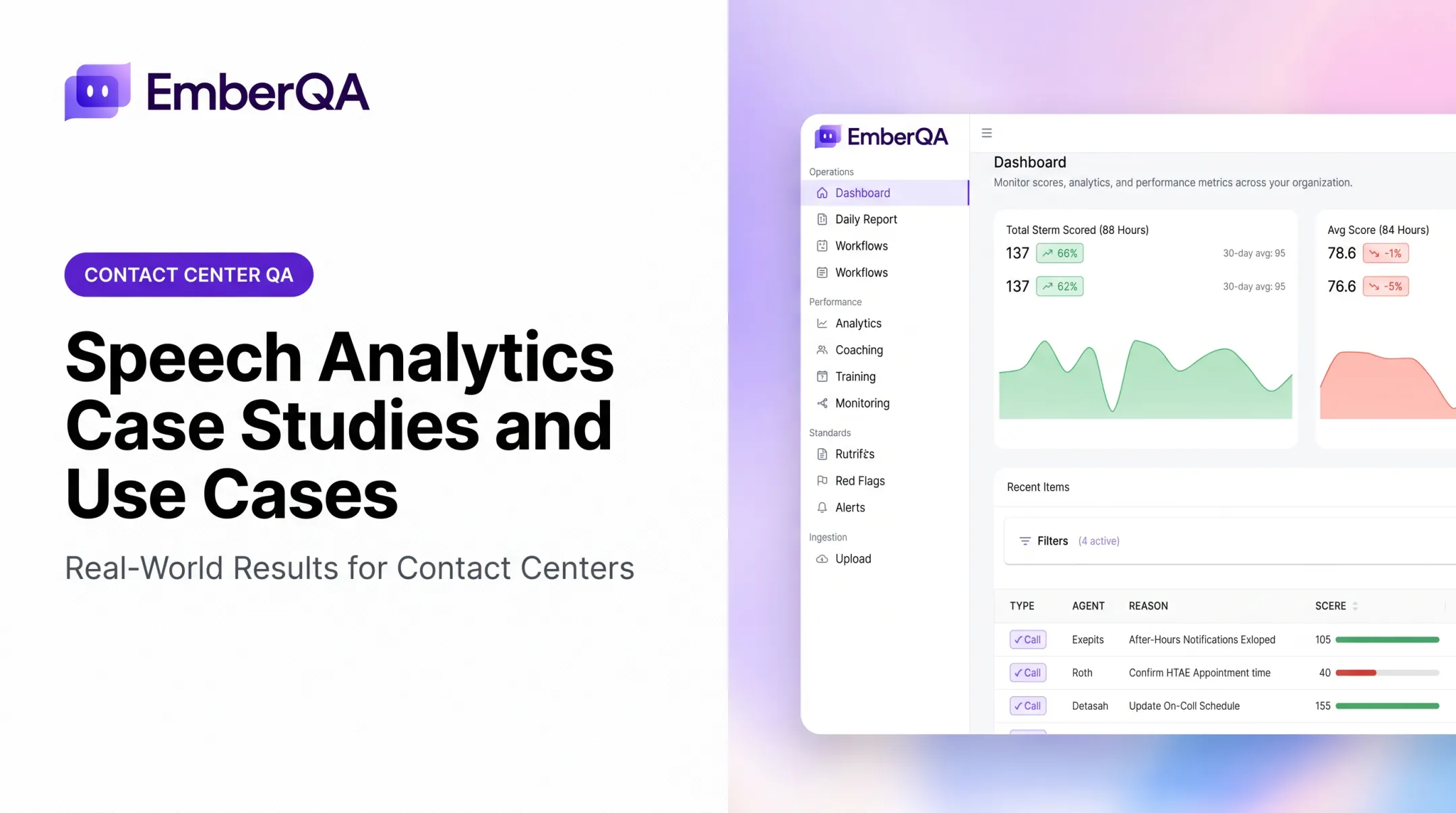
EmberQA supports that loop with automated interaction scoring, red-flag alerts, searchable calls, and coaching insights across the same use cases above. QA teams can evaluate far more of what was actually said, then act on it with a consistent process.
Limitations and Responsible Implementation
No phonetic model handles every conversation perfectly. Common failure points include:
- Heavy accents, dialects, and code-switching between languages
- Overlapping speakers talking at once
- Domain-specific jargon the model wasn't trained on
- Poor audio quality, sarcasm, or ambiguous phrasing
An alert, score, or phonetic match is an investigation signal. It is not automatic proof of misconduct, fraud, or customer emotion.
Privacy and governance matter just as much as accuracy. Recorded audio often contains sensitive personal and financial information, and requirements vary by state and industry. California's Penal Code 632 requires all-party consent for recording confidential communications, while other states apply one-party consent rules.
Regulated industries carry additional obligations—CFPB retention rules for collections calls, FTC Safeguards Rule requirements for financial data. None of this substitutes for legal review specific to your jurisdiction and industry.

Bias and quality controls to build in:
- Test performance across different speaker groups, accents, and call types
- Review both false positives and false negatives regularly
- Calibrate scorecards and document model changes over time
- Keep a human escalation path for disputed or high-stakes findings
How to Evaluate a Neural Phonetic Speech Analytics Solution
Before signing anything, test the platform against your own recordings, not the vendor's demo audio.
Buyer checklist:
- Supported audio formats, channel separation, and sampling requirements
- Language and accent coverage relevant to your customer base
- Phonetic search plus transcription (not one or the other)
- Real-time versus post-call processing options
- Configurable taxonomies and model retraining or tuning capability
Workflow integration questions:
- Does it connect to your CRM and telephony systems via API or webhook?
- Can reviewers jump from a finding straight to the relevant audio clip?
- Does it support role-based dashboards, case management, and exportable evidence for audits?
- Can a reviewer override a result and record why?
Metrics to measure during testing:
| Metric | What It Tells You |
|---|---|
| Precision | Of flagged segments, how many were actually relevant |
| Recall | Of all relevant segments, how many the system found |
| False-positive rate | How often clean calls get incorrectly flagged |
| Reviewer agreement | Whether two humans reviewing the same call reach the same conclusion |
Use standard information-retrieval definitions for precision and recall so you're comparing vendors on the same terms, not marketing claims.
Evaluation hinges on the operational layer around the analytics, not just the model. EmberQA, for example, provides automated scoring, consistent rubrics, red-flag workflows, targeted coaching, and CRM verification, at $89 per paid agent/month for the tier that includes targeted coaching.

Whatever platform you evaluate, the underlying analytics only matter if the workflow around them turns findings into action.
Frequently Asked Questions
What is the IPA chart used for?
The International Phonetic Alphabet chart represents speech sounds using standardized symbols, mainly for linguistics and language learning. It's a notation reference, not a tool for analyzing recorded business calls.
What is a phonetic generator?
A phonetic generator converts written words into predicted pronunciations, sometimes called grapheme-to-phoneme conversion. It's the reverse of what enterprise speech analytics does. It starts from text, not recorded audio.
What is neural phonetic speech analytics?
Neural phonetic speech analytics is an AI method that analyzes sound patterns in recorded speech to find phrases, score interactions, and flag behaviors. Contact-center teams use it to support QA workflows, not replace human review.
How is phonetic speech analytics different from speech-to-text?
Speech-to-text produces a written transcript of what was said. Phonetic analytics searches sound patterns directly, which can catch phrase variations a transcript-based search might miss. Many platforms use both together.
Can neural phonetic speech analytics analyze every call?
Large-scale or full-coverage analysis is possible when recordings, processing capacity, and governance are set up properly. Even then, findings still need validation and human review before acting on high-stakes results.