Introduction
Call volumes keep climbing, and manual quality reviews can't keep pace. In a 2024 McKinsey survey, 57% of customer-care leaders expected call volume to grow by as much as 20% over the next one to two years.
Most QA teams still review a small, randomly selected slice of interactions, leaving gaps in compliance checks, coaching accuracy, and reporting.
Quality management system software closes that gap. It connects standards, interaction reviews, compliance checks, coaching, and reporting into one continuous workflow instead of scattered spreadsheets and one-off audits.
This guide covers what QMS software is, its core components, the different system types available, the business case for adopting one, and a practical framework for choosing and rolling out a platform inside a US contact center, BPO, or answering service.
Key Takeaways
- QMS software turns quality standards into repeatable workflows for scoring, coaching, and documentation.
- Modern platforms move teams beyond manual sampling with automated scoring, alerts, and trend analytics.
- The right fit depends on your scorecards, channels, compliance obligations, and existing tech stack.
- Automation should support human calibration and judgment, not replace it.
What Is Quality Management System Software?
Quality management system (QMS) software is technology that helps an organization document quality standards, apply them consistently, monitor outputs or interactions, flag gaps, assign corrective actions, and track improvement over time.
In a contact center context, that means organizing scorecards, analyzing calls, chats, emails, and other interactions, identifying compliance risks, tracking coaching progress, and generating performance reports across teams and sites.
QA, QC, and Automated QA Aren't the Same Thing
These terms get used interchangeably, but they describe different functions:
- Quality assurance focuses on preventing problems through standards, training, and process controls.
- Quality control focuses on inspecting individual interactions to catch defects or nonconformance after the fact.
- Automated QA uses rules or AI to evaluate interactions at scale.
A broader QMS connects those evaluations to governance, corrective action, and documented improvement. The quality management lifecycle ties these pieces into a loop: define standards, collect interaction data, evaluate performance, identify root causes, coach or correct, then review results and start again.

Why Software Beats Spreadsheets
Manual call reviews and disconnected spreadsheets create blind spots. Software centralizes records, standardizes workflows, and makes evidence searchable across teams.
For example, a contact center might build one scorecard covering required disclosures, resolution quality, customer treatment, and CRM data accuracy. That same standard then applies across every office and campaign, instead of each site interpreting quality differently.
Treat QMS software as an operating system for quality, not a dashboard or a call-recording archive. A dashboard shows you numbers. A QMS connects those numbers to action.
Key Elements of Quality Management System Software
A complete QMS platform ties several components together. Miss one, and you create gaps in coverage or accountability.
Configurable Quality Standards and Scorecards
Scorecards translate business goals, customer expectations, and regulatory requirements into measurable criteria. Look for:
- Weighted criteria and critical-failure rules (some violations should fail a call regardless of overall score)
- Version control so scorecard changes are tracked over time
- Different scorecards by campaign, office, client, channel, or role
Interaction and Process Data Collection
Scoring is only as good as the data feeding it. Platforms need clean integrations across your interaction stack:
- Call recording
- CRM systems
- Ticketing tools
- Chat, email, and SMS
Incomplete or mislabeled data weakens scoring accuracy, trend analysis, and audit trails.
Automated Evaluation and Quality Monitoring
Speech and text analytics, keyword detection, sentiment signals, script adherence checks, and AI-assisted scoring all fall here. Automated scores should always be tested against human-reviewed examples and recalibrated regularly. An AI model that drifts from real judgment is worse than no automation at all.
Alerts, Red Flags, and Corrective Workflows
Good software surfaces urgent compliance, conduct, or process issues and routes them to the right supervisor immediately. This includes:
- Escalation rules that define who gets notified and when
- Case ownership so issues don't fall through the cracks
- Due dates and evidence capture for accountability
- Closure tracking to confirm the issue actually got resolved
Coaching and Continuous Improvement
Recurring scorecard failures should feed straight into coaching and training. Agents get the most from QA when they can:
- See the evaluation criteria up front
- Review feedback tied to specific interactions
- Track their own improvement over time
Those same patterns should also trigger training assignments or knowledge-base updates when the issue is systemic.
Analytics, Reporting, and Governance
Reporting has to hold up for clients and internal compliance teams. Look for:
- Agent-, team-, campaign-, site-, and vendor-level views
- Filters by channel, issue type, and time period
- Trend visibility and full audit history
- Exportable reports with role-based access
Security, Privacy, and Responsible AI
Call-recording consent laws vary by state. California requires all-party consent for confidential communications, while New York follows a one-party framework under its wiretapping statute. Confirm your recording practices match the states where your customers are located before automating anything downstream.
Beyond consent, evaluate data retention policies, access controls, and encryption standards.
Also confirm the vendor can explain how a score was generated, with a clear path for agents or supervisors to challenge or correct an evaluation.
What Are the Different Types of QA Management Systems?
Not every organization needs the same setup. Systems generally fall into a few categories.
Manual or traditional QMS relies on human sampling, spreadsheets, and scheduled audits. COPC's 2022 benchmarking research found that 63% of surveyed contact center leaders used random transaction selection for monitoring — a reasonable approach for small teams or specialized reviews, but one that inherently limits coverage.
Automated and AI-assisted QMS platforms use rules, speech or text analytics, and machine learning to score interactions at scale, flag risks, and detect trends without adding headcount.

Systems also differ by deployment and scope:
| Type | Best fit | Primary focus |
|---|---|---|
| Cloud-based platforms | Distributed, multi-site, or outsourced operations | Accessibility, scalability across locations |
| Enterprise QMS | Formal document control and audit management | Standards-based governance |
| Contact-center QA platforms | Calls, chats, emails | Scorecards, coaching, compliance, customer experience |
Many organizations combine types: automated monitoring for broad coverage, paired with human audits for calibration, appeals, and complex cases. When matching a system to your operation, weigh interaction volume, regulatory exposure, number of sites or client programs, and how much internal QA capacity you actually have.
Benefits and Use Cases of QMS Software
The case for QMS software comes down to coverage, consistency, and speed.
- Fairness across teams. Centralized standards and consistent scorecards evaluate an agent in one office the same way as an agent in another, so grading no longer drifts between supervisors or sites.
- Broader coverage, faster detection. Automated scoring reviews far more interactions than a handful of manually selected calls and surfaces patterns a small sample would miss.
- Sharper coaching. Quality data reveals recurring behaviors, knowledge gaps, and high-performing practices, turning vague feedback into specific, evidence-backed coaching conversations.
- Compliance and risk management. This matters most in regulated environments. CFPB examiners found that certain debt collectors failed to make required identity and debt-collection disclosures on calls. A disclosure-focused scorecard is built to catch that gap before it becomes an enforcement issue.
- Client reporting for BPOs. Outsourced providers need to prove quality to the brands they serve. Program-level reporting, client-specific scorecards, and campaign comparisons turn QA data into something a client can actually review.
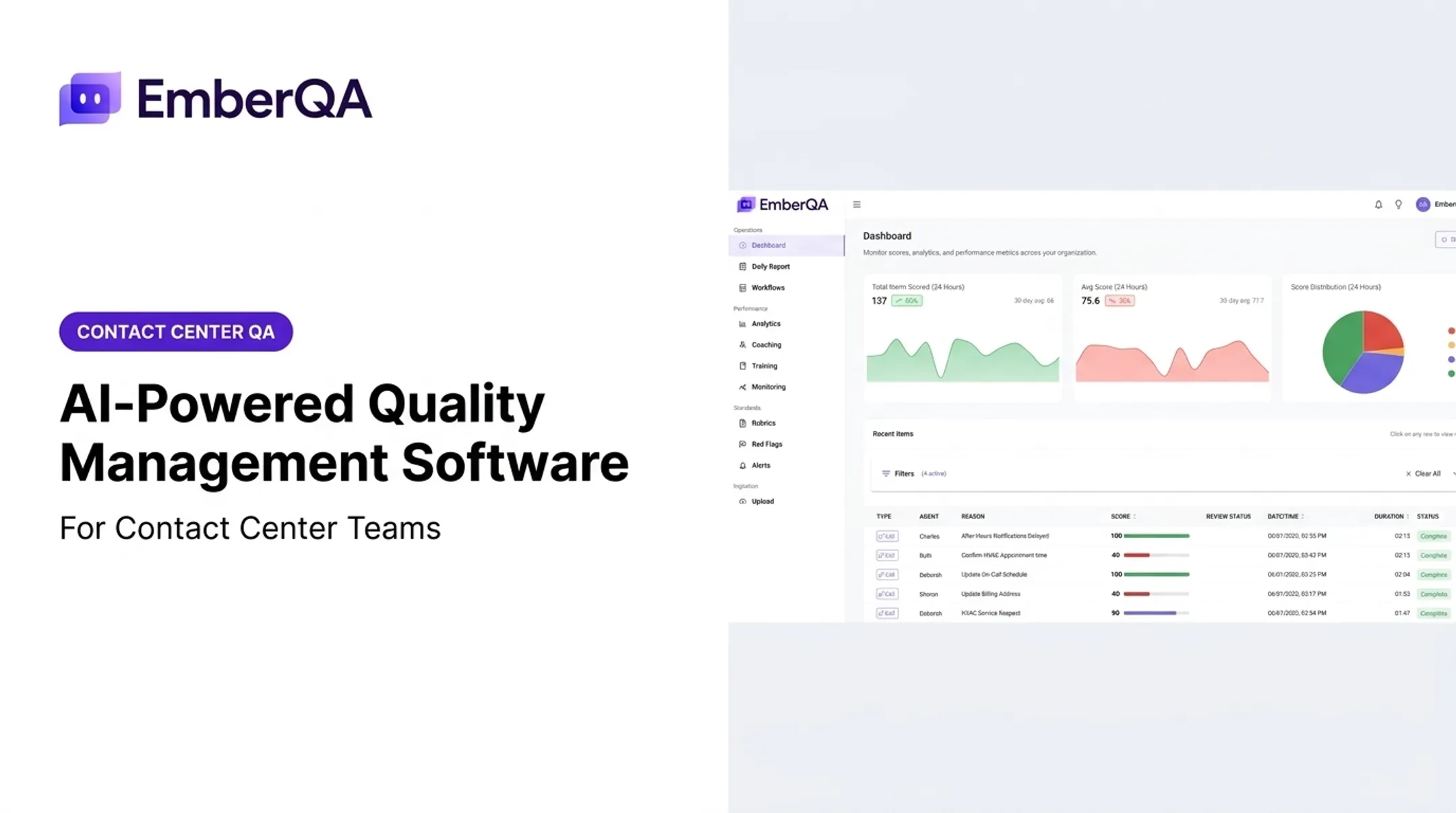
EmberQA is built for this workflow. It analyzes customer interactions across calls, SMS, emails, and documents, applies consistent scoring rubrics, and surfaces red flags for hostile behavior or privacy risks.
Those insights route into targeted coaching for BPOs, insurance call centers, and collections teams that need more than manual sampling to prove quality at scale.
How to Choose and Implement Quality Management System Software
Start With a Requirements Assessment
Document current review volumes, existing scorecards, channels in use, and where feedback delays happen most. Define objectives in concrete terms (broader coverage, faster risk identification, more consistent coaching) without inventing numbers you can't yet back up.
Evaluate Core Capabilities
Confirm the platform supports your required channels, recordings, transcripts, and CRM data. Ask vendors directly:
- How does it handle accents, background noise, or multiple languages?
- What happens with ambiguous interactions that need human judgment?
- Can scorecards include critical-fail rules and automatic rubric selection?
Test Integration, Security, and Scalability
Review APIs, native connectors, role-based permissions, and audit logs. Confirm the platform can scale across rising volume, additional sites, and outsourced vendors without a re-implementation.
Assess Scoring Accuracy and Explainability
Run a pilot using representative, anonymized interactions and compare automated results against calibrated human evaluations. Vendors should be able to explain how scores are generated and how agents can appeal a result they disagree with.

Roll Out in Controlled Stages
- Establish ownership across QA, operations, compliance, and IT
- Start with a focused pilot on one team or campaign
- Validate data quality and scoring against human review
- Gather feedback from supervisors and agents
- Expand only after the pilot meets agreed criteria
EmberQA's three-step path mirrors this staged model: connect interaction data, configure QA standards, then surface urgent issues and coaching recommendations in days rather than months.
Vendor Question Checklist
Before signing, ask about:
- Total cost and per-agent pricing (EmberQA Essentials: $49/agent/month; Pro: $89/agent/month; free manager and reviewer seats)
- Implementation timeline and onboarding support
- Data ownership and contract portability
- Uptime commitments and security documentation
- Customer references and available proof of results
Conclusion
Quality management system software earns its keep when it connects standards and evidence to timely action. Scores and dashboards only matter if teams use them. The right platform fits your interactions, workflows, risk profile, and people.
Before scheduling demos, map out where your current manual QA process actually breaks down. That gap is your real requirements list.
Frequently Asked Questions
What is a QA management system?
A QA management system combines processes, standards, scorecards, reviews, and feedback loops to keep quality consistent. It is separate from the software that supports and automates those activities.
What are the key elements of a QA management system?
Core elements include quality standards, evaluation criteria, interaction data, monitoring, and scoring. Coaching, corrective action, reporting, and governance tie those pieces into one working system.
What are the different types of QA management systems?
Manual/traditional systems, automated or AI-assisted systems, enterprise QMS platforms, and contact-center-focused QA platforms. Many organizations combine more than one type.
What is the difference between QMS software and QA software?
QA software typically focuses on evaluating and monitoring interactions. Broader QMS software also manages standards, documentation, audits, corrective actions, and governance workflows.
How does QMS software help contact centers?
It analyzes interactions, applies consistent scoring, expands review coverage beyond manual samples, flags compliance risks, and turns patterns into targeted coaching and trend reporting.
What should you look for when choosing QMS software?
Prioritize integrations, customizable scorecards, AI explainability, security, scalability, and coaching workflows. Choose a vendor that supports human calibration rather than replacing it entirely.