Introduction
Healthcare contact centers run on volume. A single 2024 survey of 54 healthcare contact-center leaders found respondents fielded an average of 58,702 inbound calls per month, according to the Healthcare Contact Center Survey Report. Most QA teams can manually review only a fraction of that.
That gap matters more in healthcare than almost anywhere else. A missed disclosure, an unresolved billing question, or a botched eligibility check doesn't just hurt a metric. It hurts a patient or member.
Speech analytics uses AI to analyze recorded or live conversations for keywords, topics, intent, sentiment, and process adherence. It is a QA and operations tool—not a clinical one—and does not diagnose patients or replace a nurse's judgment.
This article explains how the technology works, where it fits in healthcare operations, which privacy and compliance questions matter, and how to evaluate a platform for the US market.
Key Takeaways
- Speech analytics turns raw conversations into searchable, structured data for QA, coaching, and compliance review.
- Distinct from medical speech recognition, which converts clinician speech into clinical documentation.
- The strongest programs pair automated scoring with human review and clear governance rules.
- Manual sampling typically covers only a fraction of call volume; automated QA closes that gap.
What Is Speech Analytics in Healthcare and How Does It Work?
Speech analytics in healthcare uses AI to analyze patient and member conversations for quality, compliance, and experience. Platforms transcribe calls, score them against defined criteria, and flag patterns that manual sampling often misses.
What Gets Analyzed
Speech analytics platforms typically evaluate:
- Transcripts and keywords — what was said, and how often specific terms or phrases came up
- Intent and topics — why the person called and what they needed
- Sentiment and tone shifts — frustration, confusion, or relief across the interaction
- Script and workflow adherence — whether required steps and disclosures happened
- Pace, silence, and interruptions — signs of poor call control or agent hesitation
Capabilities vary by vendor and audio source. Confirm what a platform actually captures before assuming full coverage.
Speech Analytics vs. Medical Speech Recognition
These two categories get confused constantly, but they solve different problems. Medical speech recognition converts a clinician's spoken words into structured clinical documentation, such as dictation software that feeds an EHR. Speech analytics evaluates contact-center conversations between patients, members, and staff for service quality, compliance, and operational insight. One documents care; the other reviews how conversations were handled.
Real-Time vs. Post-Call, and Where Humans Still Matter
Real-time analysis can trigger in-call prompts or supervisor alerts when a workflow platform supports it. Post-call analysis handles QA scoring, trend analysis, and root-cause review after the fact.
Voice analytics is related but separate. It looks at how something was said (pitch, pace, pauses), while speech analytics focuses on what was said. Treat emotional signals from either as flags for human review, not clinical conclusions.
Automated scores should never be the sole basis for a patient-care or employment decision. Someone still needs to validate transcripts, review flagged calls, and tune scorecards for healthcare-specific language.
Healthcare Use Cases for Speech Analytics
Speech analytics supports providers, payers, resupply teams, answering services, and healthcare contact centers across the patient or member journey. These are the places it delivers measurable value.
Quality Assurance and Call-Flow Adherence
Automated evaluation checks whether agents followed approved workflows, verified the right information, gave required explanations, and completed the intended objective. This is the area where manual sampling struggles most.
Consider ECA, a company using EmberQA: before automation, managers manually reviewed less than 1% of calls, so most agent interactions went unscored. Automated evaluation let the team score every call instead of guessing from a handful of samples.

Patient and Member Experience
Recurring confusion around scheduling, billing, eligibility, benefits, and claims shows up in transcripts as clear patterns:
- Long holds
- Repeat contacts
- Unnecessary transfers
Supervisors can pull real transcripts to investigate complaints. They can also flag strong empathy and clean resolution to reuse in coaching.
Compliance and Risk Monitoring
Configurable rules can flag missed disclosures, inappropriate language, and escalation failures. But verify which HIPAA provisions, payer requirements, state rules, and consent obligations apply to your specific use case first. Speech analytics supports compliance monitoring; it doesn't guarantee compliance on its own.
Agent Coaching and Onboarding
Instead of coaching from a few subjectively chosen calls, managers review patterns across a much larger sample:
- Incomplete explanations
- Weak de-escalation
- Excessive silence
That wider view makes onboarding faster and coaching more specific to what agents actually say on live calls.
Operational and Service Improvement
Call-driver analysis surfaces repeat-contact themes before they spread. A common win: catch a spike in eligibility or payment questions early, fix the script or knowledge base, and stop absorbing the same complaint hundreds of times.
Benefits, Risks, and Governance Considerations
What Improves, and What to Measure
Speech analytics pays off when broader QA coverage, consistent scoring, and faster escalation of urgent issues show up in operational metrics—not slideware. Map each benefit to concrete KPIs:
| KPI Category | What to Track |
|---|---|
| QA coverage | Percentage of interactions scored vs. sampled |
| Workflow adherence | Rate of required disclosures completed |
| Contact patterns | First-contact resolution, repeat-contact rate |
| Call handling | Transfer rate, escalation rate, average handle time |
| Experience | Complaint themes, satisfaction trends |
| Coaching | Completion rate and score improvement over time |
Source healthcare-specific benchmarks for any numerical target you set. Don't assume industry-wide figures apply to your call mix.
Privacy, Security, and Consent
Those KPIs only hold if the underlying recordings and transcripts are handled lawfully. If a vendor creates, receives, maintains, or transmits protected health information on your behalf, HHS guidance confirms you need a HIPAA-compliant business associate agreement, along with appropriate safeguards. Before rolling out any platform, confirm:
- How recordings, transcripts, and PHI are stored, encrypted, and retained
- Who has access, and whether a BAA is in place where required
- What audit logging and deletion controls exist
- How call-recording consent notices are documented, since requirements vary by state
Accuracy and Bias
Compliance controls do not remove model risk. Transcription accuracy isn't uniform across speaker populations. A 2020 peer-reviewed study found automated speech recognition systems produced word error rates of 0.35 for Black speakers versus 0.19 for white speakers in tested recordings, according to research published in PNAS.

Medical terminology, accents, overlapping speakers, and code-switching add further error. Test any platform against representative healthcare audio, track false positives and negatives, and keep a human review path for high-impact flags—especially where automated scoring or red-flag alerts drive coaching or escalation.
Building Workforce Trust
Even accurate systems fail if agents treat them as covert surveillance. Position analytics as a fairer coaching layer and set guardrails up front:
- Involve agents and supervisors in scorecard design
- Explain what is scored, why it matters, and how disputes work
- Pair automated scores with human review before high-stakes actions
- Avoid discipline based solely on a single machine score
Done this way, broader coverage supports coaching quality instead of eroding trust.
Implementation and Selecting a Healthcare Speech Analytics Tool
A Practical Rollout Sequence
- Define the business problem — QA coverage gaps, compliance risk, or coaching consistency
- Inventory data sources — which systems record calls, chats, and other interactions
- Choose a narrow pilot — one team or workflow, not the whole organization
- Configure healthcare-specific scorecards — categories, red flags, and required disclosures
- Validate outputs — compare automated scores against expert human reviewers
- Train managers and establish a recurring review cadence — so scores turn into coaching, not just reports
Vendor Evaluation Checklist
- Transcription quality for medical vocabulary and diverse accents
- Real-time and post-call options
- Configurable scorecards, keywords, and red-flag rules
- Searchable, comparable transcripts
- Dashboards, alerts, exports, and audit trails
- Role-based access, redaction, and retention controls
- Integrations with telephony, CRM, and reporting systems
Request a demo using representative, de-identified recordings, and ask vendors directly how they manage accuracy, model updates, and human review.

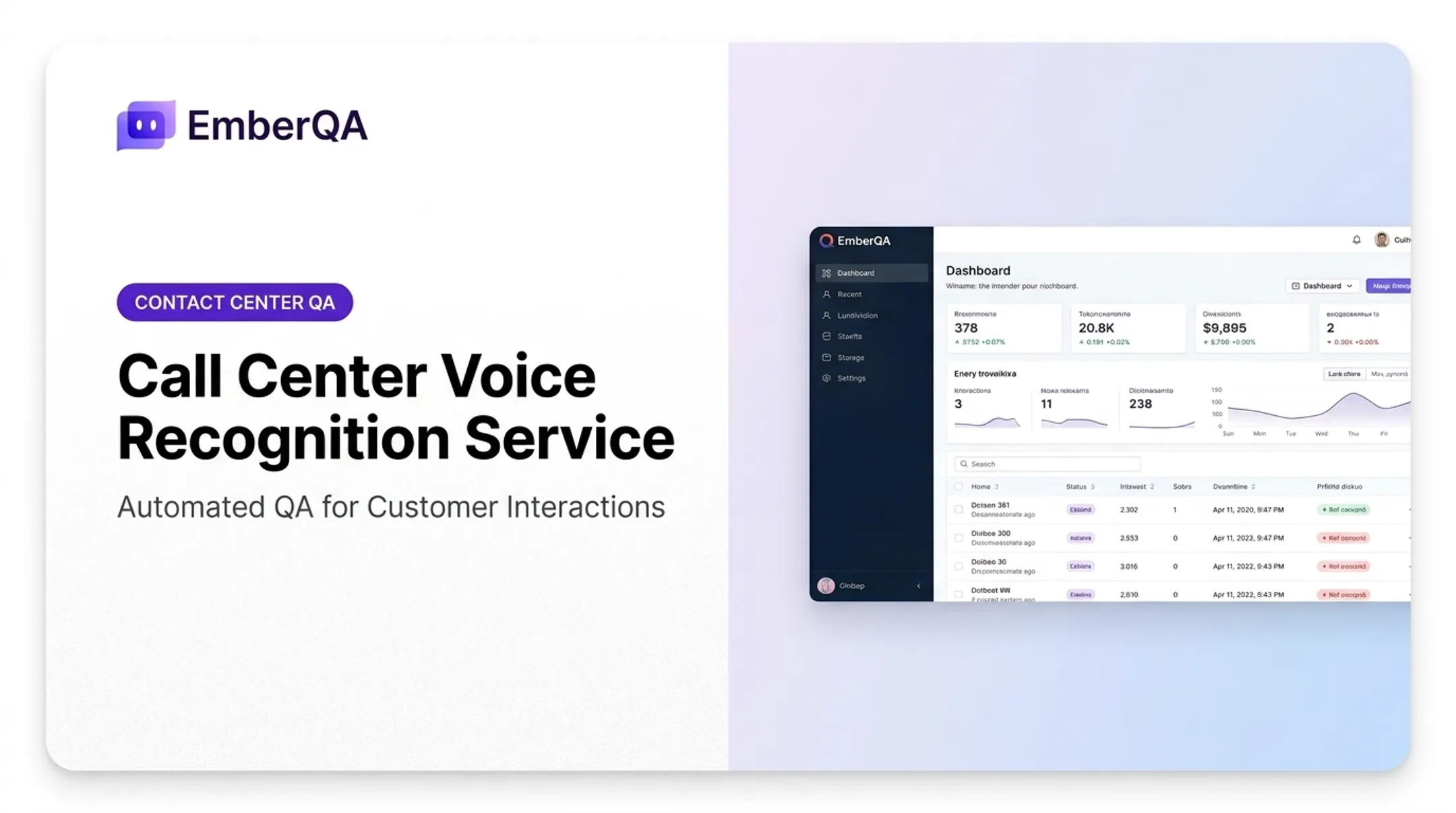
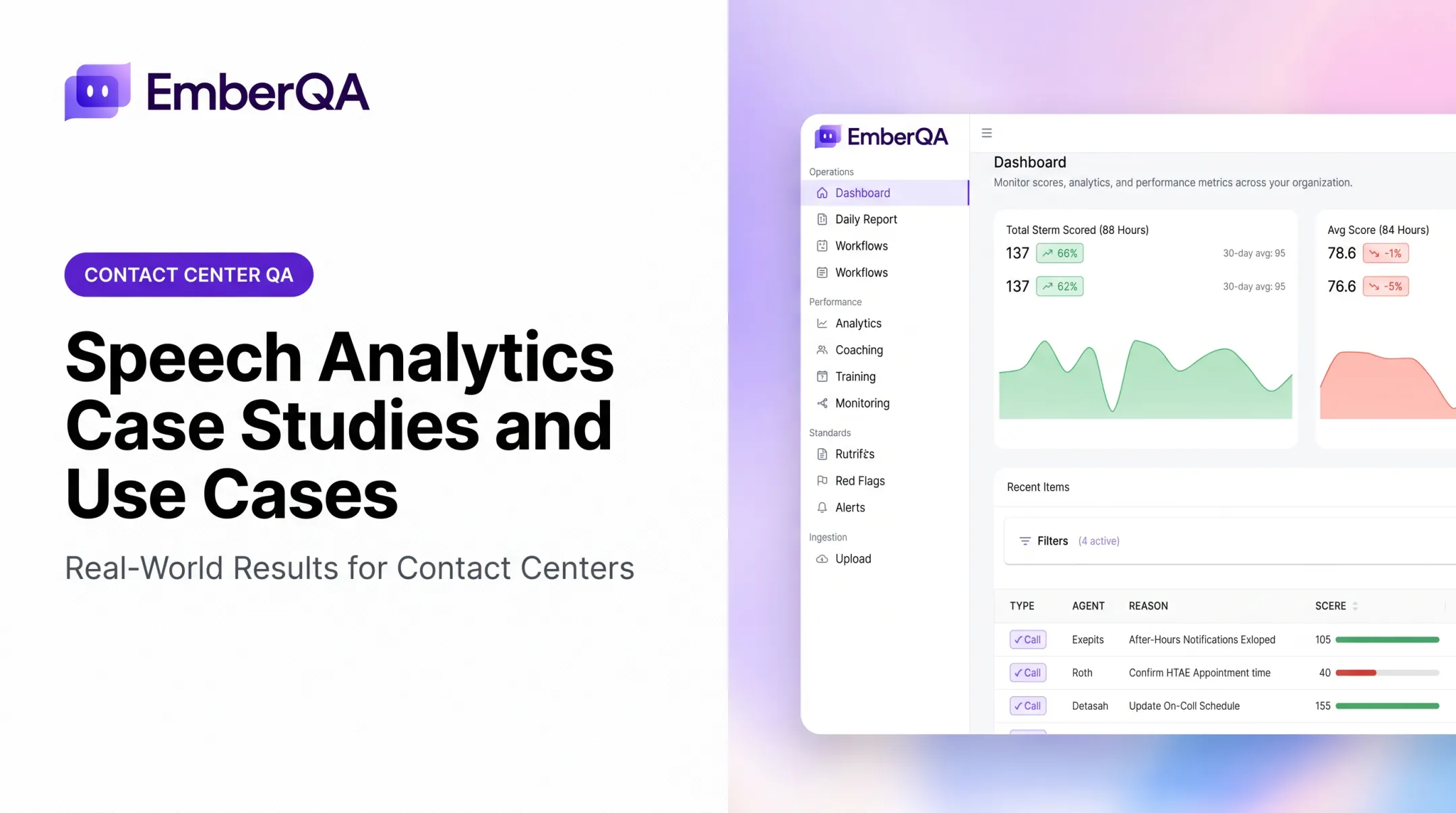
EmberQA supports contact centers that need AI-powered QA across customer interactions. It offers automated scoring, red-flag detection, targeted coaching insights, and searchable, comparable calls.
Spot On Schedulers uses it to review 100% of calls across 18 dental offices, with office-specific QA workflows and CRM verification against each interaction. Plans start at $49 per agent/month for Essentials and $89 per agent/month for Pro, which adds targeted coaching, training programs, and AI roleplay.
EmberQA is built for contact-center QA, not medical speech recognition. It does not claim clinical functionality or HIPAA certification.
Measuring the Pilot
Baseline current QA coverage and review time before you start. Then track a small set of pilot KPIs:
- Automated findings vs. expert human reviewers
- False-alert rate and review time saved
- A clear go/no-go decision point before expanding
Conclusion
Speech analytics helps healthcare contact centers move past thin manual sampling toward broader, more consistent insight across patient and member conversations. Technology only pays off when healthcare-specific scorecards, privacy governance, accuracy testing on representative samples, and human oversight work together.
Start small before you scale:
- Pick one high-value workflow where fuller coverage will matter most
- Audit the call data you can actually access and use
- Evaluate platforms on security, integration, accuracy, and actionability
Frequently Asked Questions
What does speech analytics do?
Speech analytics transcribes and analyzes spoken interactions to identify topics, intent, sentiment, workflow adherence, and quality trends. It supports operational and QA decisions, not clinical diagnosis.
What is the best medical speech recognition software?
Medical speech recognition handles clinical dictation and documentation—a different category from speech analytics for patient or member conversations. Score each category on workflow fit, specialty vocabulary, security, and integrations.
What are the best speech analytics tools?
The right tool depends on your recording environment, compliance requirements, accuracy needs, and integrations. Rank vendors on how they perform against your own representative call recordings.
Is speech analytics HIPAA compliant?
Compliance depends on system configuration, data involved, and the vendor's safeguards and contractual terms, including a business associate agreement where required. Verify current requirements with qualified compliance counsel.
How is speech analytics used in healthcare?
Healthcare contact centers use it for QA, patient and member experience analysis, agent coaching, compliance monitoring, and call-driver analysis. It complements—but never replaces—clinical judgment.