Introduction
Insurance agents don't fail calls because they can't recite a pitch. They fail because real calls throw curveballs: an angry policyholder, a coverage question with no easy answer, a caller who wants an exception the agent can't grant.
Mock call practice needs to test all of it — accuracy, empathy, qualification, and compliance at once, not just word-for-word memorization.
Building those skills takes deliberate practice, and the training window is short. New contact center hires often have to learn multiple product lines, systems, and internal procedures within weeks, according to LOMA's contact center performance materials. That compressed onboarding window is why structured practice matters for insurance teams.
Insurance teams typically build mock calls for four reasons:
- Onboarding new agents faster
- Preparing agents for difficult customer interactions
- Standardizing service quality across reps and locations
- Reinforcing claims or sales procedures after a QA finding
This guide covers script frameworks, five ready-to-adapt roleplay scenarios, objection-handling prompts, and a practical way to score and coach the results.
Key Takeaways
- Treat scripts as flexible guides with required checkpoints, not lines agents must recite word for word.
- Build scenarios around real insurance moments: quotes, coverage questions, first notice of loss, renewals, objections, escalations.
- Score both customer experience and risk controls: verification, disclosures, documentation, accuracy, empathy, escalation.
- Turn recurring roleplay and call findings into targeted coaching plans for agents and teams.
How to Build an Effective Insurance Mock Call Script
Every insurance mock call should follow the same skeleton, even when the situation changes:
- Opening — greeting, purpose, and permission to continue
- Verification — identity or account authentication
- Discovery — questions that uncover the real reason for the call
- Explanation or recommendation — what the agent can offer or confirm
- Objection handling — price, prior claims, confusion, exceptions
- Next steps — what happens after the call ends
- Compliant close — required disclosures and documentation
Compliance steps stay fixed. Tone and wording should still sound like a real conversation.
Standardize the Risk, Improvise the Rest
Lock down the pieces tied to compliance and liability:
- Required disclosures and consent language
- Authentication steps
- Escalation rules for out-of-authority requests
- Documentation requirements
Everything else, including tone, word choice, and small talk, should stay natural. An agent who sounds like they're reading a script loses the caller's trust before the real conversation even starts.
New York's insurance regulator has drawn this line clearly for unlicensed staff: a non-licensed caller can offer to connect a prospect with a licensed agent, but cannot discuss specific policy terms, compare plans, or advise on coverage needs, per New York DFS Office of General Counsel opinion 04-04-20. Build that handoff into the script as a required checkpoint, not a judgment call left to the agent.

Write Realistic Customers, Not Generic Ones
A scenario only works if the agent has to actually listen. Give each mock customer:
- A specific policy type and account history
- A goal, such as adding a driver, disputing a bill, or reporting a loss
- An emotional state: frustrated, confused, rushed
- A constraint, like limited time or a prior bad experience
Discovery questions should surface the facts without steering the agent toward coverage promises they can't make:
- Policy type
- Reason for the call
- Coverage concern
- Timeline
- Prior actions already taken
- Desired outcome
Then add a branch. The caller might push back on price, reopen a denied claim from last year, or ask for something that needs a licensed specialist. Every script needs at least one moment where the agent must hand off, say no, or ask for help. That is usually where real calls break down.
Score those branch points the same way you would a live call so coaching stays tied to the behaviors that matter under pressure.
Before any script goes live, route it through:
- Compliance
- Legal
- Carrier relations
- Training
State rules on licensing, privacy, recording consent, and required disclosures vary. A script cleared in one state can create exposure in another.
Insurance Roleplay Scenarios and Sample Scripts
Five recurring situations cover most of what insurance agents face on live calls. Treat each one as a framework—not a full script—so agents practice judgment, compliance checkpoints, and next steps under realistic pressure.
1. Cold-Call or Outbound Quote
- Setup: Prospect filled out an online form weeks ago and is skeptical about an unsolicited call.
- Objective: Earn permission to continue, confirm relevance, ask two or three qualifying questions, avoid unsupported savings claims, and lock a next step.
- Watch for: Overselling before qualifying, or guaranteeing a lower rate before gathering facts.
Sample opening: "Hi, this is [agent] with [company]. You requested an auto quote a few weeks back. Do you have two minutes, or is there a better time to call?"
2. Policy Service Request
- Setup: Customer needs to update an address, add a driver, request proof of insurance, or dispute a charge.
- Objective: Authenticate first, explain only what is on the account, document the change, and escalate anything outside authority.
- Watch for: Skipped verification or promises about coverage the agent has not confirmed.
Sample line: "Before I pull up your policy, can I verify the full name and the last four of the policy number on the account?"
3. Claims Intake
- Setup: Policyholder reporting an accident, property damage, or injury while visibly upset.
- Objective: Lead with empathy, gather facts methodically, keep fact-finding separate from coverage decisions, flag urgent risk, and explain next steps.
- Watch for: Speculating on coverage instead of documenting and routing the claim.
Sample line: "I'm sorry you're dealing with this. I'm going to take the details carefully, then walk you through what happens next—I won't make coverage decisions on this call."
4. Renewal or Retention
- Setup: Customer reacting to a premium increase and hinting they are shopping other insurers.
- Objective: Acknowledge the frustration, explain only verified pricing, explore retention options on the current policy, and avoid guaranteeing future rates.
- Watch for: Empty apologies with no explanation, or promising the rate will not rise again.
Sample line: "I hear the increase is frustrating. I can walk through what changed on this renewal and the options available on your current policy—I can't promise a future rate."
5. Difficult or Escalated Customer
- Setup: Caller who interrupts, demands an exception, or threatens to complain publicly.
- Objective: De-escalate tone, set a boundary without matching their energy, own the next step, and document the escalation path.
- Watch for: Going silent under pressure, or agreeing to exceptions they are not authorized to make.
Sample line: "I want to help resolve this. Here's what I can do right now, and here's what I need to escalate so it is handled by the right person."

For each scenario, set the exercise up before the conversation starts:
- Role assignments (agent, customer, observer)
- Customer background and motivation
- Required compliance checkpoints
- Likely objections
- Acceptable outcomes
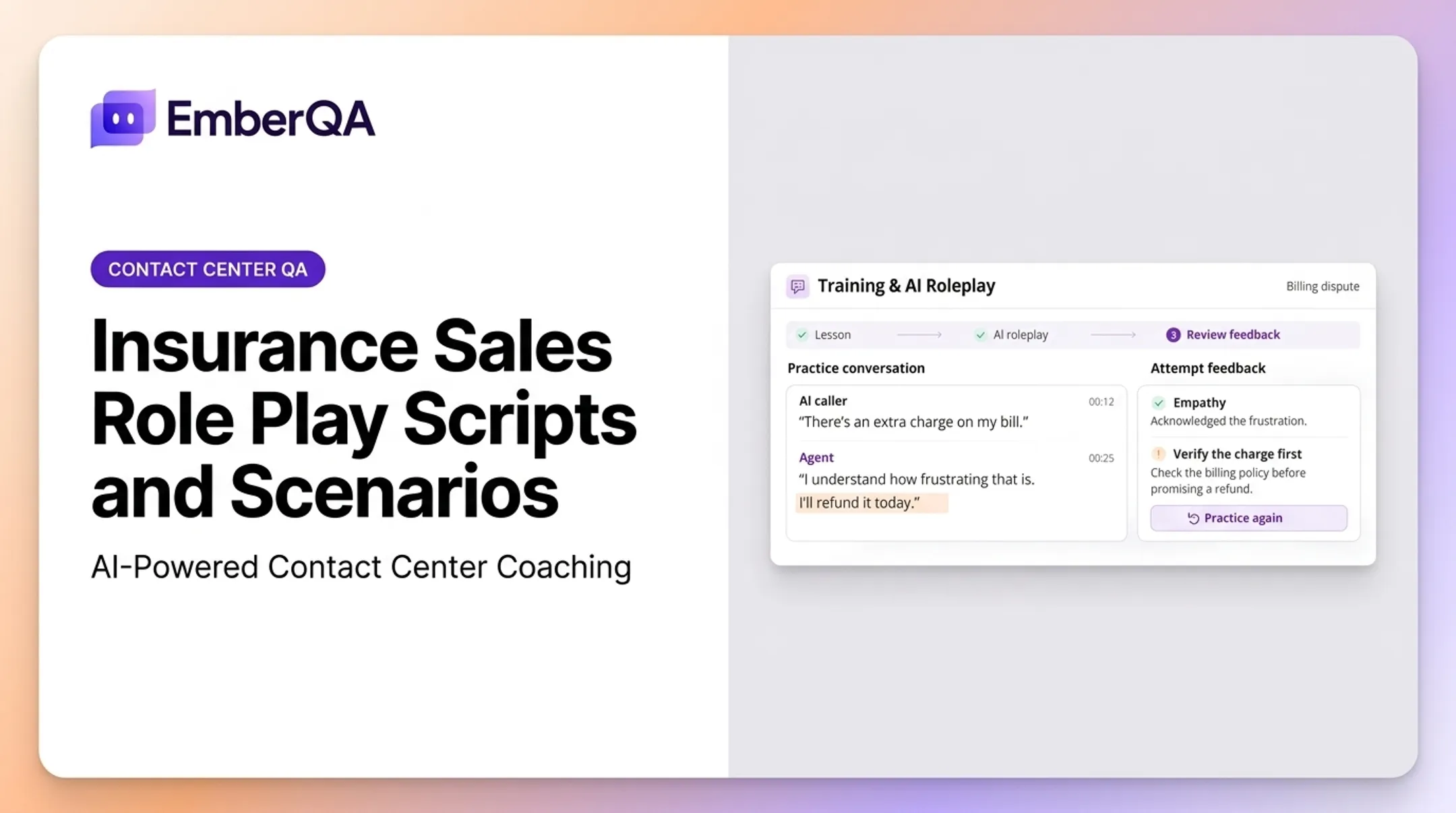
Leave the dialogue itself unscripted so agents practice real judgment. Some teams run these in live coaching; others use AI mock-caller tools—including EmberQA's insurance roleplay training—so agents get repeated reps before a live queue.
How to Evaluate and Coach Mock Calls
A scorecard only works if it measures behavior, not vibes. Build yours around:
- Opening and tone
- Active listening and discovery accuracy
- Verification and disclosure delivery
- Insurance knowledge and documentation
- Empathy, objection handling, resolution, and closing
Separate Critical Risks from Coaching Opportunities
Not every miss deserves the same response. Some issues need immediate review:
- Unauthorized promises about coverage or pricing
- Skipped authentication
- Inaccurate coverage statements
- Mishandled personal information
- Failure to escalate an urgent situation
Everything else, like tone, pacing, or phrasing, is coachable, not a red flag. Mixing the two categories makes evaluators either too lenient on real risk or too harsh on minor style choices.
Write scoring descriptions around specific behavior. "Asked a relevant follow-up question about the caller's prior claim" tells an evaluator something concrete. "Asked discovery questions" just confirms a box got checked.
Calibrate Before You Trust the Scores
Have two or three supervisors score the same mock call independently, then compare results side by side. Where scores differ, the goal isn't to average them out. It's to agree on what evidence actually justifies each score.
This matters more than most teams assume. Cross-industry research from COPC found that roughly 90% of organizations perform calibration, and about 74% track customer, business, and compliance critical errors separately, according to COPC's 2022 Global Benchmarking Series.
Insurance teams should calibrate compliance-critical errors on their own track, separate from general conversation quality.
Turn Results Into Coaching, Not Just Scores
A finding that never becomes a coaching session doesn't improve anything. Turn each priority miss into a short coaching loop:
- Pick one or two priority behaviors for the agent
- Show a model response from a strong call or script
- Run a repeat roleplay on the same scenario
- Set a follow-up date to confirm the behavior stuck
Manual sampling hits a wall here. Reviewing 2 to 5% of calls by hand means most patterns never surface.
EmberQA applies one QA rubric across every recorded interaction, surfaces red flags automatically, and groups recurring issues into coaching insights. On the Pro plan ($89 per agent per month), that scoring pairs with unlimited AI roleplay so agents get the audit and the practice loop in one system.

How to Adapt Scripts for Different Insurance Teams
A single script doesn't work across an entire book of business. Auto customers ask about deductibles and rental coverage. Life customers ask about beneficiaries and replacement rules. Terminology, information needs, and escalation paths shift by line.
| Team | What the script should protect |
|---|---|
| Sales | Qualifying without overselling; licensed handoff for coverage advice |
| Service | Account changes within authority; escalation past that line |
| Claims | Fact-gathering kept separate from coverage determination |
| Retention | Acknowledging frustration without guaranteeing future pricing |
| Answering service | Accurate message-taking and routing, not coverage discussion |
Match the script to the agent's experience level, too:
- Give new agents explicit checkpoints and slower pacing
- Stress-test experienced agents with edge cases they haven't hit yet
- Equip BPO teams with scripts that work without deep product tenure
- Build the same protections into every language and channel, not bolted on afterward
None of this holds up without version control. When a product changes, a carrier updates instructions, or a state adds a disclosure requirement, every trainer and evaluator needs the updated script, not a mix of old and new versions floating around different teams.
Frequently Asked Questions
What is a good script for cold calling insurance clients?
A strong script earns permission to continue, establishes relevance quickly, and asks a small number of qualifying questions. It avoids unsupported savings claims, handles objections respectfully, and ends with a clear next step.
What makes a good mock call script?
It pairs a realistic customer objective with a defined agent goal, plus natural dialogue prompts instead of word-for-word lines. Include required compliance checkpoints, likely objections, and clear evaluation criteria.
How can insurance teams practice claims calls without giving agents authority to make coverage decisions?
Focus the exercise on empathy, fact-gathering, documentation, and setting expectations about next steps. Agents should practice explaining what happens next without stating whether something is or isn't covered.
What should supervisors score during an insurance roleplay?
Score communication quality, active listening, accuracy, verification, disclosure delivery, and privacy handling. Also score documentation, empathy, resolution, and whether the agent escalated appropriately.
How often should insurance call scripts be reviewed and updated?
Review scripts whenever products, carrier procedures, laws, disclosures, or escalation policies change. Schedule regular calibration checks between reviews to confirm scripts and scorecards still hold up in practice.
Can AI evaluate insurance mock calls and recorded customer interactions?
Yes. AI tools can score mock and live calls against defined rubrics, flag red flags, and surface recurring patterns across recordings. Regulated organizations should still keep human reviewers involved for disputed compliance findings.