Why Call Centers Are Turning to Voice Recognition Services
At one answering service, quality managers reviewed less than 1% of calls by hand. Everything else went unscored, unchecked, and unused. That's not a rare situation. Most contact centers rely on small manual samples, inconsistent scorecards, and feedback that arrives days or weeks after a call ends.
That coverage gap is why more call centers are adopting voice recognition services. The term covers a lot of ground: converting speech to text, routing calls based on spoken input, verifying a caller's identity, or analyzing thousands of conversations for quality and compliance signals.
This guide breaks down how these technologies work, where they create real value, what can go wrong, and how to pick a service that supports both your customer experience goals and your QA program.
Key Takeaways
- Speech recognition, voice recognition, voice biometrics, and speech analytics each solve a distinct problem.
- Automated transcription and AI scoring can expand QA coverage from a tiny sample to every eligible call.
- Accuracy, privacy protections, and human escalation paths matter as much as automation itself.
- Choose a service that fits your workflows, regulatory obligations, and existing CRM or telephony systems.
What Is a Call Center Voice Recognition Service?
A call center voice recognition service captures, converts, identifies, or analyzes spoken interactions. The catch: "voice recognition" gets used as an umbrella term for several distinct capabilities that don't always live in the same product.
Here's how the core categories actually differ:
| Technology | What It Actually Does |
|---|---|
| Speech recognition (ASR) | Converts spoken audio into text or commands. Answers "what was said." |
| Voice recognition / speaker ID | Identifies or verifies who is speaking, not the words themselves. |
| Voice biometrics | Creates and compares voiceprints to authenticate a caller's identity. |
| Speech analytics | Examines conversation content: topics, sentiment, keywords, compliance behaviors. |
| Text-to-speech / NLU | Generates spoken responses (TTS) or interprets intent and context (NLU). |
There's also a practical split worth understanding:
- Customer-facing voice automation (IVR menus and call routing) shapes what a caller experiences
- Post-call or real-time analysis for QA, compliance, and coaching shapes what a manager sees
This distinction matters because vendors rarely offer all of it. A platform built for IVR automation may have no analytics layer at all. One built for QA scoring may have zero authentication features.
Before evaluating providers, get specific about which capability you actually need. Don't assume "voice recognition" describes a complete contact center platform.
How Does a Call Center Voice Recognition Service Work?
The path from raw audio to usable insight follows a fairly consistent sequence, regardless of vendor.
- Audio capture — The system pulls live or recorded call audio from your telephony platform, contact center software, or recording repository.
- Transcription — An ASR engine separates speech from background noise and produces a text transcript. Accuracy still hinges on audio quality, accents, overlapping speakers, and industry terms.
- Language analysis — Natural language processing classifies intent, topics, keywords, sentiment signals, and conversation patterns based on how the service is configured.
- Evaluation — Rules, scorecards, or AI models score the interaction against quality, compliance, or operational criteria.
- Delivery — Results show up as transcripts, searchable recordings, scores, alerts, dashboards, or coaching recommendations.

Where Voice Biometrics Fits In
Authentication sits beside this pipeline, not inside transcription. Biometrics compare vocal traits to an enrolled voice profile to confirm identity; speech recognition only determines what was said. Treat a voiceprint match as one control among several—not a standalone guarantee.
Integrations and Human Review
Most services connect with telephony systems, call recording repositories, CRM platforms, and QA software. Supported integrations vary widely by vendor, so verify compatibility with your specific stack rather than assuming universal support.
Human review still matters here. Managers should validate uncertain transcripts, investigate flagged alerts, and treat AI findings as decision support, not unquestionable judgment. A model can flag a pattern; a person still needs to confirm what actually happened on the call.
A working example: An answering service records a customer call. EmberQA then:
- Transcribes the call automatically
- Scores it against a custom rubric
- Flags a missed disclosure as a red flag
- Cross-checks the outcome against CRM notes
- Routes the finding into a targeted coaching plan
Managers get the issue without listening to the full recording first.
Applications and Benefits for Contact Centers
Voice recognition technology earns its keep in four areas. Here's where contact centers see measurable gains.
Quality Assurance and Agent Coaching
Analyzing every eligible interaction, instead of a handful sampled by hand, reveals recurring behaviors that small samples simply miss. Consistent rubrics also improve scoring comparability across agents, teams, and even outsourced vendor programs.
One answering service, ECA, used to review under 1% of its calls manually. After moving to automated scoring, coverage jumped to 100%, and every call was measured against the same rubric — making performance comparable across agents for the first time. Recurring findings feed directly into targeted coaching plans instead of generic "be more polite" feedback.

Compliance and Risk Monitoring
Speech analytics can check for:
- Required disclosures
- Prohibited language
- Identity verification steps
- Escalation triggers
That matters most in regulated environments such as insurance, financial services, collections, and healthcare-adjacent operations, though no platform can promise automatic legal compliance.
Mortgage lender Florius paired speech analytics with coaching tools and saw first-contact resolution climb from 83% to 88%, alongside a CSAT increase, within the first four months of deployment.
Customer Experience and Operational Insight
Intent signals, sentiment indicators, and escalation patterns expose friction points in the customer journey. Searchable transcripts let teams find representative calls in seconds instead of listening through recordings sequentially. That speed helps when teams need to update scripts, close knowledge gaps, or pinpoint training needs.
Efficiency and Performance Visibility
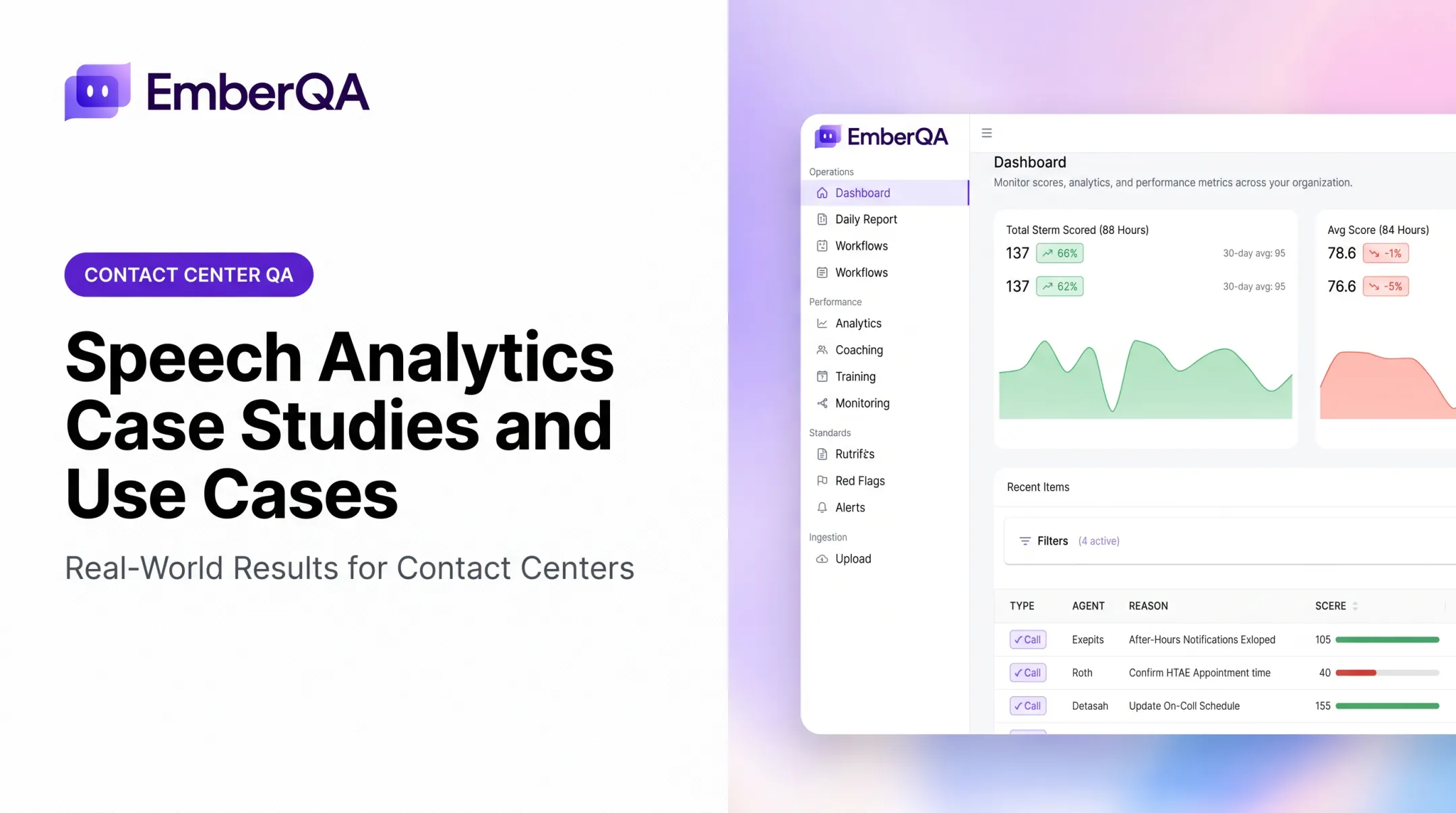
Automation reduces the manager hours spent on manual review while increasing consistency. EmberQA's platform, for instance, scores every interaction against the same rubric, flags urgent issues as they appear, and cuts the need for managers to sample and score calls one by one.
Challenges and Risks to Plan For
No voice recognition service works perfectly out of the box. A few risks deserve attention before you sign a contract.
Accuracy problems are common, not exceptions. Background noise, crosstalk, accents, code-switching, and industry jargon all degrade transcription quality. No single model performs best across every audio condition, so test on your own calls before trusting benchmark numbers from a vendor's pitch deck.
Privacy obligations vary by data type. Recorded conversations may contain payment information, health details, or biometric voiceprints — and each carries different legal requirements.
The FTC's 2023 biometric policy statement treats voice recordings as biometric information when a person can reasonably be identified from them. It flags misleading collection practices and inadequate security as potential concerns.
Other risks to plan around:
- False positives and false negatives that penalize agents based on incomplete context
- Opaque scoring that makes it hard to explain a result to an agent who disputes it
- Consent and retention gaps: recording laws differ by state, and some require all-party consent
- Poor IVR design that traps callers in loops with no path to a human
Build in a clear escalation route. Nothing frustrates customers faster than a voice system that won't let them reach a person.
How to Choose and Implement a Call Center Voice Recognition Service
Start with a use-case assessment before you look at a single vendor demo.
Define your primary need first:
- IVR automation
- Transcription
- Voice authentication
- Conversation analytics
- QA automation and coaching
- Some combination of the above
Document your call sources, languages, recording quality, interaction volume, existing scorecards, and which teams need access to results.
Evaluation Criteria That Actually Matter
| Criteria | What to Check |
|---|---|
| Accuracy | Performance across your actual accents, noise levels, and terminology |
| Configurability | Custom scorecards, alerts, and explainable scoring logic |
| Integrations | CRM, telephony, and reporting compatibility (verify, don't assume) |
| Security | Encryption, access controls, audit logs, retention policies |
| Pricing | Per-agent vs. usage-based, onboarding costs, support quality |
Run a controlled pilot using representative calls, including your messiest audio and edge cases. Establish a baseline before deployment so you can measure what actually changed, not just what the vendor claims changed.

Once you commit, train QA managers, supervisors, and compliance stakeholders on interpreting alerts and results. Then build an ongoing governance process:
- Audit accuracy quarterly
- Review disputed scores
- Refresh rubrics as your business changes
For QA and coaching use cases, EmberQA offers automated scoring, red-flag detection, office-specific workflows, and CRM data verification. Implementation typically follows three steps:
- Connect your data sources
- Set your standards
- Start taking action on the findings
EmberQA covers QA and coaching, not voice authentication.
Conclusion: Turning Voice Data Into Better Contact Center Decisions
A call center voice recognition service earns its value by turning conversations into reliable, actionable information, not by automating a phone menu. Getting there depends on clear use cases, quality audio data, privacy safeguards, human oversight, and metrics tied to real customer and agent outcomes.
Your next moves:
- Audit how much of your call volume actually gets reviewed today
- Identify your highest-risk or highest-volume interaction types
- Compare vendors through a pilot using your own calls, not a demo reel
Frequently Asked Questions
What are the four most common KPIs used in call centers?
Average handle time, first-contact resolution, customer satisfaction (CSAT), and service level are the four most widely tracked metrics. The right mix depends on your center's specific goals and customer segments.
What is considered a good WER?
WER (word error rate) benchmarks vary by audio quality, accent, and use case, so there's no universal "good" number. Test any service on your own representative calls rather than relying on a vendor's published benchmark.
What are some examples of voice recognition systems?
Common examples include speech-enabled IVR menus, automatic call transcription, voice assistants, voice biometric authentication, real-time agent assist tools, and post-call speech analytics. Each recognizes or analyzes something different: words, identity, or conversation patterns.
What is a voice call center?
A voice call center handles customer interactions over the phone, using human agents, automated systems, or both. Voice recognition technology can support routing, documentation, quality assurance, and analysis within that operation.
What is the difference between speech recognition and voice recognition?
Speech recognition converts or interprets what someone says. Voice recognition identifies who is speaking. Speech analytics goes a step further, evaluating conversation content and behavioral patterns across many calls.