Many teams struggle with the same bottlenecks: manual sampling covers a sliver of total interactions, scorecards drift between reviewers, and QA data sits disconnected from CRM systems and coaching workflows. A 2019 ICMI survey found that 44% of contact centers evaluating inbound voice interactions reviewed only 1% to 3% of them — a coverage gap that leaves most conversations unexamined.
This article walks through how to define your requirements, evaluate QA methodology and security, compare vendors, and validate your choice with a structured pilot before you sign anything.
Key Takeaways
- Map interaction types, risks, teams, and outcomes before you contact vendors.
- Prioritize scoring consistency, full coverage, coaching, and data security over feature lists.
- Compare total value, not sticker price — factor in manager time, setup effort, and reporting needs.
- Validate any provider with a pilot, references, and clear success criteria.
Define Your Quality Assurance Requirements Before Comparing Options
A clear requirements brief is the foundation for choosing an appropriate QA provider, especially for centers handling high volumes across multiple sites. Without one, vendor demos become a parade of impressive features that may not match how your team actually operates.
Map Your Interaction Types and Channels
Start by listing every interaction type that needs evaluation:
- Voice calls (inbound and outbound)
- Chat and SMS conversations
- Emails and written correspondence
- Documents, transcripts, and related CRM or account notes
Separate what you evaluate today from channels you plan to add. A provider that only handles calls won't serve you well if chat volume is growing.
Identify the Risks and Outcomes That Matter
Different centers care about different failure points. Insurance and financial services teams often prioritize disclosure accuracy and escalation handling. Answering services and BPOs care more about consistency across client programs.
Define which of these apply to your operation:
- Customer experience and satisfaction signals
- Agent consistency across teams and locations
- Sales or service accuracy
- Compliance controls specific to your industry
- Coaching effectiveness and follow-through
Document What's Broken Today
Document your current state before you score any vendor:
- Sample size and composition
- Existing scorecards
- Reviewer responsibilities
- Review frequency
- Calibration practices
This baseline becomes your comparison point.
Spot On Schedulers, a dental scheduling operation, faced this exact challenge. Each office had distinct expectations for call handling and CRM documentation, so a single generic scorecard could not apply fairly across locations.
That kind of variability is exactly what a requirements brief needs to surface early, not after a contract is signed.
Set success measures before any vendor demo:
- Improved review coverage
- More consistent scoring
- Faster risk identification
- Reduced manual effort
Where you need numerical targets, pull industry benchmarks instead of guessing.
Evaluate QA Methodology, Interaction Analysis, and Coaching Capabilities
Once requirements are clear, the next step is stress-testing how each provider actually scores interactions and turns those scores into action.
Ask How Scoring Rubrics Are Built
A generic scorecard forced onto every client rarely reflects your actual policies. Ask whether the platform supports configurable rubrics tied to your specific:
- Customer-service standards
- Product or process requirements
- Industry-specific compliance controls
Then dig into the mechanics. How is a score produced? What happens with ambiguous or low-confidence results? Is there a reviewer override workflow, an audit trail, and a plain-language explanation for why an interaction passed or failed?
Push for Full Coverage, Not Just Sampling
Ask directly: does the platform evaluate every eligible interaction across your channels and languages, or only a selected sample? This distinction matters more than almost any other feature comparison.
Coverage claims and accuracy are separate. McKinsey's 2024 early-work estimates put largely automated QA accuracy above 90%, compared to 70%–80% for human scoring. The same research flags hallucinations, bias, and missing context as real failure modes.

Validate each scorecard criterion against your own labeled interactions rather than accepting a headline number.
Confirm Red Flag Detection and Coaching Follow-Through
Ask the vendor to demonstrate, using realistic examples, how the system identifies:
- Missed disclosures or improper advice
- Poor escalation handling
- Privacy violations or hostile behavior
- Recurring process failures across agents or teams
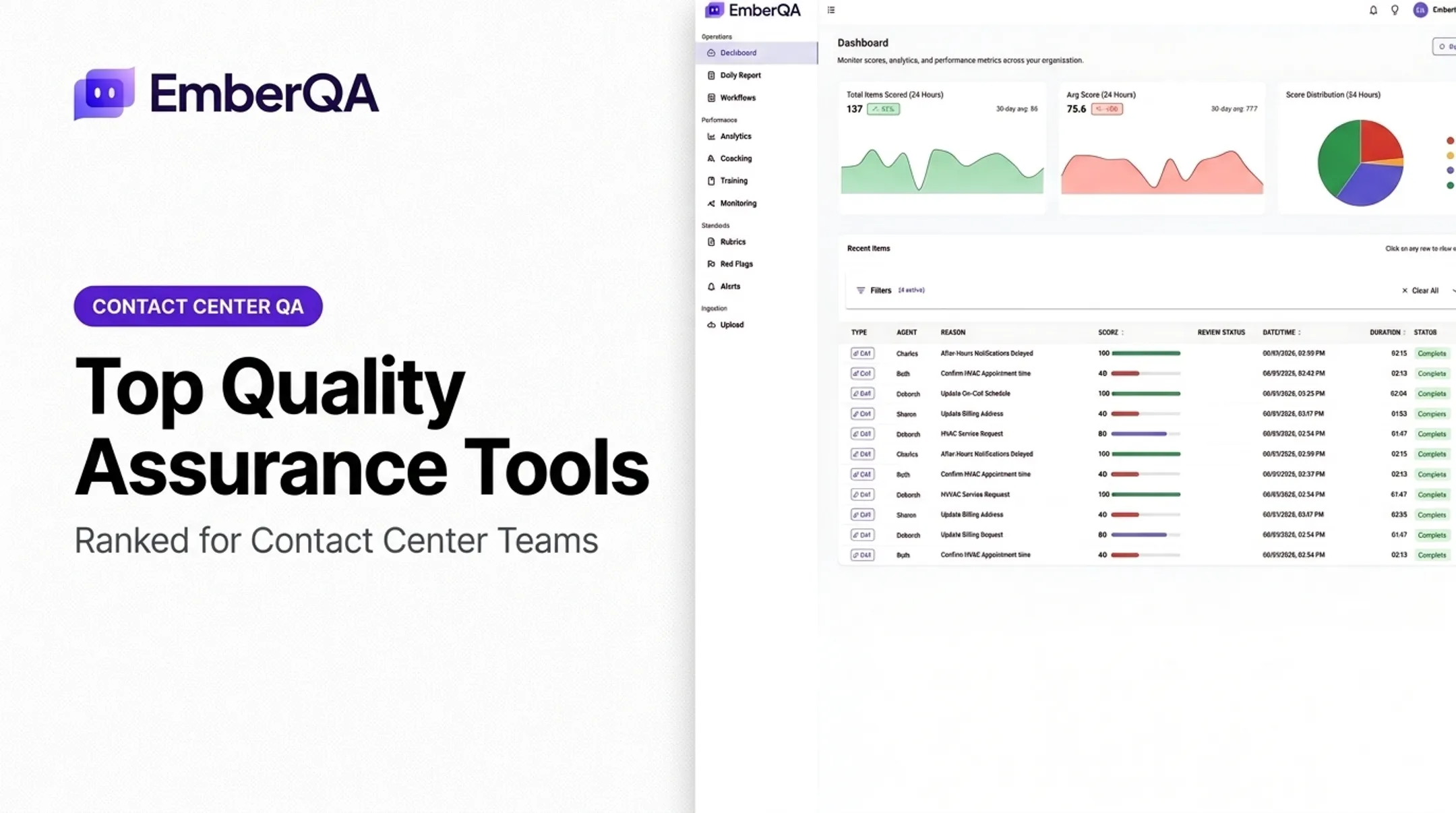
Then confirm findings actually reach agents. EmberQA, for example, scores every recorded call, SMS, email, and document against custom scorecards, flags urgent issues in real time, and routes recurring patterns into targeted coaching queues with searchable evidence attached.
That integration of scoring and coaching is the bar to test in demos. Whether any platform is the right fit still depends on your requirements brief.
Check Integration, Security, Governance, and Operational Fit
A QA platform that can't connect to your existing systems creates more manual work, not less.
List the Systems That Must Connect
Ask vendors to explain supported integrations and who owns implementation responsibility for each:
- Call-recording or contact-center platforms
- CRM systems
- Workforce management tools
- Reporting and BI environments
- Identity management systems
Some workflows also need CRM verification, not just conversation analysis. When accuracy depends on whether an outcome was actually logged, the platform should compare call content against CRM records.
Spot On Schedulers used this approach to evaluate 100% of dental scheduling calls while cross-checking appointment details against CRM entries, catching gaps a transcript alone wouldn't reveal.
Get Real Security Documentation
Ask precisely how recordings, transcripts, messages, customer information, and generated scores are stored, accessed, retained, exported, and deleted. Require current documentation, not general assurances.
For regulated operations, retention rules vary by activity. Telemarketing records, debt-collection compliance records, health information, and payment-card data each carry different requirements. Consult your legal, compliance, and information-security teams about which rules apply; no vendor can substitute for that review.
Also confirm:
- User permissions and data segregation
- Auditability of every score and correction
- Incident response processes
- How disputed evaluations get corrected
Understand What Implementation Actually Requires
Ask what data must be available, how much configuration effort is involved, and what training or admin support the vendor provides versus what your team must supply. Use a simple three-step baseline to compare vendors: connect interaction data, configure scorecards and red flags, then turn signals into action.

Compare Providers, Pricing Models, References, and Pilot Results
Build one consistent comparison framework so every vendor is scored the same way. Cover at least:
- Experience and interaction types
- Methodology and integrations
- Security, implementation, and support
- Reporting and commercial terms
Comparing apples to oranges across vendor pitch decks wastes time.
Know Which Operating Model You're Buying
Providers generally fall into three categories. A 2022 COPC benchmarking report found 27% of contact centers used manual-only QA systems, 20% used quality-specific software only, and 53% combined manual processes with software.
That split suggests most teams still blend human judgment with technology rather than choosing one extreme.
| Model | Best fit for |
|---|---|
| Outsourced QA service | Teams wanting external reviewers without building internal capacity |
| Software platform | Teams wanting automation and internal control over scoring |
| Hybrid | Teams keeping human calibration alongside automated coverage |
Get the Full Cost Picture
Ask for every cost component, not just the headline subscription price:
- Setup, configuration, and data integration fees
- Usage-based charges and per-seat pricing
- Support and custom reporting costs
- Professional services, renewal terms, and exit or data-export fees
As a reference point, EmberQA's Essentials plan runs $49 per agent/month and Pro runs $89 per agent/month, with managers and reviewers included at no extra cost unless their own work is being scored. That structure is worth comparing against per-seat or per-minute pricing from other vendors.

Request References and Run a Real Pilot
Ask for references from organizations with similar interaction volume, channel mix, regulatory exposure, and number of locations. Verify whether any cited results are independently documented rather than self-reported.
Then run a time-limited pilot using representative interactions, your existing scorecards, and known edge cases. Compare:
- Score alignment with your current reviewers
- Issue detection on known problem calls
- Workflow usability for managers
- Reporting quality and implementation effort
Assess Communication, Scalability, and Long-Term Partnership Fit
QA is an ongoing operating relationship, not a one-time purchase. Evaluate how the provider communicates once the contract is signed.
Ask about:
- Named contacts and response times
- Escalation paths for urgent issues
- Reporting cadence and release updates
- Support for changing rubrics as policies shift
Confirm the platform scales without fragmenting into separate QA programs per site, vendor, or client. If you run multiple locations or client programs — like a BPO reporting scores back to several brand partners — a single standardized scoring layer matters more than a flashy dashboard.
Ask how the provider handles real-world edge cases:
- Incomplete recordings
- New compliance requirements
- Model errors and integration failures
- Disagreements between automated scores and human reviewers
A vendor with no answer to these questions hasn't thought through real-world operations.
Finally, confirm ongoing calibration is part of the standard relationship. Continuous review of trends and periodic scorecard updates should be included by default, not treated as a special request.
Next Steps: Select the Option That Best Matches Your QA Operating Model
The decision sequence, in order:
- Document your requirements: channels, scorecards, compliance rules, and monthly volume
- Shortlist providers that match your interaction types and risk profile
- Validate capabilities and security documentation against your stack
- Run a representative pilot on real interactions, not polished demos
- Calculate total value, not just price—coverage, coaching lift, and manager time saved
- Agree on implementation ownership before signing
If your main challenge is high interaction volume with limited manual bandwidth, EmberQA fits that model. It supports automated scoring, red-flag detection, searchable interaction analysis, and targeted coaching.
The best next step is a product walkthrough on your scorecards and edge cases—so you can judge fit before you commit.
Frequently Asked Questions
What are the requirements for quality assurance?
A solid QA program needs documented standards, measurable objectives, clear evaluation criteria, and trained reviewers or configured technology to apply them consistently. It also needs quality records, feedback loops, and alignment with any applicable industry or internal requirements.
How much of my contact center’s interactions should QA cover?
Manual QA often samples only 1–2% of interactions, so most coaching and compliance issues never surface. Use the broadest coverage your process and tools can sustain, then calibrate scores with human review.
How do I choose the right quality assurance provider for a contact center?
Compare contact-center experience, interaction coverage, scoring flexibility, integrations, and security alongside coaching workflows and scalability. Weigh references, total cost, and pilot performance before deciding.
What should I ask a QA vendor during a product demonstration?
Ask how scoring works, how rubrics are configured, and which channels are supported. Also ask how red flags are identified, how results are explained to agents, and what implementation effort is required.
Is AI-powered quality assurance better than manual quality monitoring?
They serve different purposes. AI expands coverage and spots patterns across every interaction, while human reviewers remain essential for calibration, context, and coaching judgment.
How can I evaluate a QA platform before signing a contract?
Run a structured pilot using representative interactions, your existing scorecards, and key stakeholders. Pair it with a security review, integration validation, and a full-cost assessment before committing.