Introduction
A customer doesn't judge your business by one call, one email, or one survey score. They judge it by the sum of everything: the sales pitch, the onboarding email, the hold music, the agent who finally fixed their billing issue.
Miss one of those moments, and the whole relationship can wobble. Seventeen percent of US consumers say they'd walk away from a brand they love after just one bad experience, and 59% would leave after several, according to PwC's research. That's a lot of risk riding on interactions many companies never formally review.
Customer experience management (CXM) gives you a structured way to track, measure, and improve those interactions instead of guessing which ones matter. This article defines CXM and separates it from customer service and CRM. You'll see how contact centers use interaction data, including AI-powered analysis, to close the gap between what customers experience and what companies actually see.
Key Takeaways
- CXM designs, monitors, and improves customer interactions across every channel and journey stage.
- Treat CXM as a cross-functional strategy—not a department, CRM database, or software tool.
- Tie feedback and behavioral signals to specific owners and measurable fixes.
- AI interaction analysis expands visibility beyond manual samples; human judgment still drives decisions.
What Is Customer Experience Management?
Customer experience management is the deliberate practice of shaping how customers perceive your business at every point of contact, before a sale, during it, and long after. It covers satisfaction, effort, trust, and loyalty as ongoing outcomes to be managed, not measured once a year and forgotten.
CXM vs. Customer Experience vs. Customer Service
These three terms get used interchangeably, but they aren't the same thing:
- Customer experience is the outcome. It's how a customer perceives your company across all interactions.
- Customer service is one input. It's the support calls, chats, and tickets that shape part of that perception.
- Customer experience management is the discipline. It's the system of people, processes, and data used to monitor and improve the experience on purpose.
CXM includes direct interactions: calls, chats, emails, SMS, sales conversations, and onboarding sessions. It also includes indirect influences that companies often overlook: unclear billing policies, clunky product handoffs, long wait times, and confusing self-service menus.
CXM vs. CRM
This distinction trips up a lot of teams. A CRM organizes customer records and relationship activity, tracking who a customer is, what they've bought, and when someone last spoke with them. CXM focuses on the quality and consistency of what actually happens during those interactions.
You can have a fully populated CRM and still deliver an inconsistent, frustrating experience. The database being accurate doesn't mean the conversation was good.
Software Supports the Discipline
CXM platforms, survey tools, and analytics dashboards are useful, but they don't replace the discipline itself. Organizations still need:
- Defined goals for what "good experience" looks like
- Clear ownership for acting on findings
- Documented workflows connecting insight to action
- Follow-through to confirm changes actually worked
Buy the software without the operating discipline, and you've bought a very expensive reporting tool.
How Does Customer Experience Management Work?
CXM runs as a repeatable loop, not a one-time initiative. The cycle looks like this:
- Identify customer expectations at each journey stage.
- Collect signals, both solicited and unsolicited.
- Analyze friction points across interactions and channels.
- Prioritize opportunities based on impact and risk.
- Implement changes with a named owner.
- Measure the result and feed it back into the loop.

Where the Signals Come From
Most teams lean too heavily on one source. A complete picture requires both:
- Solicited feedback: surveys, ratings, reviews, interviews, post-interaction questionnaires
- Unsolicited or operational signals: call transcripts, chat and email themes, repeat contacts, escalations, call abandonment, complaints, compliance alerts
Surveys alone tell you what customers are willing to report. Operational signals reveal what actually happened, including problems customers never bother to mention. A surge in repeat contacts after onboarding, for instance, often exposes a setup gap no survey score would flag.
Journey Mapping Connects the Dots
Customer journey mapping links individual interactions to broader stages: awareness, purchase, onboarding, product use, renewal, support, and retention.
Without a map, teams optimize isolated touchpoints while missing how friction compounds across the full relationship.
Prioritizing What to Fix
Not every friction point deserves equal attention. Weigh each issue against:
- Customer impact and frequency
- Business risk and revenue implications
- Effort required to fix it
- Regulatory or compliance exposure
Closing the Loop
CXM only works when someone owns the fix. Closing the loop means:
- Communicating what was learned
- Assigning a specific owner
- Implementing the change
- Checking whether the experience actually improved
This isn't a job for one CX team alone. Customer service, operations, product, marketing, sales, compliance, and IT all touch the experience, and each needs a stake in fixing it.
Why Customer Experience Management Matters
Managed experiences reduce avoidable friction. When handoffs are clean, disclosures are clear, and CRM records match what actually happened on a call, customers spend less effort getting what they need. That consistency builds trust, which shows up in retention, repeat purchases, and word-of-mouth advocacy.
The connection between CX and business results isn't just intuition. McKinsey's analysis of more than 8,500 insurance customers found a clear pattern: carriers with above-median CX scores posted four percentage points stronger revenue growth and four percentage points stronger EBIT growth than their peers. That's an observed association, not a guaranteed causal outcome, but it's a strong signal that experience quality and financial performance move together.

Operations Where CXM Carries Extra Weight
CXM carries extra weight for:
- BPOs and answering services, which must prove consistent quality across every client program
- Insurance and financial services contact centers, where a missed disclosure creates real compliance exposure
- Regulated collections teams, where call conduct is legally scrutinized
- Multi-site operations, where standards can drift wildly between locations without a shared framework
Consider a common scenario: a customer calls a multi-office dental scheduling line, explains their situation to one agent, gets transferred, and has to repeat the entire story. The CRM note doesn't match what was actually said on the call.
That single breakdown frustrates the customer, wastes agent time, and creates a data-accuracy gap the next time someone touches that record. Multiply it across dozens of offices, and it becomes an operational problem—not just a bad call.
How to Measure Customer Experience Management Success
No single number captures the entire customer experience. Effective measurement combines three categories:
| Category | What It Captures | Common Metrics |
|---|---|---|
| Customer perception | How customers feel about the brand or interaction | CSAT, NPS |
| Interaction quality & effort | How hard customers had to work | Customer Effort Score, first-contact resolution, repeat-contact rate |
| Business & operational outcomes | What the company actually experiences | Retention, churn, conversion, complaint volume, resolution time |
Choosing the Right Metric for the Job
- CSAT measures satisfaction with a specific, recent interaction.
- NPS measures relationship-level loyalty and recommendation likelihood.
- Customer Effort Score flags how much work a customer had to do to resolve an issue.
- First-contact resolution (FCR) tracks whether an issue was solved without a repeat contact.
SQM Group's 2024 benchmark put average inbound-service FCR at 69% across North American contact centers. Use it as a reference point, and track your own baseline rather than chasing an industry average.

These metrics measure different things and shouldn't be treated as interchangeable. A high CSAT alongside high repeat-contact rates usually means agents are pleasant but not actually solving problems.
Make Measurement Lead to Action
For every metric you track, define:
- A baseline
- A target
- A named owner
- A review cadence
- A documented action when it moves off track
Measurement without action is just reporting. It doesn't improve anything on its own.
Common CXM Challenges and Mistakes
Even well-intentioned CXM programs run into predictable problems:
- Collecting feedback without acting on it. This erodes trust and fuels survey fatigue. Close the loop visibly, and tell customers what changed because of their input.
- Treating CXM as a project instead of a process. A software rollout or a one-time journey mapping workshop isn't CXM. It's a starting point.
- Operating with fragmented systems and silos. When sales, support, and billing hold different pieces of the customer history, agents lack context and customers repeat themselves.
- Optimizing only for speed or scores. Chasing a faster average handle time or a higher CSAT can quietly sacrifice compliance, accuracy, accessibility, or agent well-being.
- Relying on tiny manual samples. Reviewing 2% of calls each month leaves 98% of interactions unchecked, including real compliance risks and angry customers who never complain.
Small samples don't just miss individual problems. They miss the pattern of problems, which is often the more useful signal for coaching and process design.

How Technology and AI Support CXM in Contact Centers
CXM leans on several technology categories:
- CRM systems and contact center platforms
- Survey and voice-of-the-customer tools
- Journey analytics and knowledge bases
- Workforce management and quality assurance platforms
- Reporting dashboards
None of these replace strategy, but together they make the feedback loop faster and more visible.
Where AI Fits In
AI has changed what's realistically possible for interaction review. It can:
- Transcribe and analyze conversations at scale
- Identify recurring themes and sentiment shifts
- Detect red flags like hostile behavior or improper advice
- Summarize long conversations into reviewable notes
- Apply consistent scoring criteria across agents and locations
- Surface specific coaching opportunities from real interactions
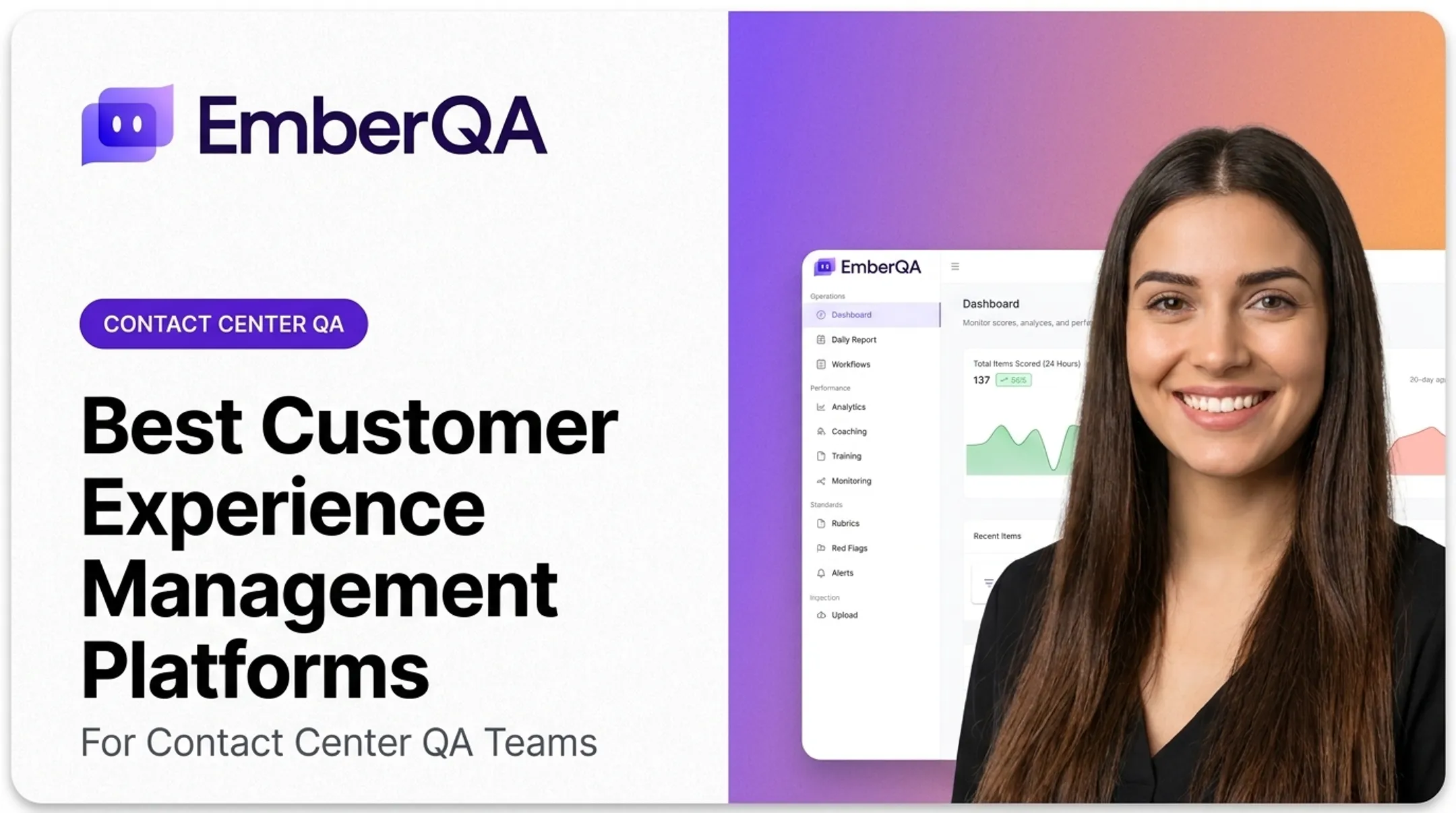
This is the space EmberQA works in. Its AI-powered quality assurance platform analyzes calls, SMS, emails, and documents, scoring every interaction against custom rubrics instead of a small manual sample.
It flags urgent issues like privacy violations or escalation risk, makes calls searchable and comparable, and generates targeted coaching insights from real interactions.
For multi-location operations, that matters. One dental scheduling customer used EmberQA to automatically review 100% of calls across 18 offices, each with its own scheduling process, while verifying CRM entries against what was said on the call. Manual sampling almost never catches that gap: a call outcome that doesn't match the CRM record.

Interaction Analysis Complements, Not Replaces, Surveys
Surveys tell you how customers say they felt. Interaction analysis shows what actually happened in the conversation, including issues customers never bothered to report. Both matter. Neither is complete alone.
Implementation Safeguards Worth Building In
Before scaling AI-driven CXM, put guardrails in place:
- Validate scoring rubrics against real outcomes, not assumptions.
- Define clear escalation thresholds for urgent issues.
- Protect customer data and comply with applicable privacy requirements.
- Maintain human oversight for sensitive or high-risk interactions.
- Audit AI outputs periodically instead of trusting them blindly.
A practical workflow: An AI system flags a recurring issue in collections calls, such as agents skipping a required disclosure. A supervisor validates the pattern, assigns it to team leads, and coaches the affected agents. The team then monitors whether the issue declines over the next review cycle. That's the CXM loop in action: faster, with far more coverage than a manual sample can provide.
Frequently Asked Questions
What is experience management (XM)?
Experience management is the broader discipline of designing, measuring, and improving experiences across stakeholders, including customers, employees, and partners. Customer experience management is the customer-focused branch of that discipline.
What does a customer experience management (CXM) company do?
A CXM company provides strategy, research, feedback collection, analytics, journey mapping, or technology that helps organizations understand and improve customer interactions. Some focus on software, others on consulting, or a mix of both.
What is the difference between CXM and CRM?
CRM manages customer records and relationship activity, like contact history and purchase data. CXM manages the quality and consistency of the actual experience customers have across every interaction.
How do you implement a customer experience management strategy?
Start by defining goals and mapping the customer journey. Collect feedback and interaction signals, prioritize the highest-impact friction points, assign owners, and implement fixes. Then measure whether those changes worked.
What metrics are used to measure customer experience management?
Common metrics include Customer Satisfaction (CSAT), Net Promoter Score (NPS), Customer Effort Score, first-contact resolution, and repeat-contact rate, paired with outcomes like retention, churn, and complaint volume. No single metric tells the whole story, so combine several with qualitative feedback.