The problem is capacity. Nobody can listen to every call. Managers pick a handful, score them, and move on, leaving most conversations unreviewed.
That gap is exactly what phonetic analytics and speech analysis were built to close. These technologies turn recorded conversations into searchable, structured data that contact centers, BPOs, answering services, insurance teams, and financial services organizations can actually use.
The scale of the problem is well documented. McKinsey reported in 2024 that manual QA assessments typically cover less than 5% of total contact-center conversations — meaning the vast majority of interactions go completely unreviewed (McKinsey, 2024).
This article breaks down what phonetic analytics and speech analysis actually are, how they work step by step, and what it takes to make them useful.
Key Takeaways
- Phonetic analytics searches spoken sounds directly; speech analysis combines ASR, NLP, and acoustic signals
- Automated analysis expands QA coverage but still requires human validation for consequential decisions
- Faster red-flag detection, consistent scoring, targeted coaching, and clearer compliance visibility
- Results depend on usable audio, tuned queries, and a real workflow for acting on findings
What Is Phonetic Analytics and Speech Analysis?
Phonetic analytics indexes the sounds, or phonemes, in recorded speech and searches for those sound patterns directly. This matters for names, product terms, or industry jargon that a standard dictionary might not recognize.
Speech analysis is the umbrella term. It covers everything from spotting a specific word to understanding sentiment, talk patterns, and compliance events across an entire conversation.
They solve different parts of the same problem. Phonetic analytics handles sound-level search; speech analysis covers the full conversation.
The Four Main Approaches
| Method | What It Searches | Best For |
|---|---|---|
| Phonetic indexing | Sound sequences, not just recognized words | Names, product terms, pronunciation variants |
| Automatic speech recognition (ASR) | Converts speech to text for searching | Keyword and semantic search across transcripts |
| Natural language processing (NLP) | Text and conversation context | Intent, topic, and sentiment classification |
| Acoustic analysis | Silence, interruptions, pace, vocal energy | Flagging conversational patterns worth reviewing |
Peer-reviewed research from IBM found that phonetic search can retrieve terms outside a recognizer's word dictionary, including new or unusual names (IBM researchers, SIGIR 2007).
The same study also documented higher error rates in phonetic transcripts than word-based ones. That is why IBM's own system combined both methods rather than relying on phonetics alone.
Phonetic analytics is not voice biometrics. Biometrics identifies who is speaking. Phonetic analytics and speech analysis focus on what is being said and how the conversation unfolds.

Where Accuracy Breaks Down
No method is immune to real-world audio conditions. Accents, background noise, poor recording quality, and single-channel calls where both speakers overlap all reduce accuracy for phonetic search and transcription alike.
Language coverage also varies by vendor and language pack. "Supports multiple languages" means different things depending on the platform.
Common Contact Center Use Cases
- Mandatory disclosure detection for regulated industries
- Complaint and cancellation discovery
- Escalation and hostile-behavior identification
- Quality assurance scoring at scale
- Root-cause analysis for repeat contacts
- Fraud or risk review
Why Phonetic Analytics Matters for Contact Centers
Manual sampling was never designed to catch everything. It was designed to catch something, given limited reviewer hours.
Speech analytics changes that math. The same rubric and search logic can run across a much larger share of interactions, supporting human judgment rather than replacing it.
Consistency and Compliance
Automated scoring applies identical criteria across every agent and team, which reduces the reviewer-to-reviewer variation that plagues manual QA. That said, over-relying on automated scores without spot-checking creates its own risk: a false positive treated as fact can misdirect coaching or compliance action.
Speech analysis also flags compliance-critical moments at scale:
- Mandatory phrases and required disclosures
- Prohibited language
- Missing scripts or incomplete call conduct
Recording consent laws vary by state (some require all-party consent). Debt collection, securities, and insurance add their own recordkeeping and call-conduct rules through bodies such as the CFPB, FINRA, and state insurance departments. None of this replaces legal counsel. It does give compliance teams visibility they would not otherwise have.
From Patterns to Coaching
Recurring speech patterns point straight to coaching opportunities:
- Missed discovery questions
- Frequent interruptions
- Weak objection handling
- Incomplete call closures
The key is using representative examples across multiple calls, not a single anecdote that might be an outlier.
Finding Process Problems, Not Just Agent Problems
Sometimes the pattern isn't about the agent at all. A spike in billing confusion across dozens of calls, regardless of which agent handled them, usually points to a process or product issue that no individual agent can fix alone. That's a signal to route upstream, not just coach downstream.

One implementation caveat: analytics only pays off when teams do the operational work around the tool:
- Define clear use cases
- Validate detections against real samples
- Protect sensitive data
- Assign ownership for acting on what the data shows
A dashboard nobody checks doesn't improve anything.
How Phonetic Analytics and Speech Analysis Work – Step by Step
The process moves from a business question to searchable data, validated findings, and operational action. Skipped tuning, poor audio, vague rubrics, and no feedback loop are the usual reasons results disappoint.
Step 1 – Define the Objective
Start with a specific question: Are agents missing required disclosures? Why are cancellations rising? What's driving a particular complaint category? The rubric, call types, and outcome metrics should all trace back to this question.
Step 2 – Collect and Prepare Interaction Data
Gather recordings, metadata, agent identifiers, call outcomes, and CRM records. Recording quality, speaker separation, and secure access controls matter more than most teams expect. A McKinsey case study found that poor single-channel recordings made two speakers hard to distinguish until recording quality improved (McKinsey, 2022).
Step 3 – Index, Transcribe, and Classify Speech
The platform makes calls searchable through phonetic indexing, ASR, NLP, acoustic signals, or a combination. Every detection carries a confidence score. A phrase match at 70% confidence is only a lead to verify. A keyword like "cancel" might appear in "I don't want to cancel" just as often as in an actual cancellation request.
Step 4 – Build and Tune Queries, Rules, or Scorecards
Configure product names, compliance phrases, and red flags for your own vocabulary. Then test against a representative sample, reviewing both flagged and unflagged calls to catch what the system is missing, not just what it's catching.
Step 5 – Interpret Results and Prioritize Actions
Segment results by agent, team, site, or call reason to turn individual detections into real patterns.
AWS's own guidance on AI-assisted evaluation is blunt: automated scoring is not 100% accurate, and generative evaluation shouldn't be trusted to score anything that depends on tone of voice (AWS documentation).
Distinguish an alert requiring immediate review from a trend requiring deeper investigation.
Step 6 – Act, Coach, and Review
Findings should trigger coaching, scorecard updates, or process changes, then get tracked before and after. Language and business processes shift, so queries and thresholds need periodic recalibration.

Practical Example: From Complaint Spike to Coaching Action
A contact center notices rising billing complaints. Here's how the loop typically runs:
- Define the question: why are billing complaints increasing this quarter?
- Locate calls tagged with billing-related language and complaint outcomes
- Identify recurring phrases or patterns across those calls
- Validate a sample: confirm the phrase is used in the intended context, not a false match
- Compare outcomes by team, site, or call type
- Determine whether it's an agent issue or a policy/product issue
If three sites show the same spike regardless of agent, that's a process problem. If it's isolated to a few agents, that's a coaching conversation. Either way, the loop closes with an update to the scorecard or process guidance, targeted coaching where warranted, and a monitoring check to confirm the fix actually worked.
How EmberQA Can Help
EmberQA is built for the gap this article started with: the space between how many calls get recorded and how many actually get reviewed.
EmberQA is not a phonetic engine. It focuses on what teams do with the analysis:
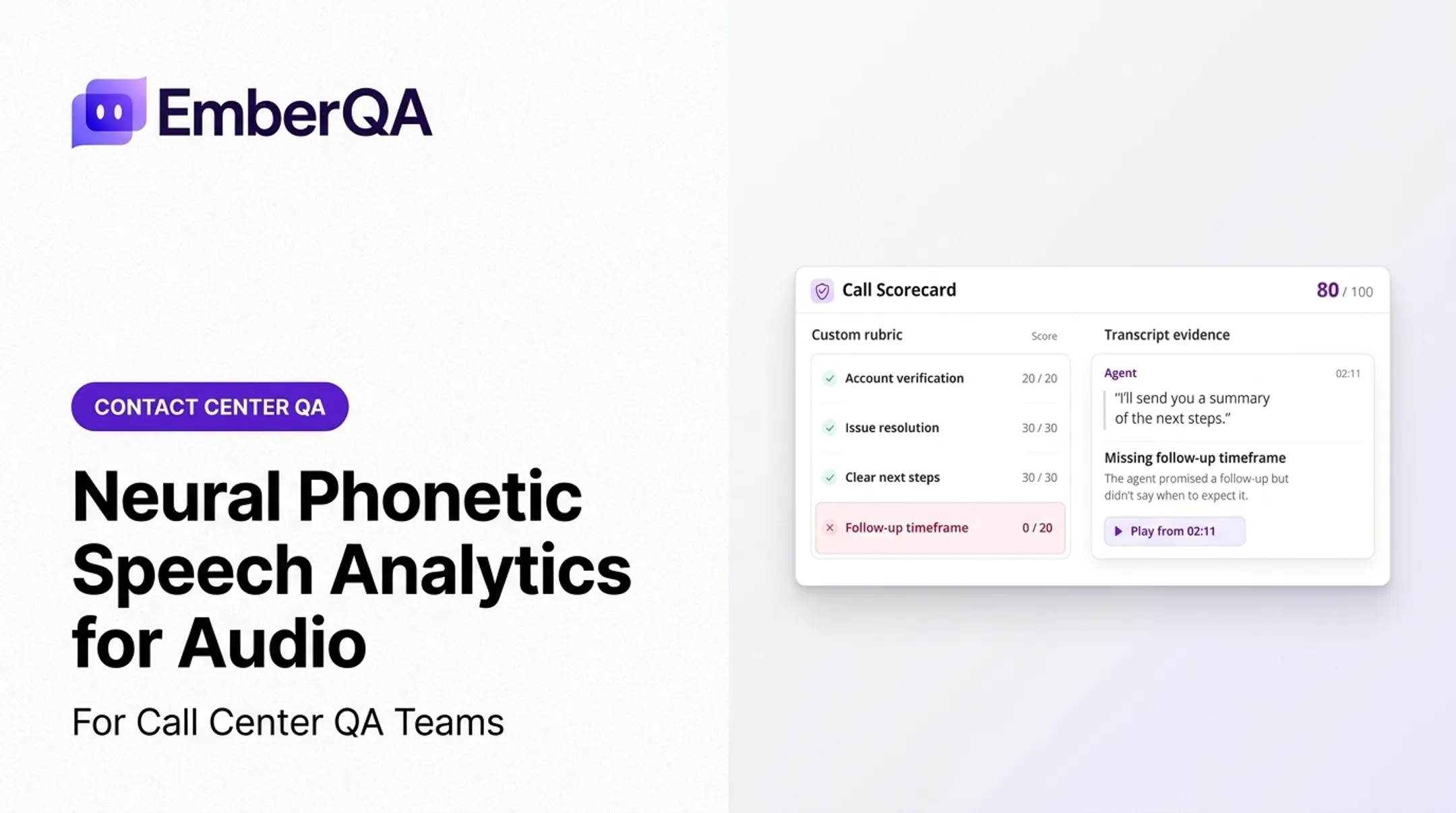
- Automated scoring against custom rubrics — every interaction, not a random sample
- Searchable, comparable interaction data across calls, SMS, emails, and documents
- Red-flag detection for hostile behavior, privacy violations, improper advice, and escalation risk
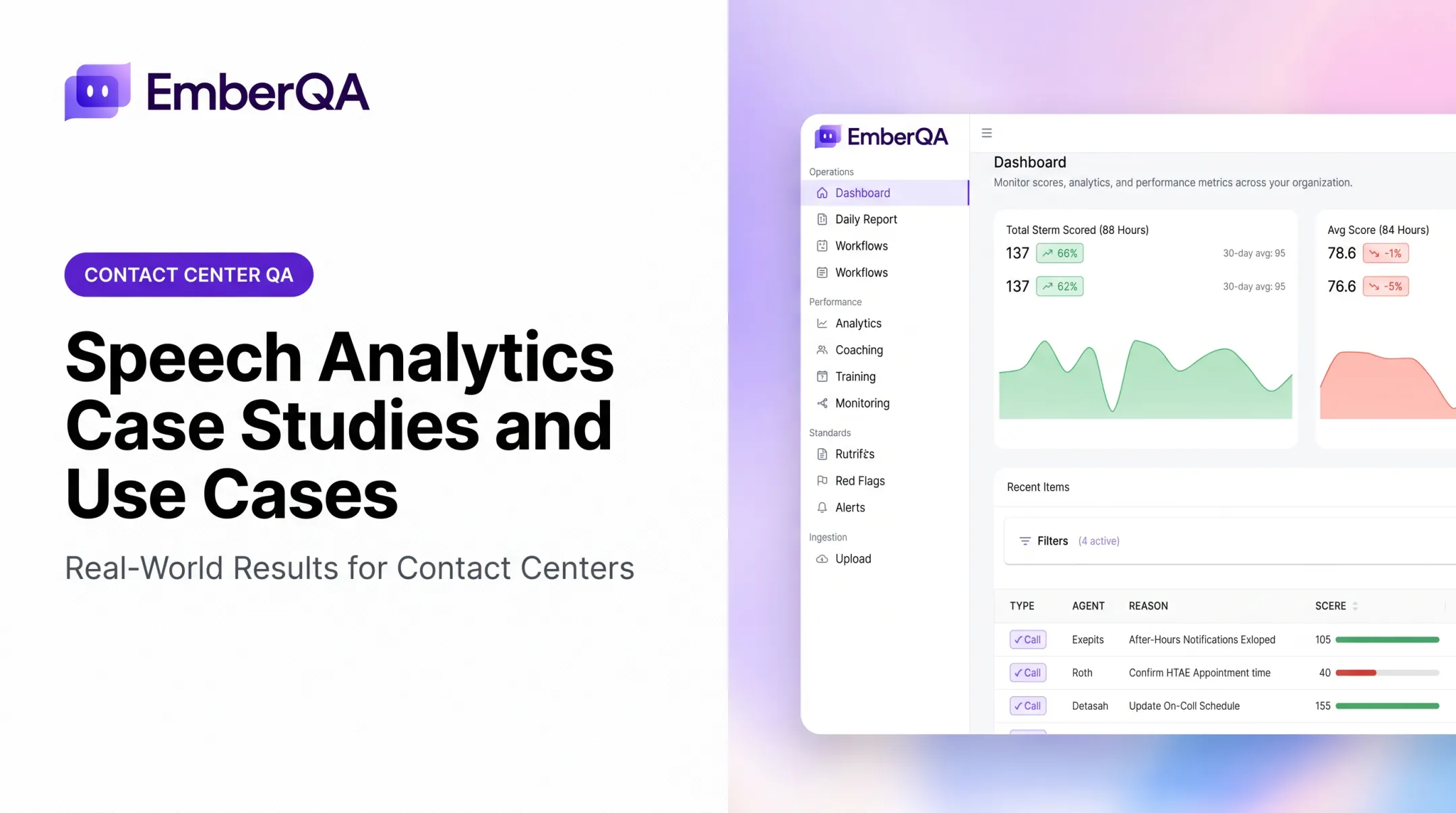
- Performance trend visibility by agent, team, and location
- Targeted coaching recommendations based on recurring patterns and top-performer examples
EmberQA also connects to CRMs, ticketing systems, and dashboards through result webhooks, so QA scores and red flags land wherever supervisors already work.
Those capabilities line up with how different operations run:
- BPOs scoring client program calls consistently and reporting results per client
- Insurance and financial services teams monitoring disclosure and compliance language across every call
- Multi-site contact centers applying one standardized rubric instead of site-by-site variation
- Answering services maintaining quality standards at scale for their clients
Whatever platform you evaluate, EmberQA included, run it against this checklist:
- Audio and data compatibility
- Privacy controls
- Tuning process
- Score explainability
- Integration requirements
- Clear ownership of the workflow once findings come in
Evidence of measurable improvement matters more than the feature list.
Conclusion
Phonetic analytics focuses on the sounds within speech. Speech analysis combines that with ASR, NLP, and acoustic signals to turn conversations into insights about quality, risk, intent, and operational performance.
The value shows up when organizations validate what the technology finds and connect it to real action:
- Consistent scoring across interactions
- Faster response to quality and compliance risk
- Sharper, more targeted coaching
- Process fixes that hold over time
From there, keep the rollout simple:
- Start with one high-value use case.
- Get your data and QA criteria in order.
- Evaluate whether a platform like EmberQA can help you analyze more interactions without adding matching manual review work.
Frequently Asked Questions
What is phonetic speech analytics?
Phonetic speech analytics indexes and searches the sounds, or phonemes, within recorded speech to find relevant words and phrases. It works alongside broader speech analytics methods rather than replacing them.
What are the best tools for phonetic speech analytics?
The right tool depends on your use case, audio sources, language coverage, integration needs, privacy requirements, and support for tuning. Compare documented capabilities directly rather than relying on generic accuracy claims.
What is ASR and NLP?
Automatic speech recognition (ASR) converts spoken language into text. Natural language processing (NLP) then interprets that text or conversation context to identify intent, topics, and sentiment.
How is phonetic analytics different from speech-to-text?
Phonetic analytics searches sound patterns directly, while speech-to-text produces a transcript for text-based search and analysis. Many modern platforms combine both approaches rather than choosing one.
How can contact centers use speech analysis for quality assurance?
Teams use it for automated scorecard checks, compliance phrase detection, red-flag identification, and trend discovery across large call volumes. Managers should still validate high-impact findings through representative call review.