This isn't about memorizing word-for-word scripts. Rigid lines fall apart the moment a customer asks an unexpected question. Instead, this guide provides adaptable insurance sales role-play frameworks. You’ll find scenarios for prospecting, discovery, handling objections, and following up—all designed to help your agents build the confidence and skill to navigate any conversation naturally and effectively.
Key Takeaways
- An effective insurance script is a flexible framework for conversation, not a rigid monologue. It should guide agents through permission-based openings, discovery, and clear explanations.
- Role-plays must simulate real-world pressure. Scenarios should include rushed prospects, budget concerns, resistance to providing information, and questions about competing quotes.
- Evaluate both sales effectiveness and compliance behaviors. This includes checking for accurate product descriptions, necessary disclosures, correct licensing language, and proper documentation.
- Record practice sessions to identify recurring patterns. Coach agents on one specific behavior at a time instead of trying to fix everything at once.
What Makes an Insurance Sales Script Effective?
The most successful insurance teams don't use "scripts" in the traditional sense. They use flexible frameworks that empower agents to listen and adapt.
Here’s the difference:
- Word-for-word script: Rigid text read verbatim. Sounds robotic and blocks real listening.
- Talk track: Key points for a scenario, such as a price objection. Better, but can still feel disconnected.
- Role-play framework: Conversational guide with prompts, open-ended questions, and transition language. Structure and compliance guardrails stay in place while agents personalize the interaction.
A strong conversation framework follows a logical flow. It moves from establishing trust to providing a solution that fits the prospect’s needs.
The basic flow includes:
- Permission-based opening: Confirm why you're calling and ask if it's a good time.
- Rapport and discovery: Build a connection and ask questions to understand their situation.
- Coverage presentation: Explain the options that align with their stated needs.
- Objection handling: Address concerns with empathy and clarity.
- Decision or next step: Ask for the business or agree on a clear follow-up.
- Follow-up and documentation: Send a summary and document the interaction.
Beyond the words, tone and pacing matter as much as the framework.
Strong delivery habits include:
- Plain language instead of product jargon
- Reflective listening ("So what I'm hearing is…")
- Permission checks before going deeper ("Would it be okay if I asked a few questions about your current situation?")
Those habits help agents cover sensitive financial topics without sounding aggressive or misleading.
Insurance Sales Role-Play Scripts and Scenarios
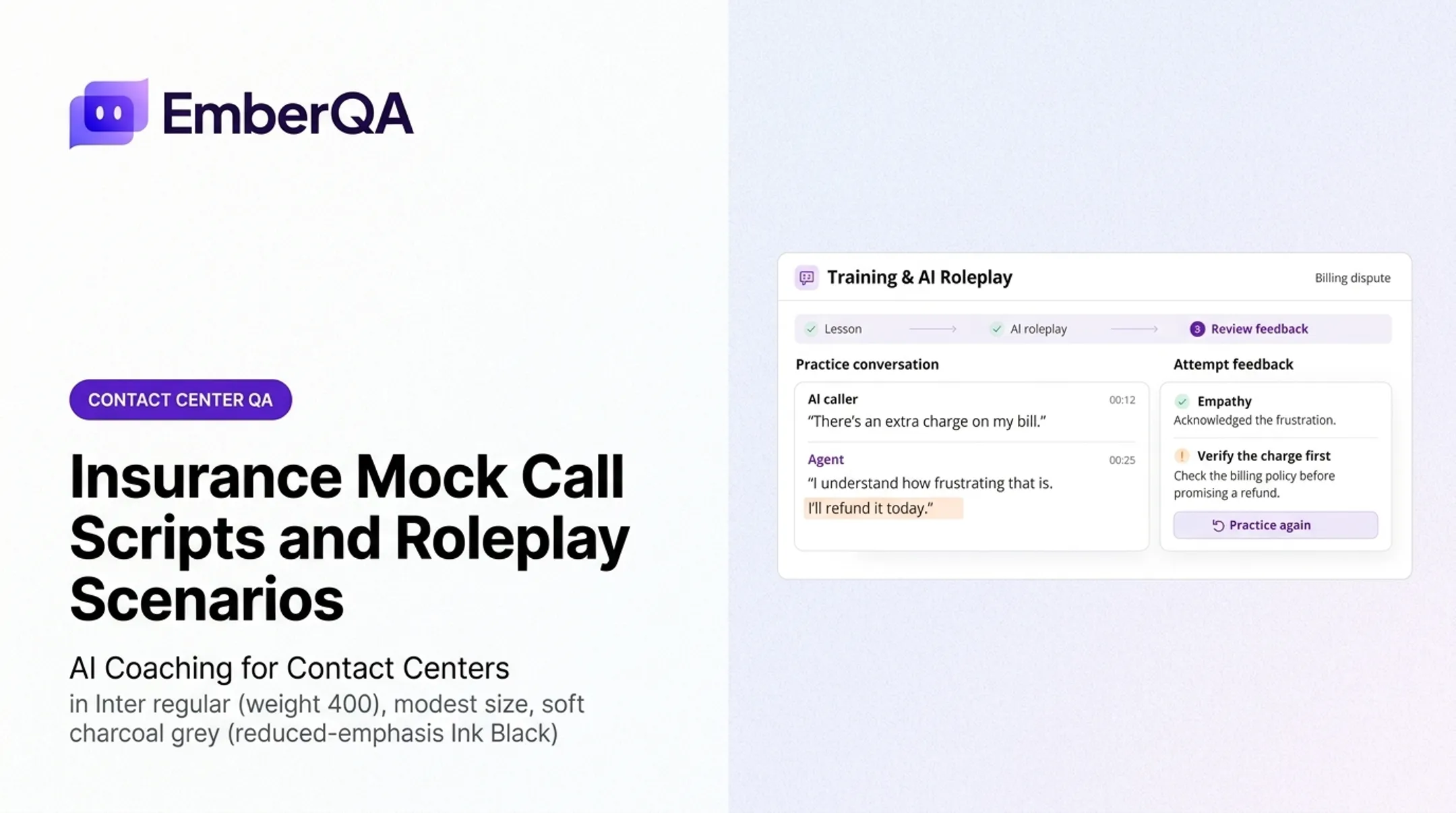
Use these scenarios as a starting point so agents can focus on the customer, not on their next line. Have a teammate play the "prospect" with different attitudes to test adaptability. Pair live practice with scored role-play and coaching review so managers can see which talk tracks hold up under pressure.
Scenario: Cold or Warm Lead Opening
Context: The agent is calling a lead who submitted an online form for a life insurance quote.
- Agent Opening: "Hi, [Prospect Name]. This is [Agent Name] with [Agency Name]. I'm following up on the request you submitted on our website for a life insurance quote. I can share that with you, and I have a few questions to make sure it’s accurate. Is now a good time to talk for about 5-10 minutes?"
Prospect Variations:
- Rushed Prospect: "I'm really busy right now, can you just email it to me?"
- Agent Response: "I can email it. To make sure the quote is accurate, could I ask two quick questions? It should take about 60 seconds."
- Skeptical Prospect: "I filled out five of those forms. What makes you different?"
- Agent Response: "That's a fair question. I can give you the price and a plain-English read on what it covers so you can compare options clearly. Would that help?"
- Interested Prospect: "Yes, now is a good time."
- Agent Response: "Great. To start, what prompted you to look for life insurance at this time?"
Scenario: Needs Discovery Before Recommending Coverage
Context: The prospect has agreed to talk. The agent needs to understand their situation before making a recommendation.
Agent Discovery Questions:
- "To make sure I recommend the right coverage, could you tell me a bit about what you're looking to protect? For example, are you focused on income replacement, mortgage protection, or final expenses?"
- "Who depends on you financially right now?"
- "Do you have any existing life insurance coverage through your employer or another policy?"
- "When you think about the future, what are your biggest financial concerns?"
Agent Summary: "Okay, thank you for sharing that. So, if I understand correctly, you're a homeowner with two young children, and your main priority is ensuring your mortgage is paid off and there's enough income to support your family for at least 10 years if something were to happen to you. Did I get that right?"
Scenario: Affordability Objection
Context: The agent has presented a quote, and the prospect is hesitant about the price.
- Prospect: "That costs more than I was expecting. I don't think I can afford that."
- Agent Response: "I appreciate you saying that. Budget matters. Before we change anything, does the coverage itself match the protection you wanted?"
- Prospect: "Yes, it covers what I need, but the price is just too high."
- Agent Response: "Got it. We can adjust the coverage amount or term to land closer to your budget. Want to look at two options side by side?"
Scenario: "I need to talk to my spouse/partner."
Context: The prospect is interested but needs to consult with another decision-maker.
- Prospect: "This all sounds good, but I need to talk it over with my spouse before I make a decision."
- Agent Response: "That makes sense—these decisions are better made together. What would help your spouse most: a short summary of price and coverage, or a quick call with both of you?"
- Prospect: "Just the price and what it covers."
- Agent Response: "Perfect. I'll email a one-page summary of the options we discussed. If useful, we can also book a brief 15-minute call with both of you."
Scenario: Required Disclosure or Compliance Resistance
Context: The prospect is impatient and wants the agent to skip mandatory compliance language. (This is especially relevant for annuity sales).
- Prospect: "Can we just skip all this legal stuff and get to the price?"
- Agent Response: "I get wanting the bottom line fast. I’m required to cover a few points so you understand how the product works and my role as an agent—it’s for your protection. It takes about a minute, then we can go straight to the numbers."
- (If pressure continues): "State rules require me to cover these points before I can quote. If now is tight, we can schedule a follow-up when you have a few minutes to go through it properly."
Scenario: Follow-up After a Quote
Context: The agent sent a quote two days ago and hasn't heard back.
Phone/Voicemail: "Hi [Prospect Name], it's [Agent Name] following up on the insurance quote I sent on Tuesday. I just wanted to check if you had any questions. You can call or text me back at [Your Number]. Thanks!"
Email:
- Subject: Following up on your insurance quote
- Body: "Hi [Prospect Name], Just a quick follow-up to see if you had a chance to review the quote I sent. Let me know if you have any questions or would like to review different options. Best, [Agent Name]"
Opt-In Text Message: (Requires prior express written consent for marketing messages)
"Hi [Prospect Name], [Agent Name] here. Following up on the life insurance quote we discussed. Any questions? Reply STOP to unsubscribe."
Include a clear opt-out path. According to the FCC, consumers must have a clear way to opt out of marketing communications.

How to Build an Insurance Sales Role-Play Script
Creating effective role-play scenarios is a strategic process. Each scenario should function as a targeted training exercise built around one skill.
Start with the Training Objective: What specific skill do you want to improve? Don't try to fix everything at once. Focus on one area per exercise, such as:
- Improving call openings.
- Asking better discovery questions.
- Handling the price objection.
- Executing compliance disclosures under pressure.
- Securing a concrete next step.
Define the Characters and Context: Give the role-play a realistic backstory.
- Insurance Line: Life, P&C, Annuity, Medigap?
- Lead Source: Inbound web lead, cold call, referral?
- Customer Profile: Young family, pre-retiree, small business owner?
- Known Concern: Are they price-shopping, confused about coverage, or recovering from a bad experience?
- Communication Channel: Phone call, video meeting, text exchange?
Write the Dialogue in Stages: Structure the script around the core parts of a sales conversation. For each stage, include optional prospect replies so the agent must listen and react—not wait for a turn to speak.
- Opening and rapport
- Discovery questions
- Coverage recommendation
- Objection handling
- Close and next step
Add Compliance Guardrails: Before finalizing, research the rules that apply to the scenario. This is non-negotiable in the insurance industry.
- State-specific disclosure obligations (such as annuity suitability rules).
- Carrier requirements and product-specific language.
- Licensing boundaries (what an unlicensed assistant can and cannot say).
- Consent rules for calls and texts (TCPA).
- Prohibited promises (such as guaranteeing returns on non-guaranteed products).
Attach a Scoring Rubric: Define what "good" looks like. A rubric with observable behaviors makes feedback objective and consistent. Your rubric should measure things like:
- Did the agent ask relevant, open-ended questions?
- Did they accurately summarize the customer's needs?
- Did they avoid unsupported claims or guarantees?
- Did they handle objections respectfully?
- Were all required disclosures completed accurately?
- Did they secure a clear and appropriate next step?

Platforms like EmberQA allow you to build these custom scoring rubrics directly into your quality assurance system, applying them automatically to every role-play recording and live call.
How to Run Insurance Role-Plays and Turn Practice Into Coaching
Practice only leads to improvement when it’s paired with targeted feedback. A structured approach turns role-play exercises into coaching opportunities. One LIMRA case study found that trainees who underwent a comprehensive training program sold 27% more policies than their non-participant colleagues.
Use a Repeatable Exercise Format
A consistent format helps agents focus on the skill, not the process.
- Brief: Give the agent and the "prospect" their context and objectives.
- Run: Let the conversation play out without interruption.
- Review & Re-do: Replay challenging moments and let the agent try again.
- Debrief: Focus feedback on one or two priority behaviors from the scoring rubric.
Progressively increase the difficulty. Start with a straightforward scenario and then add layers of realism, such as time pressure, a spotty phone connection, competing quotes, or a prospect who is emotional or confused.
Ask Effective Debrief Questions
Go beyond "good job." Ask questions that encourage self-correction:
- "Where in the call did you first sense the prospect's concern about affordability?"
- "Which question revealed their most important priority?"
- "Did the recommendation you made directly match the needs they described?"
- "Was any required compliance language rushed, or did it sound like you were reading?"
Turn Practice into Performance
Analyzing role-plays and live calls reveals patterns that manual reviews often miss. Analysis of over 300,000 sales calls found that on winning calls, sellers talked 57% of the time, versus 62% on lost deals. Are your agents talking more than they listen?

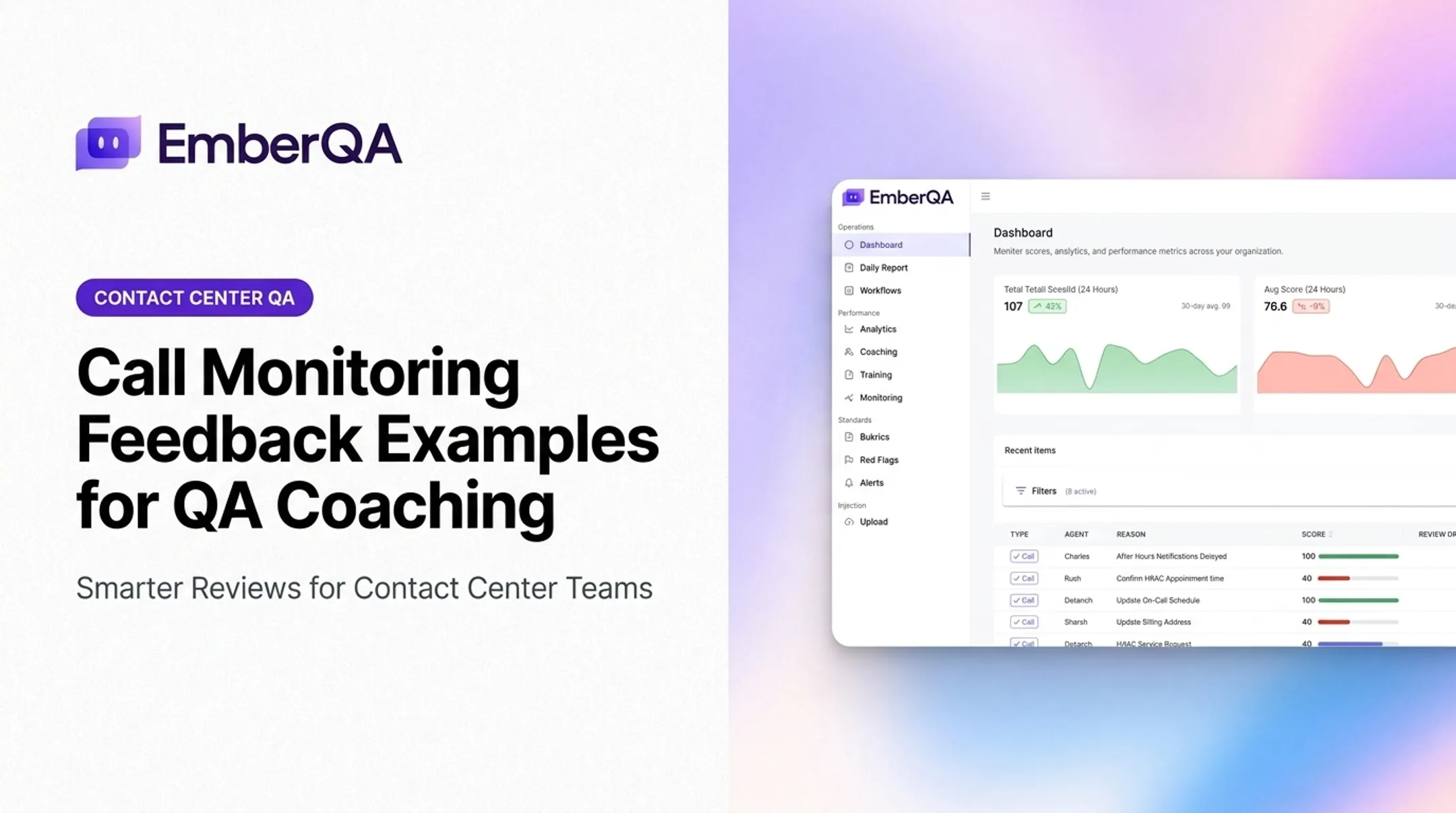
Instead of manually reviewing a tiny fraction of calls, EmberQA scores role-plays and live work against your rubric so coaching tracks real behavior. The platform can:
- Analyze role-plays and live customer calls, chats, and emails
- Apply your custom QA rubric consistently across every agent
- Surface red flags like missed disclosures, unapproved language, or customer frustration in real time
- Turn recurring patterns into targeted coaching recommendations for each agent
Connect practice to performance data and you see which behaviors drive closed policies—then coach to those. Always validate specific compliance criteria with your legal, compliance, or state-level resources.
Common Insurance Sales Script Mistakes and How to Improve Them
Even with a great framework, agents can fall into bad habits. Here are some common mistakes and how to fix them.
- Leading with product features: Jumping into policy details before learning the prospect's needs. Require discovery questions before any recommendation in your script framework.
- Talking through objections: Interrupting and arguing instead of listening. Coach Acknowledge–Clarify–Respond: acknowledge the concern, ask what sits behind it, then answer.
- Using guarantees or unsupported claims: Promising "the cheapest rate you'll find" or guaranteeing investment returns. Keep a "do not say" list in training, and use EmberQA red-flag detection to catch prohibited words and phrases on calls.
- Treating compliance as optional: Rushing or skipping disclosures to reach the sale. Score disclosures as non-negotiable in your role-play rubric, and practice scenarios where prospects ask to skip them.
- Ending without a clear next step: Closing on a vague "I'll get back to you." Script specific closes such as "What would be a good next step for you?" or "Can we schedule a follow-up Thursday morning to review this with your partner?"
When you spot a problem, test one change at a time. Update a single part of your talk track and measure its impact across comparable conversations.
Pair role-play scores with live call reviews in EmberQA and conversion data. That mix shows whether you have a simple wording problem or a deeper training issue.

Frequently Asked Questions
What are some catchy phrases for selling insurance?
Strong phrases put the customer first, not the close. Try: "Let's make sure you have clarity on exactly what this policy does." Check every line against carrier and state rules before you use it.
Can you give examples of insurance sales role-playing scenarios?
Practice the moments that stall deals: first contact, needs discovery, price pushback, "I need to talk to my spouse," compliance resistance, and quote follow-up by phone, email, or text.
What is an example script for an insurance text message?
Keep opt-in texts short and identified. Example: "Hi [Customer Name], it's [Agent Name] from [Agency]. Following up on the quote we discussed. Any questions? Reply STOP to opt out." Meet consent, ID, and record-keeping rules every time.
How do you role-play insurance sales objections?
Give the prospect one clear objection—price, timing, or need—and let the agent respond without interruption. Score listening, acknowledgment, accuracy, and respect with a simple rubric afterward.
How can insurance agents practice compliance during sales calls?
Use realistic role-plays that test an agent's ability to deliver required disclosures under pressure. Create scenarios where a prospect is impatient or asks them to skip details. Review recordings against a checklist of current state, carrier, and internal compliance rules.
Should insurance sales scripts be read word for word?
Usually no. Treat scripts as flexible frameworks with prompts and talking points so agents can listen and personalize. Read mandatory disclosures word for word when regulations require it.