Introduction
AI is no longer a side project inside US insurance carriers. It now touches customer service calls, underwriting submissions, claims files, fraud alerts, and the paperwork that used to pile up on an adjuster's desk.
In Deloitte's 2025 survey, 76% of insurer respondents said they'd implemented generative AI in at least one business function (Deloitte, 2025). That result shows AI has moved from pilot to production for the industry's early movers.
That adoption creates a real operational problem. Insurance teams manage high interaction and document volumes, manual review processes, and strict compliance rules, all while being expected to improve service without adding headcount.
"Best AI insurance software" isn't one product category. A fraud-detection tool won't help a QA manager score licensed sales calls, and a document-intake platform won't investigate a suspicious claim.
This guide compares leading AI insurance software by use case, then covers how to evaluate security, integration, explainability, human oversight, and measurable outcomes.
Key Takeaways
- Match tools to the use case—contact-center QA, underwriting, claims, fraud, and documents need different platforms
- Prioritize insurance workflow fit, auditability, and core-system integration over a long AI feature list
- EmberQA fits insurance contact centers that need automated scoring, red-flag alerts, and compliance monitoring
- Validate vendor claims on your own data and define success metrics before you sign
Overview of AI Insurance Software in the US Insurance Market
AI insurance software applies machine learning, natural language processing, computer vision, generative AI, predictive analytics, and workflow automation to specific insurance operations. In the US market, that broad label covers very different tools with different compliance and integration needs.
Most products fall into one or more of these categories:
- Customer and contact-center automation: call and chat handling, virtual assistants, interaction analysis
- Quality assurance and compliance monitoring: scoring agent interactions against rubrics and regulatory requirements
- Underwriting and risk assessment: scoring submissions, predicting loss, prioritizing risk
- Claims processing: intake, triage, adjudication support, exception handling
- Fraud detection: flagging suspicious claims, policies, or billing patterns
- Document intelligence: extracting and validating data from applications, loss runs, and scans
Some tools are point solutions built for a single workflow, like a claims-fraud model. Others are orchestration platforms that connect multiple systems and route work between AI and human reviewers. Neither approach is automatically better. The right choice depends on the problem you're solving.
Before comparing vendors, check four things:
- Industry fluency: does it understand US insurance terminology, documents, and regulatory context, or was it repurposed from a generic AI product?
- Explainability: can it show why it flagged, scored, or recommended something?
- Data handling: how is sensitive customer and claims data stored, retained, and secured to meet carrier and state requirements?
- Integration depth: does it connect to your policy administration system, claims platform, CRM, telephony, or agency management software?

The products below are organized by their strongest use case, not treated as interchangeable options. Capabilities, pricing, and availability change quickly, so verify current details directly with each vendor.
Top AI Insurance Software by Use Case
Each platform below has a clear strength, and none claims to do everything. Insurance operations are specialized enough that a single "best" tool rarely exists.
| Platform | Best For | Primary Workflow |
|---|---|---|
| EmberQA | Contact-center QA and compliance monitoring | Interaction scoring, red-flag alerts, coaching |
| Kognitos | Enterprise claims workflow orchestration | Document intake, exception handling, routing |
| V7 Go | Document processing and underwriting intake | Extraction, classification, validation |
| Shift Technology | Fraud detection and investigation support | Anomaly detection, investigator workbenches |
| Gradient AI | Specialized underwriting and risk assessment | Risk scoring, loss prediction, triage |
EmberQA: Best AI Quality Assurance Software for Insurance Contact Centers
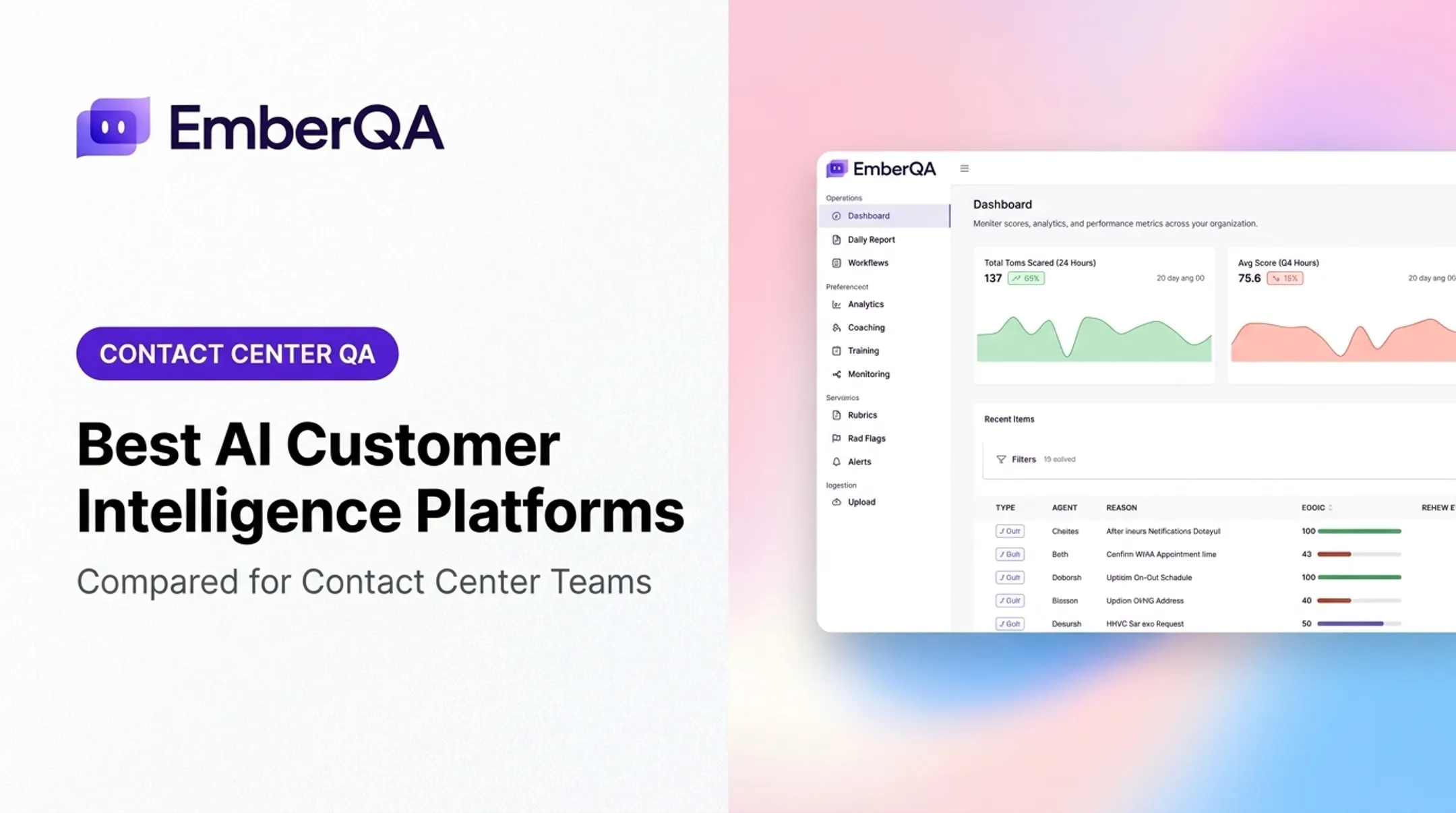
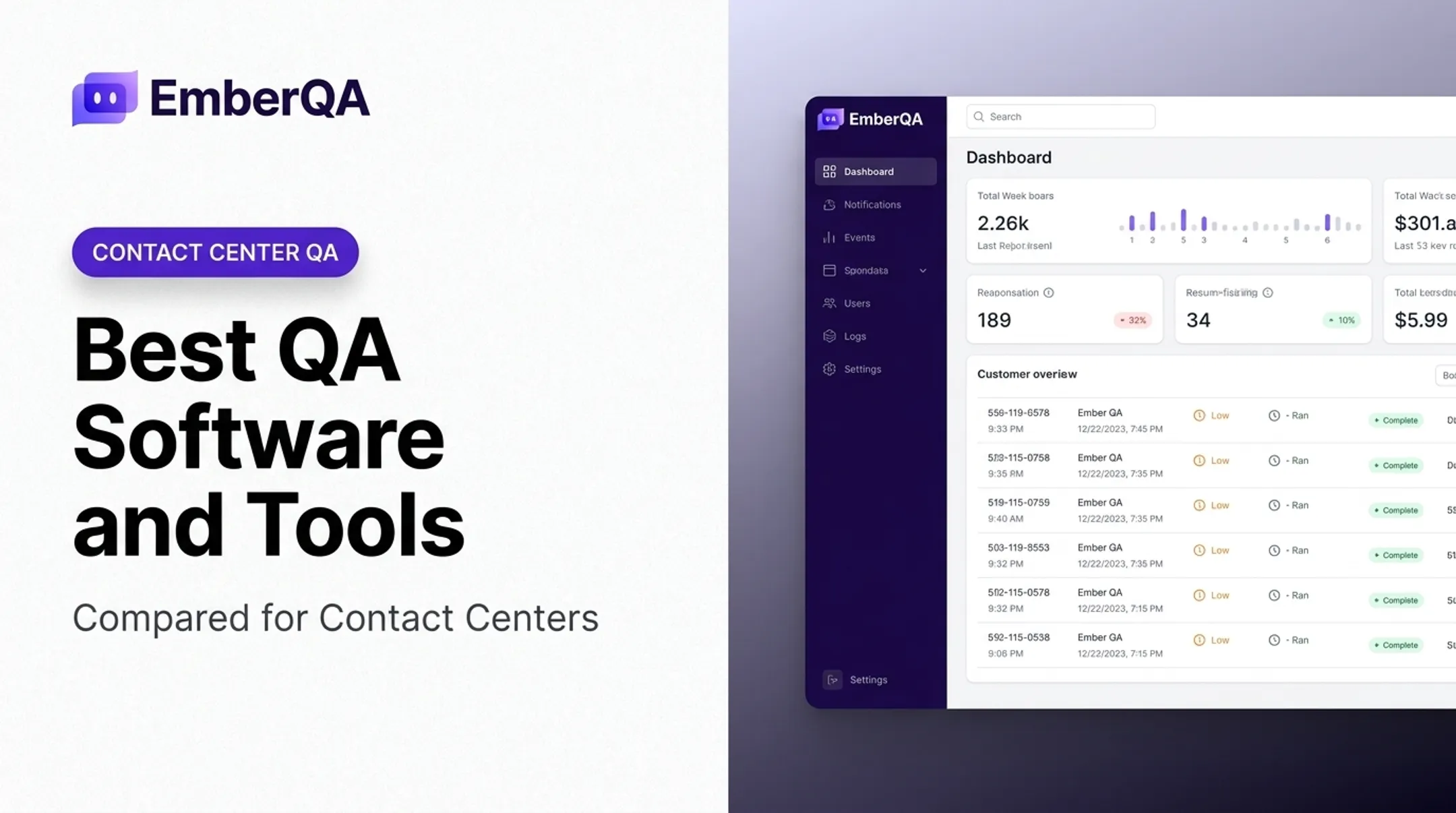
EmberQA is an AI-powered quality assurance platform built for call and contact-center teams. That includes insurance carriers, agencies, and answering services handling licensed sales, service, and claims calls.
Instead of a manager sampling a handful of calls a month, EmberQA scores every recorded interaction against a scorecard built for the organization.
Key capabilities:
- Automated scoring against custom QA rubrics, metrics, and weights
- Red-flag detection that alerts supervisors to improper advice, privacy violations, escalation risk, or hostile behavior (available on the Pro plan)
- Searchable, comparable interaction data, so managers pull transcripts, recordings, and score explanations instead of guessing at patterns
- CRM verification, comparing what was said on a call against what's logged in the CRM to catch documentation gaps
- Office-specific QA workflows, useful for multi-location carriers and agencies with different regional requirements
- Coaching insights that turn recurring issues into targeted agent coaching, backed by CSV exports and PDF trend reports
This makes EmberQA a fit for licensed sales, service, claims, answering-service, and BPO teams that need broader QA coverage and more objective scoring than manual sampling allows. It's not built for underwriting or claims adjudication itself.
Before you buy, confirm: supported interaction channels, telephony and CRM integrations, data retention controls, implementation timeline, and security documentation.
EmberQA publicly lists Essentials at $49 per agent/month and Pro, which adds red-flag alerts and white-glove onboarding, at $89 per agent/month. Verify current rates directly.
Kognitos: Best for Enterprise Claims Workflow Orchestration
Kognitos is an enterprise automation platform for claims operations that need document intake, workflow execution, exception handling, and human-in-the-loop review tied to downstream systems.
In a published demo, Kognitos ingests a pet-insurance claim from email, extracts the data, and pushes it into Salesforce. A human resolves a terminology mismatch through plain-English instructions rather than code.
That's a useful illustration, but it's a vendor demonstration, not a measured production result. Its strongest fit is likely complex, exception-heavy claims and back-office workflows rather than contact-center QA or standalone underwriting.
What to verify:
- Claims-specific capabilities: which lines of business and claims types are actually supported
- System connectivity: Kognitos lists 130+ integrations, including Salesforce, SAP, and ServiceNow
- Audit trails and explainability for regulated claims decisions
- Security certifications: its trust center references SOC 2 Type 2 and ISO 27001:2022; confirm current, accessible reports
- Configuration effort: whether setup requires vendor services, in-house development, or both
Limitation: No independently validated insurance claims-processing benchmark was available at the time of research. Ask for customer references specific to your claims type.
V7 Go: Best for Insurance Document Processing and Underwriting Intake
V7 Go targets the document-heavy front end of underwriting and claims: PDFs, scans, images, emails, applications, and handwritten notes. It extracts, classifies, summarizes, and validates submission data, such as loss runs, property schedules, and inspection reports, before a human underwriter makes a decision.
V7 lists support for common file types (PDF, DOCX, XLSX, CSV, JPG, PNG) and a directory of 400+ application connectors. Its trust center references SOC 2 Type 2 and ISO 27001.
On results: V7's Trent-Services case study describes a UK insurance third-party administrator that expected claims capacity per assessor to rise from roughly 15 to 20 daily, adding about 30 claims daily across six assessors. That's a projected outcome during an ongoing rollout, not a completed measurement.
G2 also showed zero reviews specifically for V7 Go at the time of research, so ask for references before assuming that figure applies to your operation.
Limitation: Document intelligence handles the intake layer. It doesn't independently price a policy, adjudicate a claim, or complete compliance review. A human still owns that decision.
Shift Technology: Best for Insurance Fraud Detection and Investigation Support
Shift Technology builds fraud-focused AI specifically for insurance: claims fraud, policy misrepresentation, and health-plan fraud, waste, and abuse. Its models analyze relationships, historical behavior, anomalies, and documents to prioritize which cases an investigator should look at first, rather than making the fraud determination itself.
Fraud detection matters at scale. Deloitte cites an industry estimate that roughly 10% of US property and casualty claims involve fraud, tied to an estimated $122 billion in annual losses (Deloitte, 2025). Manual review alone struggles to keep pace with that volume.

Shift integrates directly into core claims systems, including a Guidewire ClaimCenter accelerator and a Duck Creek Claims partnership. Suspicious claims route to special investigation units with fraud scores and reason codes attached. Shelter Insurance went live on Shift's claims fraud detection for auto and property lines in 2025, though the announcement didn't publish independently measured results.
What to verify:
- Which lines of business and claims systems are actually supported
- How alerts are explained to investigators
- Model governance and bias-testing documentation
Limitation: Fraud detection complements, but doesn't replace, claims intake, document processing, adjudication, or contact-center QA.
Gradient AI: Best for Specialized Underwriting and Risk Assessment
Gradient AI focuses on risk scoring, underwriting decision support, and loss prediction for group health, P&C, and workers' compensation lines, serving carriers, MGAs, and PEOs. The goal is supporting underwriters with consistent data analysis, not replacing their judgment on complex or regulated decisions.
Gradient's April 2025 workers' comp release describes training data built from tens of billions of dollars in premium data plus proprietary and third-party signals. The company states its models can explain key risk drivers in plain language, which matters for fairness reviews.
On results: Gradient's own release attributes to early adopters a 5-point loss-ratio improvement, 80% faster quote turnaround, and 6% more bound premium. These are vendor-reported figures without a disclosed independent evaluation.
Maine insurer Community Health Options adopted Gradient's risk-management platform for underwriting and renewals in 2025, according to trade press, without a published measured outcome.
What to verify:
- Which specific lines of business the model was trained on
- Data sources and fairness-testing methodology
- Integration method (Gradient describes APIs) and implementation timeline
Limitation: Model performance varies by line, data quality, and portfolio. Validate against your own historical data before deployment.
How We Chose the Best AI Insurance Software
We compared these platforms by demonstrated use case and business outcome, not by marketing copy or how many "AI-powered" features appear on a pricing page.
Insurance-specific workflow fit
A platform needs to understand insurance terminology, document types, interaction types, policy rules, claims processes, and licensing requirements, not just generic customer service or document AI.
We matched each product to one defined workflow and scored it against that job specifically:
- Interaction QA
- Submission intake
- Fraud investigation
- Underwriting triage
- Claims processing
Integration, implementation, and scalability
We looked at how each tool moves data in and out of existing systems:
- APIs and pre-built connectors
- Telephony and CRM connections
- Compatibility with policy and claims systems
A tool that can't reach your system of record adds a manual step instead of removing one. We also weighed implementation effort (training, configuration, and support model) against the vendor's ability to handle growing volume.
Security, governance, and human oversight
We checked for encryption, access controls, data retention policies, audit logs, and independently verifiable certifications like SOC 2 or ISO 27001. A vendor's own security description was not enough on its own.
The NAIC's 2023 AI Model Bulletin calls on insurers to maintain written AI governance programs, conduct third-party due diligence, and preserve meaningful human oversight of AI-influenced decisions (NAIC AI Model Bulletin (2023)).

That framework matters here. Human review, escalation rules, explainable outputs, and documented approval controls aren't optional extras when AI touches underwriting, claims, customer treatment, or agent performance evaluations.
Measurable business value
We prioritized platforms with a clear path to measurable outcomes over generic ROI claims:
- QA coverage and scoring consistency
- Critical-error detection
- Claim cycle time and quote turnaround
- Fraud-investigation yield
Where a vendor cited a specific number, we noted whether it came from an independent benchmark or a vendor-published case study. Those aren't the same thing.
Conclusion
There's no single best AI insurance software. The right platform depends on your highest-value workflow, risk profile, current technology stack, data readiness, and how much human oversight a given decision requires.
Start by naming your bottleneck:
- Call and document review stuck on small samples
- Claims files trapped in manual routing
- Fraud alerts you can't investigate fast enough
- Underwriting submissions piling up
That answer points toward the right category above.
From there:
- Shortlist two or three use-case-specific platforms
- Run a controlled pilot using representative US insurance data
- Verify integration and governance requirements against your actual systems
- Measure results against a documented baseline, not a vendor's projected numbers
If your bottleneck is contact-center quality—especially licensed sales, service, or claims calls with compliance risk—evaluate EmberQA. Compare its automated scoring, red-flag detection, searchable interaction analysis, and CRM verification against the manual sampling process you run today.
Frequently Asked Questions
How can AI be used in insurance?
AI is used across service, contact-center QA, underwriting, claims intake, document processing, fraud detection, quoting, compliance monitoring, and workflow automation. High-impact decisions, such as denying a claim, still need human oversight.
Is AI insurance software legitimate?
Yes, it's a legitimate and growing technology category, but legitimacy varies by vendor. Validate accuracy claims, data practices, security controls, regulatory fit, and human-review procedures before deploying any platform.
What is the best AI insurance software?
There isn't one universal answer—match the tool to the job. EmberQA for contact-center QA and compliance monitoring; Kognitos for claims orchestration; V7 Go for document intake; Shift Technology for fraud investigation; and Gradient AI for underwriting risk assessment.
What should insurers look for in AI software?
Look for insurance-specific functionality, real integrations with core systems, verifiable security certifications, explainable outputs, human-oversight controls, and defined success metrics, not just a long feature list.
Can AI insurance software integrate with existing insurance systems?
It depends on the vendor and your systems. Verify available APIs, pre-built connectors, data synchronization, access controls, and testing requirements before committing to a platform.
How can AI improve quality assurance in insurance contact centers?
AI can score every interaction instead of a small sample, apply consistent rubrics, flag compliance issues, verify CRM records against what was said, and route complex judgment calls to a human supervisor.