Introduction
Every call center manager knows the feeling: call volume spikes without warning, three agents call in sick, and the queue starts climbing before anyone can react. Customer demand rarely arrives on a predictable schedule, but staffing does — or at least it should.
Workforce management (WFM) turns that daily scramble into a repeatable process. Instead of guessing how many agents to schedule based on last month's gut feeling, WFM uses historical data, forecasting models, and real-time monitoring to match staffing with actual demand.
This guide covers what WFM involves, how the process works day to day, why it matters to your bottom line and your agents, and what to look for in WFM technology, including how it connects with quality assurance.
Key Takeaways
- WFM ties forecasting, capacity planning, scheduling, intraday adjustments, and performance measurement into one operating loop.
- Effective WFM balances service levels, labor costs, agent well-being, and compliance at the same time.
- WFM software delivers the most value when it links accurate data with flexible scheduling and real-time visibility.
- Quality assurance data shows whether staffing decisions produce effective customer interactions.
What Is Call Center Workforce Management?
Call center WFM is the discipline of making sure the right number of agents, with the right skills, are working at the right times to meet expected demand. That applies whether you're staffing inbound phone queues, outbound sales campaigns, live chat, email, or SMS support.
WFM overlaps with HR and quality assurance in a contact center, but each function owns a different job:
- WFM manages demand forecasting, staffing capacity, schedules, adherence, and operational performance.
- HR handles recruiting, compensation, benefits, and broader employment policy.
- QA evaluates whether interactions were handled well and compliantly — it doesn't determine whether you had enough people scheduled to answer them.
Industry frameworks like SWPP's certification standards draw this line clearly. WFM competencies focus on forecasting, staffing calculations, schedule construction, and intraday monitoring, separate from coaching or interaction review.
Who's Involved in WFM
A functioning WFM process usually involves several roles working together:
- Workforce planners who build forecasts and staffing models
- Real-time analysts who monitor intraday performance
- Supervisors managing frontline coverage and adherence
- Operations leaders setting service-level goals
- HR and finance, who weigh in on hiring timelines and budget
- Agents themselves, through self-service and shift preferences
WFM gets harder as operations scale. Add multiple channels, remote agents, specialized skill queues, several client contracts, or regulatory requirements, and a simple spreadsheet stops being enough. At that point, teams need purpose-built WFM processes and tools—not another shared spreadsheet.
How Does Call Center WFM Work?
WFM runs as a continuous cycle rather than a one-time scheduling task. Teams forecast, plan, schedule, manage in real time, then measure and adjust. Each step feeds the next.
Forecasting Interaction Demand
Forecasts start with historical volume and average handle time, then layer in seasonality, marketing campaigns, product launches, outages, and holidays. A forecast needs to predict not just how many interactions are coming, but how long they'll take and what skills they require.
SWPP's forecasting research found that professionals rely heavily on both daily and monthly actual-versus-forecast comparisons to keep models accurate. More than 90 of 140-plus surveyed professionals reported using each of those review cycles. Forecasts that don't get checked against reality drift quickly out of date.
Planning Capacity and Staffing Requirements
Once you know expected workload, you need to translate it into staffing numbers. This means accounting for shrinkage: the time agents are paid but unavailable, including breaks, training, coaching, meetings, and absenteeism.
Capacity planning also weighs:
- Skills and proficiency levels required per queue
- Operating hours and service-level targets
- Budget constraints and approved headcount
Building Schedules and Assigning Agents
Schedule building covers shifts, breaks, lunches, training blocks, time off, overtime, and split shifts. When queues require licensing, language ability, or product specialization, skills-based scheduling becomes essential. You can't just fill seats; you have to fill the right seats.
Shift bidding, shift swapping, and self-service tools give agents flexibility without breaking coverage rules.
Managing Operations Intraday
Real-time analysts compare forecasted volume against what's actually happening, watching staffing, adherence, and queue health minute to minute. When something breaks, responses might include:
- Offering voluntary overtime
- Moving cross-skilled agents between queues
- Rescheduling non-urgent offline work
- Activating backup or flex coverage
- Enabling callback options to reduce hold times
Intraday fixes should protect agent well-being, not just plug gaps with unsustainable overtime.
Measuring and Improving the Next Cycle
WFM reporting then ties results to metrics like forecast accuracy, adherence, service level, occupancy, abandonment, and shrinkage. Comparing these against quality and customer satisfaction data helps managers see whether poor results stem from staffing, process, training, or interaction quality. Those insights feed the next planning cycle.

Why Is Workforce Management Important for Call Centers?
Accurate WFM directly affects the numbers that matter most: wait times, abandonment, cost, and retention.
Customer impact is measurable. ContactBabel's 2024 US Contact Center Decision-Makers' Guide found the average speed of answer averaged 79 seconds, with a 7.1% call abandonment rate across surveyed centers. Understaffing pushes both numbers in the wrong direction fast.
Agent retention suffers without realistic scheduling. The same ContactBabel report found 21% of surveyed centers reported annual attrition above 50%, with another 12% between 31% and 50%. Unpredictable schedules and chronic overwork are common contributors. Protected breaks, fair shift distribution, and realistic workloads reduce burnout and help agents stay.
WFM mistakes show up fast in labor cost:
- Overstaffing wastes labor budget on idle capacity
- Understaffing drives overtime costs and missed interactions
- Poor hiring timing creates coverage gaps during ramp-up
For BPOs, insurance carriers, financial services, collections operations, and multi-site teams, the stakes are higher. These operations often carry contractual service-level commitments or regulatory obligations, so a staffing miss can trigger compliance exposure or client penalties.
Call Center WFM Best Practices
Establish Ownership and Governance
Assign clear responsibility for forecasting, scheduling, intraday decisions, and reporting. Operations, WFM, HR, finance, IT, and QA should agree on shared definitions before a crisis forces the debate:
- What counts as "adherence"
- What triggers an escalation
Improve the Quality of Planning Data
Weak planning data shows up fast: inconsistent queue naming, missing handle-time records, and incomplete absence data. Run regular forecast-versus-actual reviews and document adjustments for known disruptions like product launches or severe weather.
Build Flexible, Skills-Based Schedules
Cross-training and multi-skilling let you cover licensing requirements, language needs, and escalation expertise without over-hiring for niche queues. Balance business coverage with:
- Shift swap options
- Predictable schedules where possible
- Fair rotation of undesirable shifts
Recurring adherence problems often signal unrealistic schedules or unclear activity codes, not agent negligence. Coach with that context in mind.
Prepare for Demand Volatility
Every center needs a documented contingency plan for spikes, outages, and sudden absenteeism, tested before a crisis hits. COPC's 2023 global WFM survey found 72% of respondents used a structured real-time management approach, with common tactics including:
| Intraday action | Respondents using it |
|---|---|
| Offer overtime | 71% |
| Move meetings | 78% |
| Move breaks | 73% |
| Use non-telephony staff | 69% |

Protect Quality, Compliance, and Agent Development
Staffing plans need to preserve time for coaching, calibration, and required compliance training — not just phone coverage. If service pressure is causing rushed or noncompliant interactions, staffing metrics alone will not show it. WFM and quality data have to connect.
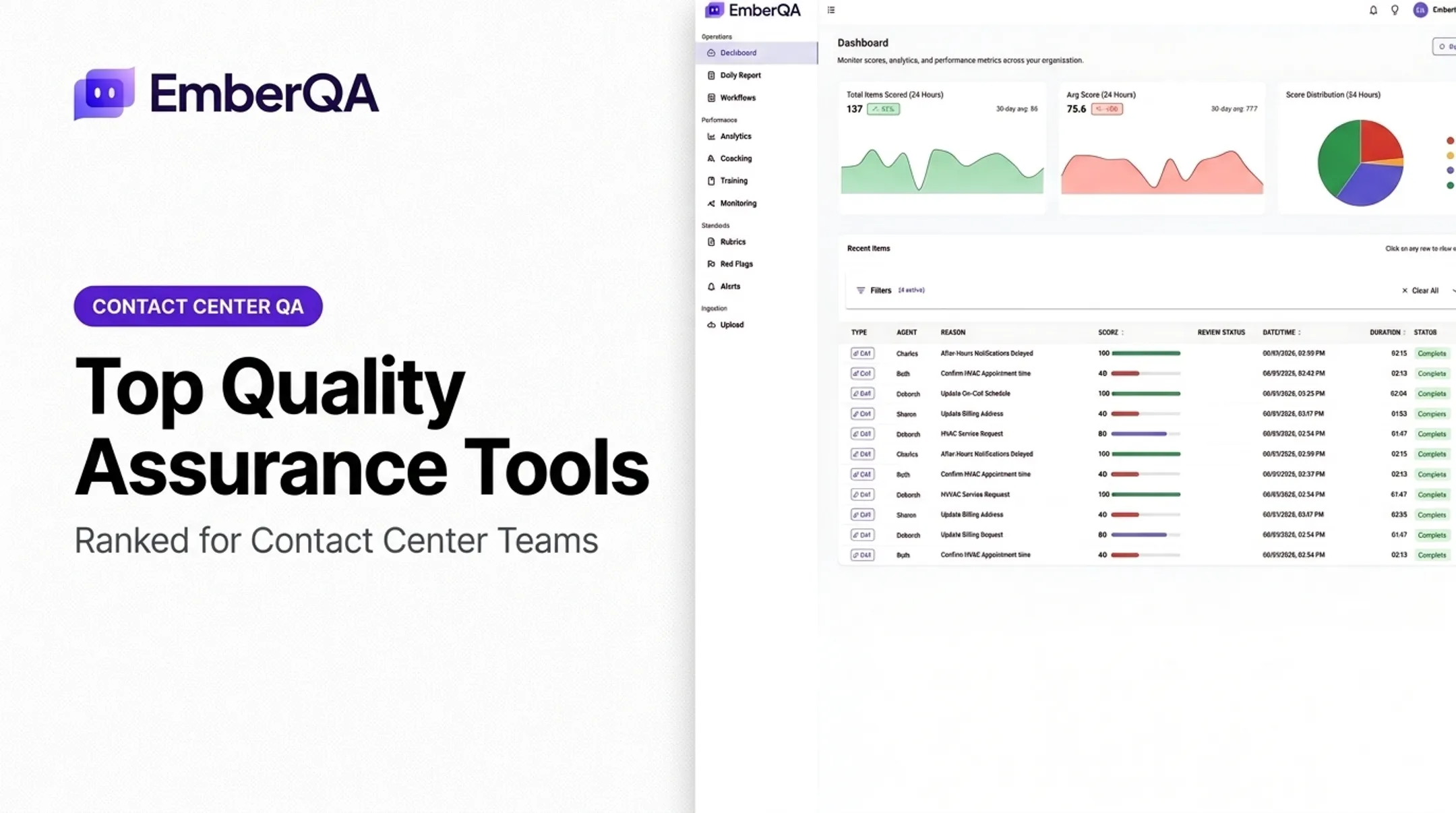
EmberQA sits alongside WFM to close that gap. It helps WFM and QA leaders see whether coverage decisions produce real quality outcomes by:
- Scoring every recorded interaction automatically
- Flagging red-flag behavior such as improper advice or privacy violations
- Surfacing coaching opportunities tied to recurring patterns
Which WFM Technology and Capabilities Should Call Centers Evaluate?
Spreadsheets vs. Purpose-Built Software
Spreadsheets can work for small, stable teams. They fall apart when operations need frequent reforecasting, skills-based scheduling, multiple channels, or multiple sites. Before choosing a tool, track how much time your team spends on manual entry, schedule changes, and reconciliation. That number usually makes the case for software on its own.
Essential Capabilities to Look For
A solid WFM platform should offer:
- Forecasting for voice and digital workloads, factoring in seasonality and shrinkage
- Capacity planning and scenario modeling for hiring and budget decisions
- Automated scheduling built around coverage rules, skills, and preferences
- Intraday monitoring with alerts for forecast-versus-actual variance
- Reporting dashboards covering adherence, utilization, absence, and trends
Integration, Scalability, and Usability
Confirm the platform covers these operational requirements:
- Integration with your ACD or contact center platform, CRM, HR, payroll, and QA systems
- Cloud deployment, role-based access, and mobile access
- Scalability across sites and time zones
Involve WFM analysts, supervisors, agents, and IT in pilot testing, not just leadership.
Connecting WFM With Quality and Coaching
Staffing metrics tell you whether coverage existed. They don't tell you whether customers got accurate, compliant, or empathetic service. That gap is why pairing WFM with interaction-level quality data matters.
ECA, an EmberQA customer, went from manually reviewing under 1% of calls to scoring 100% of interactions. Every call became searchable, comparable, and tied to targeted coaching—visibility pure scheduling data can't provide on its own.

A Practical Buying Checklist
Before signing with any WFM vendor, ask:
- Does it support our channels, skills, locations, and labor rules?
- How will we measure forecast accuracy and ROI post-implementation?
- What data is required, and how fast can we deploy?
- How do agents participate in self-service scheduling?
- What change management support does the vendor provide?
Validate every claim with a live demo, customer references, and a limited pilot. Feature lists alone won't tell you how the tool performs under your actual call patterns.
Frequently Asked Questions
What is WFM in a call center?
WFM is the process of forecasting demand, planning staffing, scheduling agents, managing intraday changes, and measuring performance. The goal is aligning coverage with customer needs while controlling labor costs.
Is call center WFM part of HR?
No. WFM and HR collaborate but manage different things: WFM handles operational capacity and schedules, while HR manages recruiting, compensation, benefits, and employment policy.
What are the main components of call center WFM?
The core components are forecasting, capacity planning, scheduling, skills assignment, intraday management, adherence monitoring, and reporting. Each stage feeds into the next planning cycle.
Why is workforce management important in a call center?
WFM keeps staffing aligned with demand, which shortens wait times, controls labor costs, and balances agent workloads. Poor WFM shows up quickly in abandonment rates and agent turnover.
What metrics should call centers track for WFM?
Common metrics include forecast accuracy, schedule adherence, service level, occupancy, average speed of answer, abandonment, shrinkage, absenteeism, and overtime. Prioritize the ones tied directly to your business goals.
How can call centers improve workforce management?
Improve data quality, review forecasts regularly, adopt skills-based scheduling, and build tested intraday contingency plans. Combine that with agent self-service and coordination across WFM, HR, QA, and IT.