That gap matters most in contact centers, BPOs, answering services, and other customer-facing teams where consistency, compliance, and agent performance need to hold steady across thousands of interactions a month. A quality assurance workflow is frequently confused with a single call review, a scorecard, or the broader QA program. It's none of those alone. This article breaks down what a QA workflow actually is, how it runs step by step, where teams apply it, and when automation earns its place alongside human review.
Key Takeaways
- A QA workflow links standards, evaluation, documentation, coaching, and improvement into one repeatable cycle.
- Strong workflows assign clear ownership, scoring criteria, evidence rules, and escalation paths.
- Manual review, automation, or a blended model all work, depending on volume and risk.
- Scores mean nothing without action: coaching, calibration, or process changes must follow.
What Is a Quality Assurance Workflow?
A quality assurance workflow is the operational sequence a team follows to plan, evaluate, record, review, and improve quality. It is the ordered set of actions that turns a quality standard into a documented decision and, over time, into behavior change.
Four traits define a functional workflow:
- Structure – a defined order of steps, not ad hoc review
- Repeatability – the same process runs whether it's Monday or the busiest day of the quarter
- Traceability – every finding links back to specific evidence in the interaction
- Accountability – someone owns each decision, from scoring to escalation
The goal is concrete: consistently identify whether an interaction met expectations, understand why or why not, and take the right next step.
QA Workflow vs. QA Program, Process, and Quality Control
These terms get used interchangeably, but they describe different layers:
| Term | What it covers |
|---|---|
| QA program | The organization's overall quality strategy, standards, and goals |
| QA process | Broader practices used to maintain quality across the team |
| QA workflow | The ordered actions, owners, decisions, and outputs that execute the process |
| Quality control | Inspecting a specific interaction or output for defects |
Quality control asks "did this call pass?" A workflow asks that question, then documents why, routes the finding to the right person, and confirms something changed as a result.
The distinction matters because a workflow replaces memory-based, inconsistent reviews with a documented system. That system supports fairer scoring, faster risk escalation, and real trend analysis instead of a manager's gut feeling about "how the team is doing this month."
How the QA Workflow Works
At a high level, the flow looks like this: define standards, select interactions, evaluate against a scorecard, document evidence, review and act, then feed lessons back into training and standards. Each step has its own decisions to get right.

Step 1: Define Quality Standards and Review Criteria
Before anyone reviews a single call, the team needs to agree on what "good" looks like. Common criteria include:
- Accuracy of information provided
- Required disclosures and policy adherence
- Empathy and tone
- Resolution quality
- Documentation and data handling
- Brand voice consistency
Criteria should be observable, not vague. "Be professional" isn't a standard. "Verify caller identity before discussing account details" is.
Step 2: Select Interactions and Prepare the Review
Not every team samples the same way. Common approaches include:
- Random sampling
- Targeted reviews of flagged interactions
- Escalation-triggered reviews
- New-agent checks
- Compliance-driven pulls
A 2022 COPC benchmarking survey found that 63% of respondents used random selection. Contact-center standards typically call for an unbiased method.
The selection method shapes what your data can actually tell you. A handful of convenient calls won't reveal a systemic disclosure gap buried in 2% of your volume.
Step 3: Evaluate and Document Evidence
The reviewer, human or AI, applies the scorecard consistently and records results tied to specific evidence: a timestamp, a transcript line, a missed step. Objective observations ("agent did not offer a callback time") stay separate from subjective impressions ("agent seemed rushed").
This is where AI-assisted QA changes the math. Instead of sampling a small slice, an automated system can analyze a much larger set of interactions, apply the same rubric every time, and flag red-flag conditions the moment they occur.
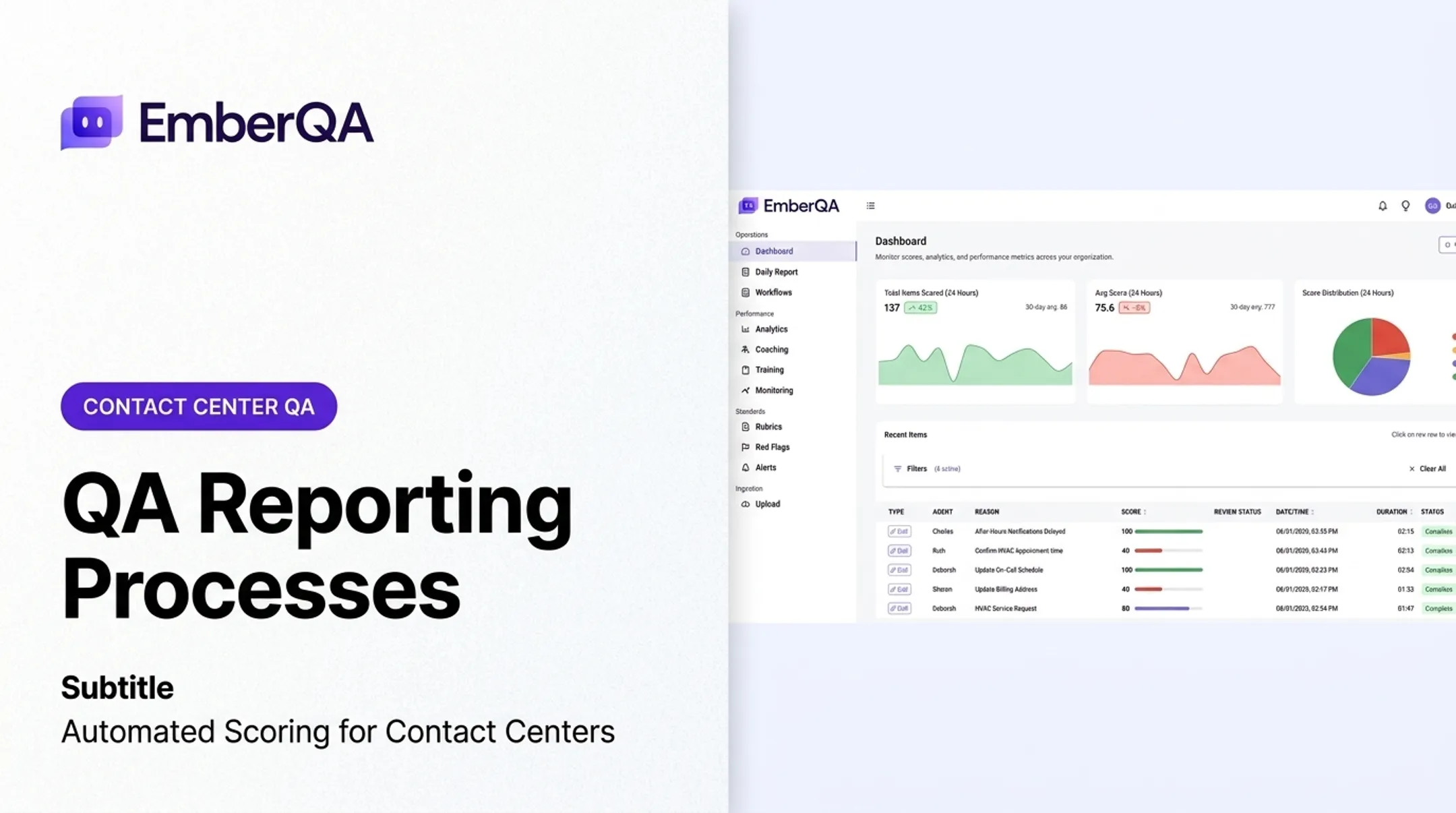
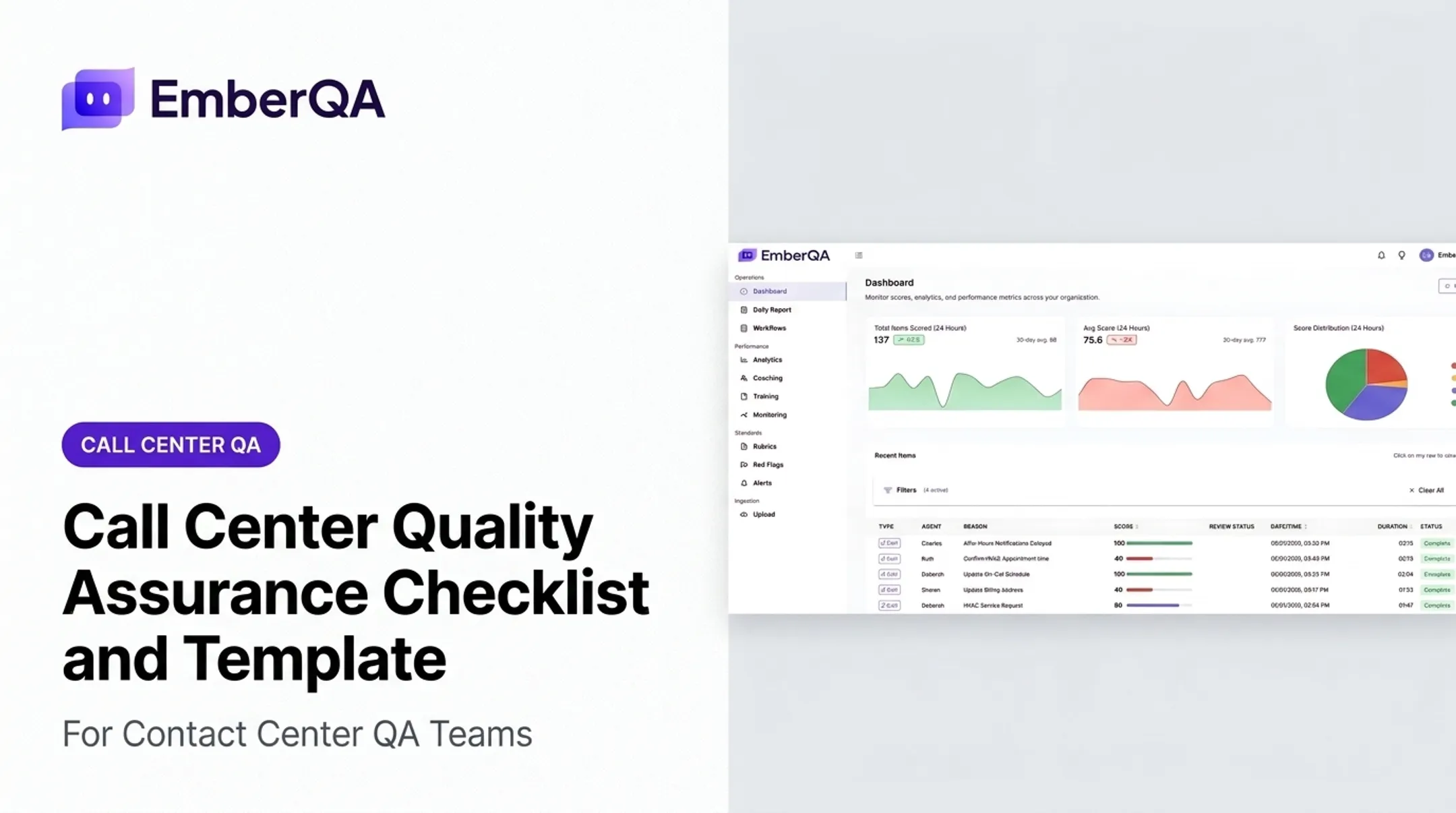
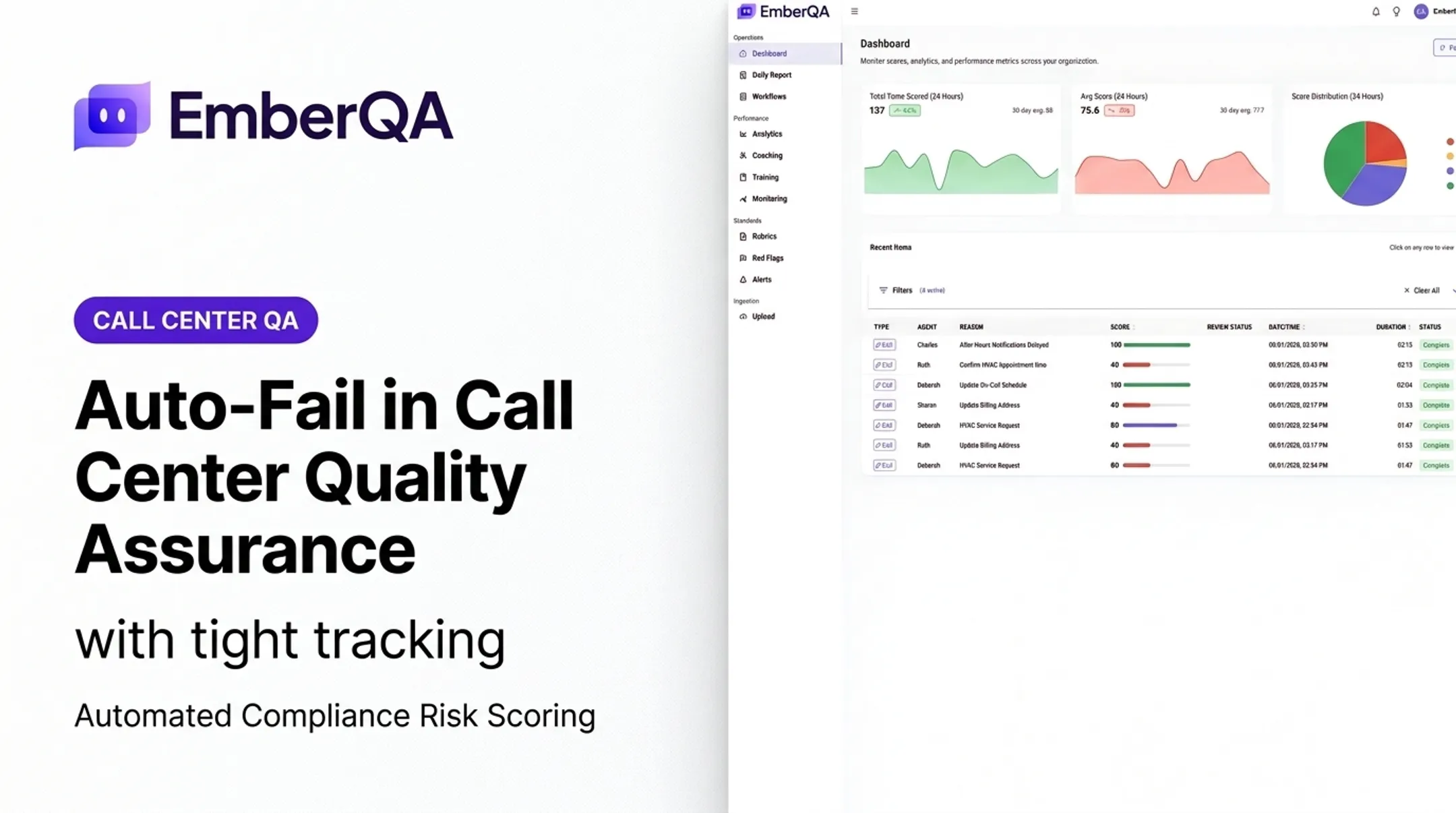
EmberQA, for example, scores every supported interaction against a company's custom rubrics and produces metric-level explanations showing exactly why an interaction passed or failed each criterion. Transcripts and recordings sit alongside those findings, so reviewers can verify results without reworking them from scratch.
Step 4: Triage Findings and Determine Action
Not every finding deserves the same response. Teams typically classify results by:
- Severity and business impact
- Compliance sensitivity
- Whether the issue is recurring or isolated
- Urgency (does this need escalation today?)
Possible outcomes range from immediate escalation to a CRM correction, agent coaching, a process clarification, or simply no further action.
Step 5: Review, Calibrate, and Communicate Results
QA analysts, supervisors, compliance stakeholders, and agents each play a role here. Calibration sessions align reviewers so two people scoring the same call land on similar results. Agents should have a path to dispute a score.
Communication should focus on observable behavior, not judgment. That's what actually changes performance instead of triggering defensiveness.
Step 6: Track Follow-Up and Improve the Workflow
The cycle isn't finished once coaching happens. Teams need to confirm the correction stuck, watch for recurrence, and roll aggregated findings into updated training, scripts, or scorecards. This step is what separates a QA workflow from a QA report: it closes the loop instead of just producing a number.
Where QA Workflows Are Applied and What Affects Them
QA workflows show up anywhere a business depends on consistent customer interactions. Common settings include:
- Customer service, sales, claims, and collections
- Appointment scheduling and technical support
- Answering services and outsourced BPO programs
Each context weights its scorecard differently. A collections team leans hard on compliance language. A scheduling team leans on accuracy and CRM data integrity.
Timing varies too. Reviews might happen:
- During routine, ongoing monitoring
- Right after a customer complaint
- When a compliance flag gets triggered
- During new-agent onboarding
- After a script or policy change
- As part of recurring coaching and calibration cycles
What Shapes Workflow Design
Several factors determine how complex a workflow needs to be:
- Interaction type and channel – calls, chats, emails, SMS, and CRM notes each need different evidence and scorecard logic
- Risk and compliance requirements – regulated sales, insurance, financial services, and collections often need stricter escalation controls and longer evidence retention
- Volume and coverage needs – multi-site or high-volume operations often need automation to extend coverage beyond a thin manual sample
- Team structure and ownership – someone must own the scorecard, approve escalations, and receive coaching results—internal staff, a vendor, or a client program
Channel coverage isn't uniform in practice. A 2026 ContactBabel survey of US contact-center managers found 40% rated inbound-call quality evaluation very effective, compared with just 15% for email.

Data quality matters as much as design. Recording quality, transcript accuracy, CRM access, and integration reliability all affect whether findings are actually usable.
Spot On Schedulers, for instance, needed reviews that verified CRM data alongside the call itself. A passing call score doesn't mean much if the account notes behind it are wrong.
Common Issues, Misconceptions, and Limitations
The biggest misconception: a QA workflow is just "listen to calls and assign a score." Useful QA needs defined standards, documented evidence, consistent interpretation across reviewers, clear action ownership, and follow-up. Skip any of those, and you have a scorecard exercise, not a workflow.
Common failure points include:
- Vague scorecards that invite personal judgment instead of consistent scoring
- Reviewers who interpret the same criteria differently
- Reviewing only convenient or easy-to-access interactions
- Treating every issue as equally urgent
- Documenting a score without documenting the evidence behind it
- Handing out scores with no actionable coaching attached
ECA shows what changes when coverage stops being the bottleneck. The team moved from reviewing under 1% of calls manually to evaluating 100% of customer interactions with EmberQA's automated transcription and scoring. Its standards for greetings, hold management, caller verification, and message accuracy stayed intact.
A complex workflow isn't always the right call. It may not fit when:
- Volume is low and interactions are straightforward
- The organization still hasn't agreed on quality standards
- The cost of review exceeds the value of the decision
Start with a focused workflow and expand it as risk, volume, and learning needs justify it.
Automation doesn't remove the need for human judgment. Reviewers still matter for context, calibration, sensitive coaching conversations, exceptions, and confirming that an automated finding is actually worth acting on.

Conclusion
A quality assurance workflow turns quality expectations into a repeatable cycle: standards, review, evidence, decisions, action, and improvement. The most effective versions assign clear ownership, evaluate meaningful criteria consistently, and connect every finding to a practical next step.
Match your approach, sampling method, automation level, escalation rules, and coaching cadence to your actual interaction volume, compliance obligations, and customer expectations. That's what separates a workflow that produces real improvement from one that just produces reports nobody reads.
Frequently Asked Questions
What are the steps involved in the quality assurance workflow?
A typical QA workflow runs in this order:
- Define quality standards and scoring criteria
- Select interactions to review
- Evaluate each interaction against the criteria
- Document findings
- Review and triage results
- Take corrective or coaching action
- Feed lessons back into the next cycle
What are the top 3 skills for a QA analyst?
Three skills matter most on the job:
- Analytical judgment to weigh evidence fairly
- Clear communication that turns coaching into behavior change
- Consistent attention to detail when applying scoring criteria
Together, they turn a review into measurable improvement instead of a scorecard number alone.