The best customer service scripts aren't paragraphs agents recite word for word. They're flexible frameworks that combine empathy, clarity, ownership, and a clear next step. Rely too heavily on rigid wording, and agents sound robotic or struggle to adapt when the customer introduces new information.
This article breaks down a five-step de-escalation framework, gives you ready-to-adapt scripts for six common angry-customer scenarios, offers phrase swaps that calm instead of escalate, and shows how to turn all of it into a repeatable coaching and QA process.
Key Takeaways
- Use scripts as flexible guides: acknowledge emotion, clarify the issue, act, then confirm.
- Own the customer's experience without admitting fault before facts are verified.
- Give specific next steps, realistic timeframes, and clear ownership of follow-up.
- Set firm boundaries when frustration turns into abuse; escalate per policy.
What Makes a Customer Service Script Effective for Angry Customers
A script isn't a monologue. It's a sequence of communication decisions: what to acknowledge first, what to ask, what to offer, and how to close. Effective scripts give agents:
- Consistency across similar situations, regardless of who answers the call
- Confidence when emotions run high and improvisation feels risky
- A training foundation for new hires learning to handle conflict
- Compliance support in regulated industries like insurance and collections
- A basis for quality control, so coaching isn't just gut feeling
Validating Frustration Isn't the Same as Agreeing With It
Agents can show they understand a customer's frustration without confirming every accusation. ICMI's guide to key contact-center phrases recommends lines like "I'm sure that's incredibly frustrating" to set a productive tone, then "Let me be sure I have this right" before committing to next steps. That's validation.
Saying "you're right, our system is a mess" before verifying the account is a promise the agent might not be able to keep.
Watch for these habits, which tend to make things worse:
- Defensiveness or arguing back
- Blaming another team or department
- Speculating about causes before checking the account
- Over-apologizing to the point it sounds insincere
- Jargon that confuses rather than clarifies
- Promising resolution times the agent can't guarantee
Adjust the Script for the Channel
Match the script to how the customer is reaching you:
- Phone: Build in pauses and vocal warmth; pacing matters as much as the words
- Live chat and email: Use shorter sentences and plain formatting—word choice carries the tone
- Social: Acknowledge publicly, then move account details to private messaging quickly
The Five-Step Framework for De-Escalating an Angry Customer
Use this five-step sequence whenever a call, chat, or email turns heated. It adapts ICMI's five-step response model for angry customers into a structure agents can run in real time.
1. Acknowledge the Emotion
Name the frustration before you touch the problem. "I can hear how frustrating this has been" lands better than jumping straight to troubleshooting.
Skip this step and customers feel unheard—no matter how good the fix is.
2. Clarify the Problem
Ask one or two focused questions about what happened, what they expected, and what outcome they need. Avoid "Why did you...?" openers—they sound accusatory.
A paraphrase works better: "If I understand you correctly, you were charged twice for the same order."
3. Own the Experience and Explain the Next Action
Take responsibility for moving things forward without admitting fault before the facts are confirmed. "I'm going to look into this right now" shows ownership without a premature apology for something you haven't verified.
4. Present a Specific Solution or Choice
Give a realistic timeframe, name alternatives, and explain policy limits in plain language. Vague promises like "we'll take care of it" erode trust faster than a clear, honest limit.
5. Confirm and Close the Loop
Summarize the agreed action, verify contact details if follow-up is needed, and ask if anything remains unresolved. Skipping this step is a common cause of repeat contacts.

When to Escalate
Build in a clear escalation path for:
- Repeated contact on the same unresolved issue
- Regulatory or compliance risk
- Threats or discrimination
- Abusive language toward the agent
Define in policy exactly when a supervisor or specialist takes over so agents are not deciding alone in the moment.
Customer Service Scripts for Common Angry-Customer Scenarios
Each script is a structure to adapt to your policies—not a line to read verbatim.
Billing dispute or unexpected charge
Customer concern: "I was charged $89 and I have no idea why."
Sample response: "I can see why that would be alarming. Let me pull up your account and check that charge line by line."
Explain findings in plain language—"This charge is for the add-on service from March 3rd"—not internal billing codes. Offer a correction or escalate to billing if the charge needs reversal.
Why it works: Validates surprise first, verifies before explaining, and avoids accusatory framing.
Delayed delivery or appointment
Customer concern: "This was supposed to arrive two days ago."
Sample response: "I'm sorry for the delay—that's frustrating when you're counting on it. Here's the most current tracking status I have."
Share the most reliable update you have. Don't blame the carrier or another team. Set a specific next checkpoint: "I'll follow up by 3 p.m. tomorrow if it hasn't moved."
Customize: Match checkpoint timing to realistic internal SLAs.
Incorrect, damaged, or faulty product
Customer concern: "This arrived broken and I need it fixed now."
Sample response: "I'm sorry your item arrived damaged. That's not the experience we want."
Gather only what you need to verify (order number, photo if required). Then offer replacement, repair, or refund per policy.
Customize: Lead with the remedy that fits the product type and policy.
Repeated contact without resolution
Customer concern: "This is my third call about the same thing."
Sample response: "I can see you've reached out before, and I'm sorry this hasn't been fixed yet."
Review previous notes instead of making the customer repeat everything. Assign clear ownership: "I'm personally following this through to resolution."
Why it works: Acknowledges effort already spent and removes redundant friction.
Customer demands a manager
Customer concern: "I want to speak to your supervisor right now."
Sample response: "I want to make sure whoever helps you has full context. Can you walk me through what happened?"
If you can resolve it, offer to try first. If escalation is warranted, transfer with context already shared so the customer doesn't restart.
Why it works: Captures full context before the handoff and avoids a repeated retell.
Abusive or threatening language
Customer concern: Anger has turned into name-calling or threats.
Sample response: "I want to help resolve this, but I need us to keep the conversation respectful."
State the boundary once, offer a path forward, and note that the call may end if the conduct continues, per policy.
Why it works: Separates frustration about the situation from abuse aimed at the agent. This aligns with Call Centre Helper's guidance on handling abusive customers.

Phrases That Calm Customers—and Phrases to Replace
Positive scripting means solution-focused language that stays accurate. Call Centre Helper defines it as optimistic, professional wording that guides the customer without dropping honesty—and warns that overuse makes agents sound robotic.
Use the swaps below to acknowledge frustration, offer a next step, and keep control of the call.
Acknowledgment and Empathy Phrases
- "I understand why that would be frustrating."
- "That sounds inconvenient, thank you for your patience."
- "I can see why that's confusing, let's sort it out."
Swap Negative Wording for Options
| Instead of | Try |
|---|---|
| "Unfortunately, we can't do that" | "What I can do is..." |
| "I can't help with that" | "Let me connect you with the person who can" |
| "That's not my department" | "I'll make sure this gets to the right team" |
| "You need to..." | "Could you... when you're ready?" |
Buying Time, Holds, and Transfers
- "Let me check with the courier and see when delivery can be arranged."
- "I'll place you on a brief hold while I pull up your account, this should take about a minute."
- "I'm going to bring in a colleague who specializes in this, one moment."
Ending an Abusive Interaction
When respect breaks down, set a clear boundary:
"I want to keep helping, but I need this conversation to stay respectful. If that's not possible, I'll need to end the call and follow up another way."
Delivery matters as much as the script:
- Let the customer finish speaking
- Don't argue or interrupt
- Skip empty assurances like "everything will be fine" unless you have a concrete plan
How to Turn Angry-Customer Scripts Into a Coaching and QA Process
A script is only as good as the coaching built around it. Convert the framework into a scorecard with observable criteria:
- Emotional acknowledgment
- Verification before explanation
- Ownership language
- Policy adherence
- Solution clarity
- Escalation judgment
- Closing confirmation
Role-Play, Then Review Real Interactions
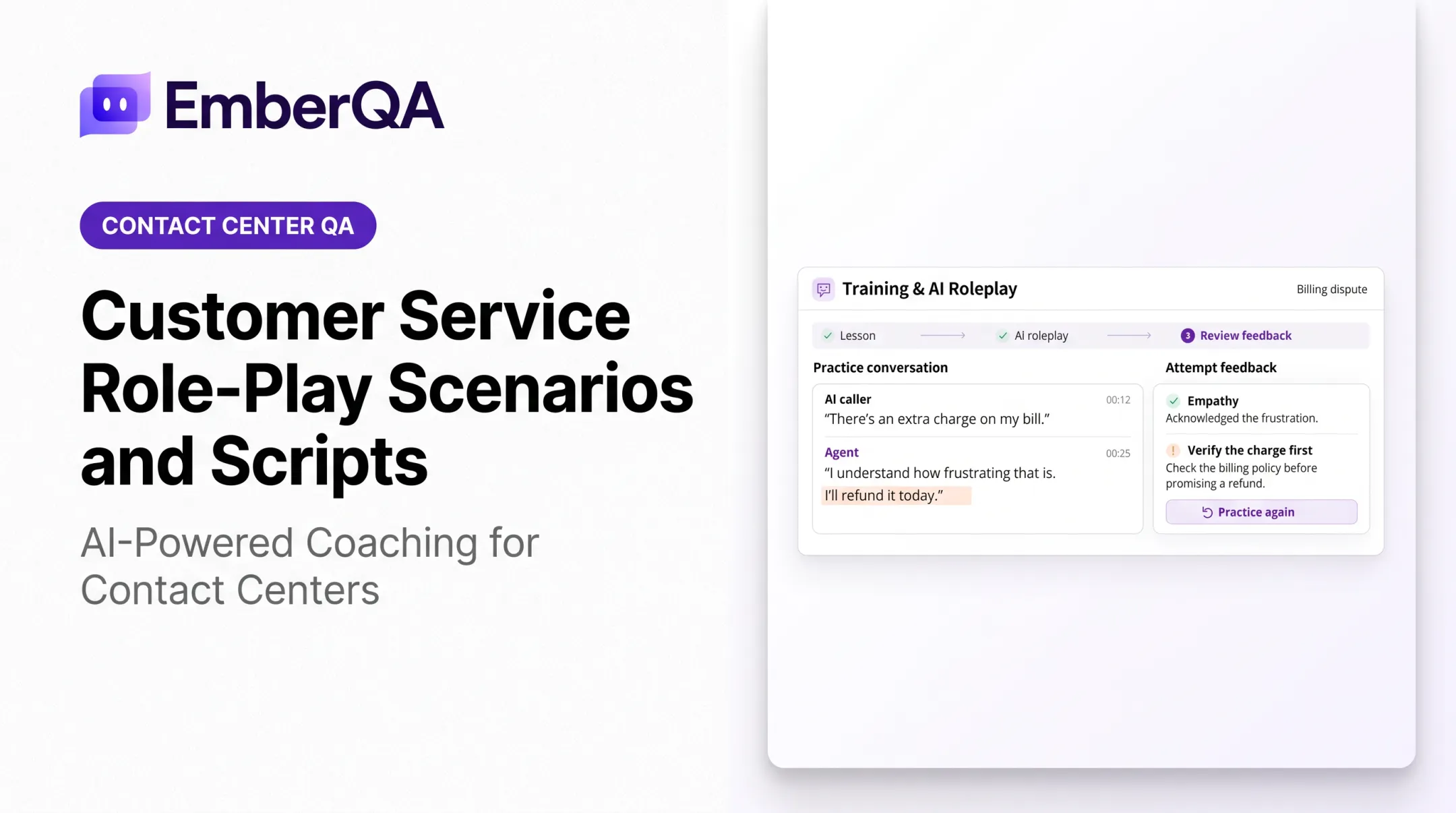
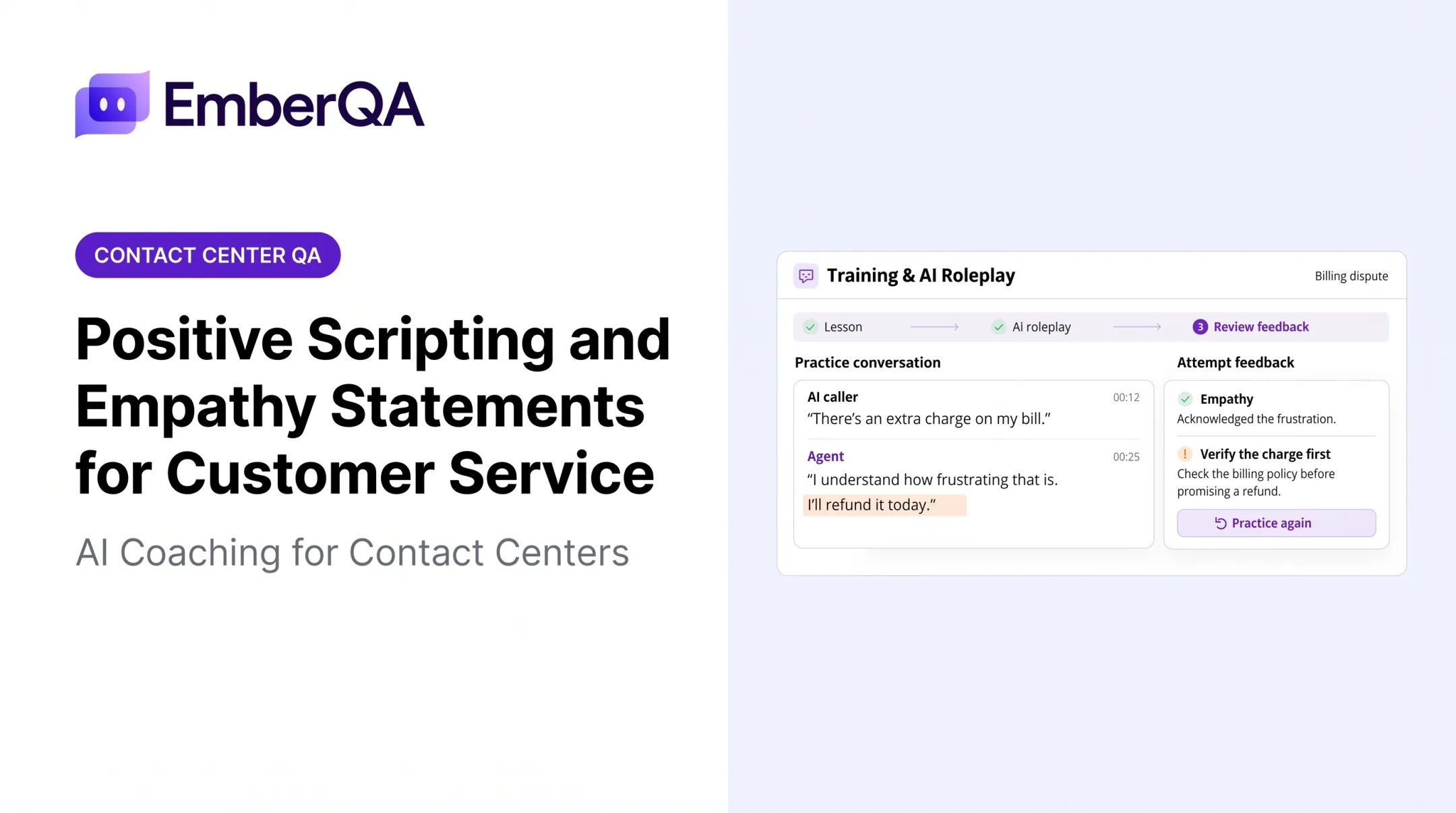
Practice high-risk scenarios such as abusive callers, billing disputes, and manager demands through role-play before agents face them live. EmberQA's AI roleplay training, lessons, and quizzes let agents rehearse those conversations and policy steps before a real customer is on the line.
After training, the harder work is reviewing what actually happens on live calls. Manual sampling typically covers a small fraction of interactions, which is why many teams struggle to spot recurring wording problems until they've already caused repeat contacts.
EmberQA scores every customer interaction (calls, SMS, emails, and documents) against custom rubrics and surfaces red-flag issues like hostile behavior, privacy violations, and escalation risk automatically.
It also maps emotional shifts across each call, so teams can see where frustration builds or a conversation turns around. Instead of sampling a handful of calls a month, managers get consistent scoring across full volume, plus coaching recommendations built from recurring gaps and top-performer examples.
Track the Right Metrics
Review script performance using indicators like:
- Repeat contact rate
- Escalation rate
- First-contact resolution
- Customer sentiment trends
For context, SQM Group's 2024 inbound call center benchmark found first-call resolution averaged 69% overall but dropped to 48% for complaint calls. Angry-customer interactions carry resolution challenges separate from routine contacts.
Feed Findings Back Into the Script Library
QA reviews should update the script library, escalation rules, and training exercises, not sit in a report nobody revisits. EmberQA's dashboards support this loop with agent, team, and location trend reports, plus PDF and CSV exports managers can bring straight into coaching sessions.

Checklist Before Publishing a Script
- Is it accurate?
- Does it reflect current policy?
- Does it give the agent a concrete next step?
- Does it protect customer dignity?
- Does it define escalation and follow-up ownership?
Frequently Asked Questions
What is a good customer service script for handling angry customers?
A good script acknowledges the emotion, clarifies the issue, takes ownership, offers a specific solution, and confirms next steps. Use it as a flexible guide, not a word-for-word transcript agents must recite.
Can you give examples of difficult or angry customer scenarios and sample responses?
Common scenarios include billing disputes, delayed deliveries, faulty products, repeated contacts, manager requests, and abusive language. Name the issue, own the next step, and state a remedy—for example, "I see the double charge; I'll reverse it today and email confirmation."
What phrases calm or defuse angry customers in customer service?
Validating phrases like "I understand why that's frustrating" work well, paired with collaborative language such as "what I can do is." Pair both with active listening and a concrete action—not sympathy alone.
What are some examples of positive scripting, and how can I say "unfortunately" more positively?
Positive scripting replaces limiting language with available options. Instead of "Unfortunately, we can't," try "What I can do is..." when that option matches policy.
What are some good scripts and common phrases used in call centers?
Common phrases cover greetings, hold requests, transfers, escalations, and closings, like "I'll follow up by [specific time]." Scripts should guide natural conversation, not lock agents into rigid, word-for-word delivery.