Customer service role-play solves this. Agents practice realistic conversations, work from adaptable scripts, and get feedback in a setting where mistakes cost nothing. ICMI describes this as demonstrating competency in a realistic simulated interaction, whether the exercise covers end-to-end handling or a narrower skill like de-escalation.
This article gives you a scenario library, a session framework, and a QA scorecard you can use across contact centers, BPOs, answering services, and other customer-facing teams.
Key Takeaways
- Use scripts as flexible guides so agents stay natural and respond to what customers actually say
- Build each exercise around a realistic customer profile, measurable skill objective, escalation boundaries, and structured debrief
- Score empathy, listening, accuracy, policy adherence, ownership, resolution, documentation, and closing quality
- Adapt every scenario for voice, chat, email, and compliance-sensitive conversations
What Is Customer Service Role-Play?
Role-play is a structured simulation where participants act as customers, agents, observers, or supervisors to practice a realistic service interaction. Agents rehearse the exact conversations they will have with real customers, without the live-call risk.
Three tools work together in a well-built exercise, and confusing them is a common mistake:
- The script supplies example language agents can adapt, not memorize word-for-word
- The scenario brief sets the context: who the customer is, what they want, and what complicates the situation
- The scorecard evaluates behavior after the fact against specific, observable criteria

Used together, those tools turn practice into skill. Practitioners at ATD describe realistic role-play as a way to build communication skills, spot unproductive habits, and test new behaviors in a safe setting. SHRM frames it the same way: rehearse a difficult exchange, reflect, get feedback, and try again until the behavior sticks.
For customer-facing teams, that repetition builds:
- Stronger communication under pressure
- Greater agent confidence going into live calls
- More consistent policy application across a team
- Better de-escalation instincts
- Faster identification of where coaching is actually needed
Those gains only show up when the exercises match what agents actually face. Generic scenarios teach generic skills.
The scenarios that move performance come from real interaction patterns: recurring complaints, compliance near-misses, and edge cases that trip up even experienced agents. ICMI recommends building both positive and negative example scripts from call recordings, not from a training manual written in a vacuum.
Role-play isn't just for new hires, either. It belongs in refresher training, promotion assessments, calibration sessions between supervisors, and ongoing coaching cycles for agents who've been on the floor for years.
Customer Service Role-Play Scenarios and Scripts
Each scenario below gives you an objective, how the agent should handle the moment, when to escalate, and what success looks like. Use them as-is or adapt the details to your product, policies, and channel mix.
Angry Customer After a Repeated Failure
Objective: Acknowledge emotion without getting defensive, then take ownership.
Customer line: "This is the third time I've called about this. Nobody has fixed anything."
Agent should avoid: "I understand, but our policy says..." — this dismisses the emotion before addressing it.
Better approach:
- Acknowledge the repeated failure by name
- Summarize what has happened so far
- Commit to one specific next step with a realistic timeframe
Escalate if: the customer requests a supervisor twice, or the same issue has failed three prior repair attempts.
Success: the customer feels heard and leaves with a clear owner, action, and timeframe.
Billing Discrepancy or Unexpected Charge
Objective: Resolve charge confusion without oversharing account data or guessing.
Customer line: "I was charged something I don't recognize—can you take it off?"
Run three variants in training:
- Valid charge the customer misunderstood
- Company billing error
- Charge still under investigation
Agent should:
- Verify account and transaction details first
- Explain only what is confirmed
- Protect sensitive account data throughout
Escalate when: an adjustment needs authorization the agent does not have.
Success: the customer understands why the charge exists, even if it is not reversed.
Technical Issue, Account Access, or Service Outage
Objective: Diagnose calmly, guide one step at a time, and keep ownership visible.
Agent should:
- Ask focused diagnostic questions
- Walk through one step at a time
- Avoid implying the customer caused the problem
- Document every troubleshooting step
Escalate when: the issue needs a technical team the agent cannot access.
Success: the customer knows what was tried, what happens next, and when they will hear back.
Refund, Defective Product, Late Delivery, or Wrong Item
Objective: Pair empathy with a clear policy path—not one or the other.
Customer line: "What I received is wrong, and I need this fixed today."
Agent should:
- Acknowledge the inconvenience first
- Explain the relevant policy in plain language
- Offer approved solution options
- Confirm the customer's preferred resolution
- Stay inside approved authority
- Commit to a proactive follow-up that closes the loop
Escalate when: the requested fix exceeds the agent's authority or stock/policy limits.
Success: the customer has a confirmed resolution path and a follow-up expectation.
Customer Requests a Discount, Exception, or Special Treatment
Objective: Stay fair under pressure without making off-policy promises.
Customer line: "Can't you just make an exception this once?"
Agent should:
- Explain eligibility criteria respectfully
- Offer alternatives that are actually permitted
- Decline off-policy requests without blaming the customer
Escalate when: only a supervisor can approve the exception the customer wants.
Success: the customer hears a clear yes/no with a real alternative, and no unauthorized promise is made.
Compliance, Privacy, Safety, or Terms-of-Service Concern
This is the highest-risk exercise in the library. The agent must:
- Verify identity before discussing account details
- Avoid disclosing restricted information, even under pressure
- Use approved language for sensitive topics
- Document the interaction thoroughly
- Escalate immediately when a red flag appears — no exceptions

BPO or Answering-Service Client-Standard Scenario
Objective: Represent the client brand consistently while hitting that program's service rules.
Agent should:
- Follow the brand-specific script and tone
- Meet the stated service-level requirement
- Use the correct transfer rule for that client
Observer checks: Did the agent sound like the client—not the BPO default—end to end?
Why it matters: BPO and answering-service agents often juggle multiple client standards in one shift.
Customer Asks for an Answer the Agent Doesn't Know
Objective: Replace "I don't know" with ownership.
Agent should:
- Explain how the answer will be found
- Offer a safe interim option when one exists
- Confirm the follow-up channel and timeframe before ending the contact
Success: the customer leaves with a next step, not a dead end.
Adapt One Scenario Across Channels
Take any scenario above and run it three times: voice, chat, and email.
Watch what changes:
- Tone and pacing
- Response length
- Written clarity and structure
- Authentication and verification steps
Success: the skill transfers across channels—not just memorized wording on one of them.
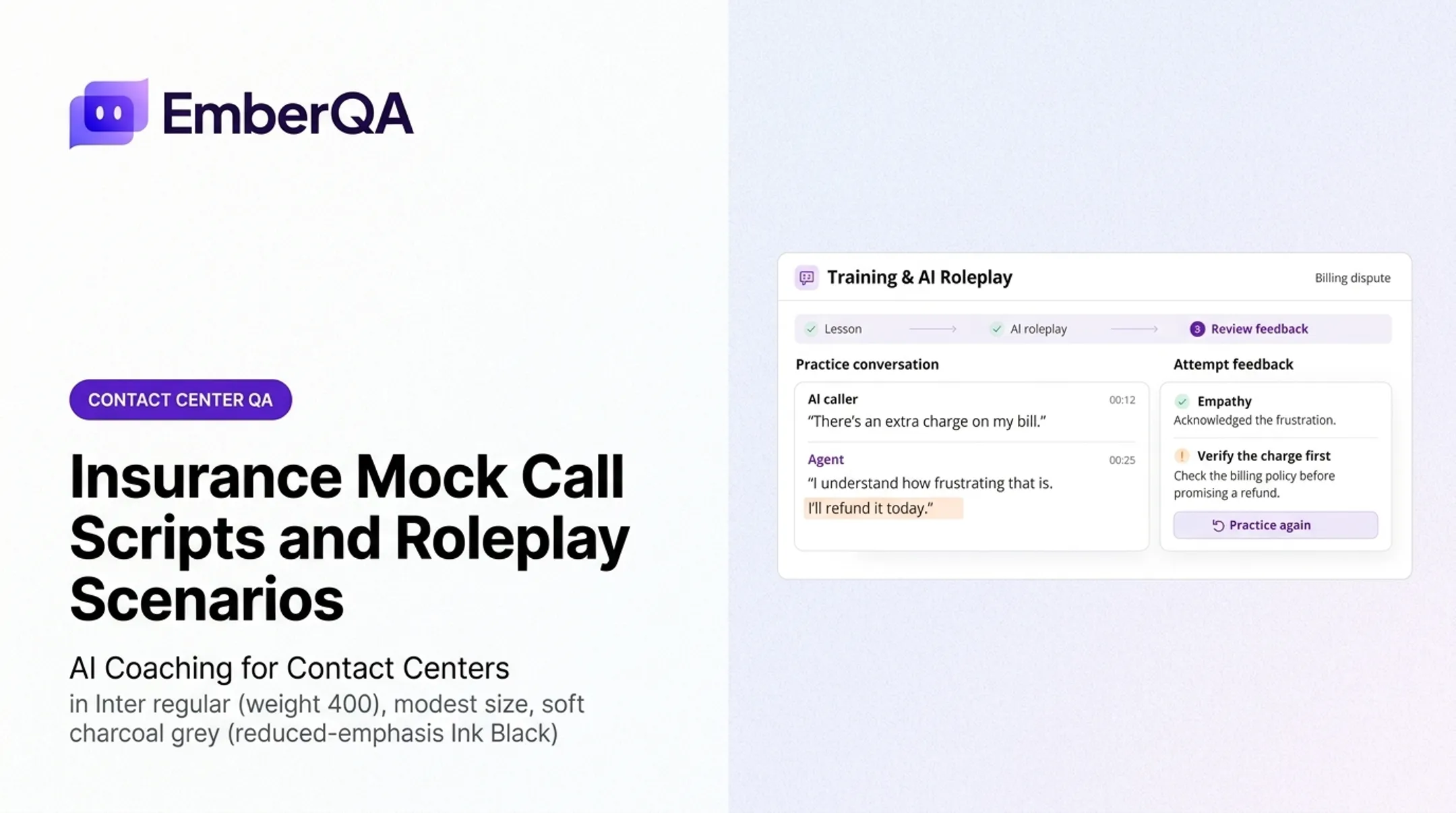
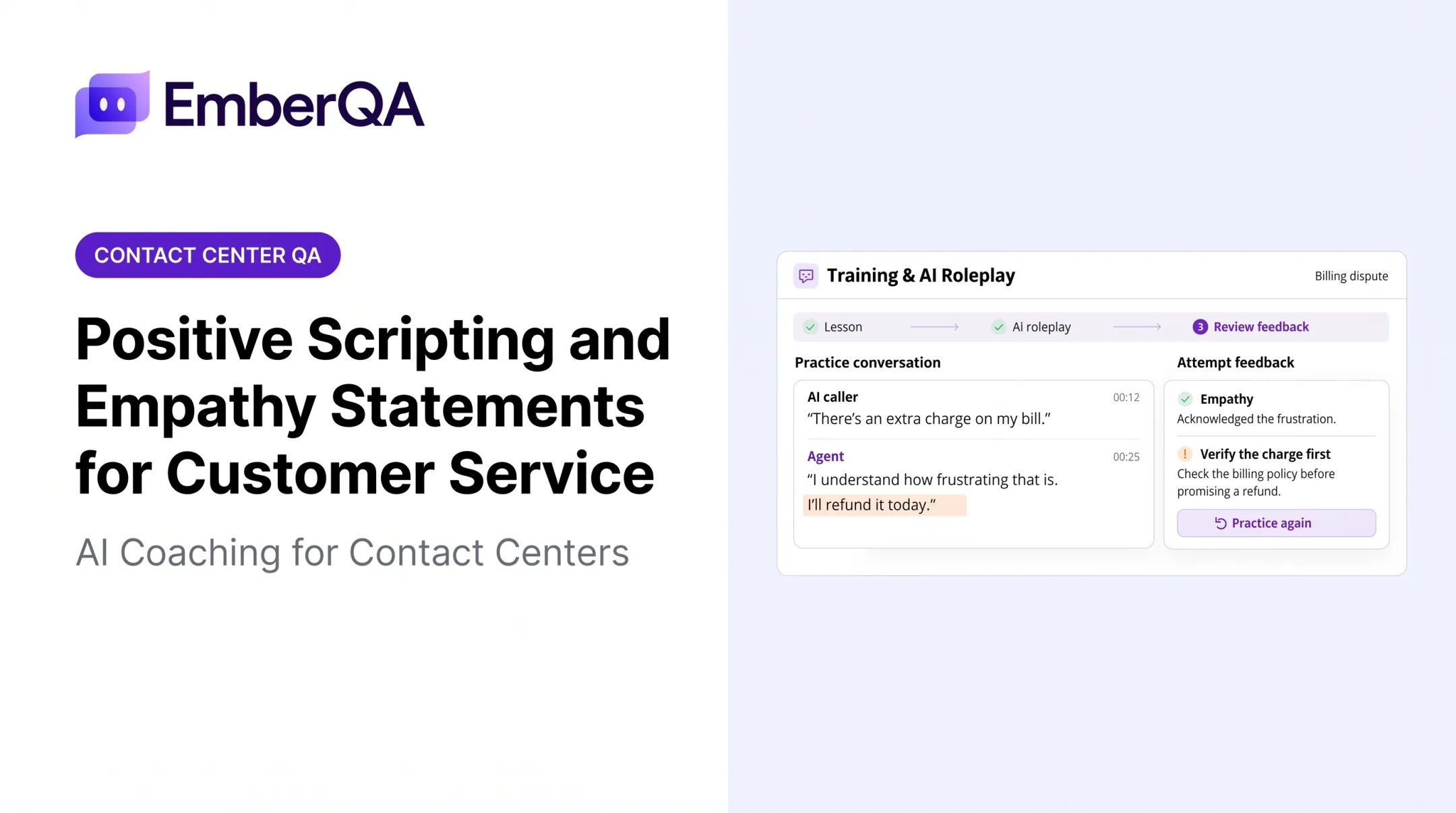
EmberQA's contact center training tools can build these scenarios from real QA data. Instead of guessing which conversations need practice, an AI mock-caller can run agents through the billing dispute, angry-customer call, or compliance check—the same situations flagged as recurring issues in live customer interactions.
How to Run an Effective Customer Service Role-Play Session
Strong scenarios still fail without a clear session structure. Use this five-step framework.
- Set the learning objective. Pick one or two behaviors — de-escalation, discovery questions, compliant disclosure, accurate documentation, or effective escalation. Don't try to test everything at once.
- Build the scenario brief. Cover customer history, emotional state, desired outcome, account context, and the relevant policy. Add one complication so the exercise feels real.
- Assign roles and boundaries. Rotate customer, agent, observer, and coach roles. Tell the customer participant which facts to reveal first and when to escalate difficulty.
- Run the simulation. Let the agent respond naturally instead of reading lines verbatim. Pause only for safety, compliance, or instructional reasons. Record when appropriate and authorized.
- Debrief immediately. Ask what the agent noticed, what the customer likely felt, which response moved the call forward, and what to improve next.

Structuring the Debrief
A "continue, change, try" format keeps feedback specific:
- One behavior to continue
- One behavior to change
- One new technique to try next round
Then repeat the scenario with a new complication, channel, or customer profile. This tests whether the skill actually transfers, rather than confirming the agent memorized one script.
The same loop works for distributed teams. Common formats include:
- Paired live video role-plays
- Written chat simulations
- Async recorded exercises with manager feedback
Training research from ATD points to the same sequence in leadership development: peer practice, coaching, then follow-up scenarios to lock in what stuck.
EmberQA's AI roleplay training supports that rotation. Agents get unlimited scored practice attempts, so managers can see which skills transferred and which need another round—without sitting in on every session.
How to Score Role-Play Performance and Improve QA
Role-play only improves performance if the feedback is consistent. That means a rubric with observable criteria, not a supervisor's gut feeling.
Build the rubric around these dimensions:
Interaction skills
- Opening and verification
- Active listening and empathy
- Questioning technique
- Ownership and closing quality
Outcome and risk controls
- Accuracy and policy adherence
- Solution quality
- Escalation judgment
- Documentation
Separate Pass Conditions from Critical Failures
A polished tone should never offset a critical failure. A privacy breach, inaccurate information, an unauthorized promise, or a missed escalation on a safety concern should fail the interaction outright, regardless of how well everything else went. COPC's standard treats these as distinct categories — customer, business, and compliance critical errors — tracked separately rather than folded into one overall score.
Calibrate Your Evaluators
Two supervisors scoring the same call should reach the same conclusion. COPC's 2022 benchmarking survey found that 89% of organizations reported having a calibration process in place, with evaluators scoring the same recording together and discussing why each behavior earned its rating. Vague scorecard language invites subjective grading, so keep criteria specific enough that two people land on the same answer.
Connect Role-Play to Real Interaction Data
Role-play results mean more when you compare them against what's actually happening on live calls. This is where manual sampling falls short: McKinsey reports that manual QA often covers less than 5% of conversations, which means most coaching decisions get made on a tiny, potentially unrepresentative slice of interactions.
EmberQA closes that sampling gap. Instead of reviewing 1–2% of calls, it scores every call, chat, email, and document against a consistent rubric. It surfaces risks like hostile behavior or privacy issues in real time and makes every interaction searchable and comparable.
One answering service client, ECA, moved from reviewing less than 1% of calls manually to evaluating every customer interaction. That shift saved roughly 30 hours of manager time per week.

Track improvement using measures your organization can verify:
- QA score movement over time
- Critical-error frequency by type
- Escalation quality and timeliness
- Repeat-contact pattern changes
- Adherence to required disclosures
Conclusion
Effective role-play combines four things: realistic context, a flexible script, deliberate practice, and feedback tied to observable behavior. Skip any one of them and the exercise turns into either a memorization drill or a session nobody takes seriously.
Start small. Pick your highest-frequency and highest-risk scenarios: the angry customer, the billing dispute, the compliance check. and build from there. Refresh the library as real interaction trends shift and agents give feedback on what's actually hard.
Teams no longer have to guess where coaching gaps are. QA insight across calls, chats, and emails shows what is actually happening. EmberQA helps managers aim role-play and coaching at the patterns that matter most, not only the ones that surface in a small manual sample.
Frequently Asked Questions
What are some good scripts for customer service?
Effective scripts include an empathetic opening, clarifying questions, clear ownership, a realistic solution, and a defined close. The best ones leave room for the agent to respond naturally rather than reading every line.
What are some good role-play scenarios for customer service?
Strong scenarios include angry customers, billing discrepancies, technical issues, refunds, late deliveries, privacy or compliance concerns, transfers, and situations where the agent doesn't know the answer.
What is a BPO script?
A BPO script is approved language and process guidance that outsourced agents use to represent a client consistently, while still allowing personalization and clear escalation paths when needed.
What are the 7 steps of customer service?
A practical sequence covers greeting and verification, listening, clarifying, empathizing, resolving, confirming satisfaction, and documenting or following up. Different organizations may adjust this slightly.
Can you provide some examples of customer service scenarios?
A customer disputes a double charge on their last invoice. Another cannot log in after a password reset. A third requests a refund outside the return window and asks for a supervisor.
What is role-play in training?
Role-play is a guided simulation where learners practice job behaviors, receive feedback, and repeat the interaction before applying the skill with real customers. Treat it as rehearsal for live calls, with room to adjust based on feedback.