This is where positive scripting and empathy statements become essential tools. Positive scripting isn't about forced cheerfulness; it's about using constructive, action-oriented language. Empathy statements show you’re listening and that you understand the customer's perspective. This article provides practical phrases, scripts, and a coaching framework to help your team turn difficult conversations into opportunities for building trust.
Key Takeaways
- Effective empathy acknowledges the customer's feelings and experience before jumping into a solution.
- Positive scripts focus on what you can do, what happens next, and when to expect an update.
- Scripts should be flexible guides, not rigid lines that prevent active listening or personalization.
- Empathetic language must be backed by action; a promise to help is meaningless if nothing happens.
What Are Positive Scripting and Empathy Statements in Customer Service?
While related, positive scripting and empathy statements serve distinct functions in a customer conversation. Used together, they keep the call calm and move it toward a clear next step.
Positive scripting is the deliberate use of affirmative, clear, and solution-focused language. It steers the conversation away from limitations and blame, focusing instead on available options and clear next steps. The agent’s job is to guide the customer toward workable options.
An empathy statement is a phrase that recognizes and validates the customer’s feelings, effort, or perspective. It shows you understand the human on the other end of the line. You can validate how the situation feels without agreeing to every demand.
Empathy vs. Sympathy
Empathy and sympathy are not the same. As defined by Qualtrics, sympathy is feeling sorry for someone, while empathy is understanding and sharing the feelings of someone.
In customer service, sympathy can sound distant ("I'm sorry you're having this issue"). Empathy connects more directly ("I can see how frustrating this is when you're on a deadline").
The most effective support interactions often follow a clear sequence:
- Acknowledge the emotion: Start by validating the customer's feelings.
- Confirm understanding: Paraphrase the issue to show you've listened.
- Take ownership: Use "I" statements to show you are personally handling it.
- Explain what can be done: Shift to a positive, action-oriented plan.
- Establish follow-through: Set clear expectations for the next update.

Empathy still has limits. It does not require accepting abuse, admitting fault before an investigation is complete, or promising an outcome you cannot control.
How to Build Positive Empathy Statements That Sound Natural
Canned empathy lines often sound robotic to callers. Give agents a reusable framework instead, so they can sound human without inventing every response from scratch.
A Reusable Formula
A strong empathy statement includes a few key components. Mix and match them to fit the call:
- Recognize the situation: "I understand that the delivery is later than expected..."
- Validate the impact: "...and that's frustrating when you needed it for this weekend."
- Express partnership: "Let's work together to figure out what happened."
- State the next action: "I'm going to track the package and contact the carrier right now."
Use Active Voice and Ownership
Confidence comes from clear ownership. Passive language creates distance and uncertainty.
Instead of: "This will be handled by our billing team."
Try: "I'm going to personally hand this off to our billing team and confirm they have all the details."
Instead of: "An update will be provided."
Try: "I will update you by 3 PM today with what I find."
Reframe Negative Language
Focus on what's possible, not what's blocked. That shift keeps the tone constructive when policy limits what you can offer.
Instead of: "I can't reverse that decision on your account."
Try: "I can't reverse this decision, but what I can do is explain the options still open and start the next step with you now."
Instead of: "You'll have to wait 24 hours for the system to update."
Try: "The system will finish its review in the next 24 hours. I'll check it first thing tomorrow morning and call you back."
Acknowledge Emotion Authentically
Avoid making claims you can't support. Saying "I know exactly how you feel" can backfire if you haven't been in their specific situation. It's safer and more genuine to acknowledge what you're hearing.
- Instead of: "I know exactly how you feel."
- Try: "I can only imagine how frustrating that must be." or "It sounds like this has been a real headache."
Phrases to Avoid
Certain phrases almost always make a bad situation worse. Coach your team to avoid them.
- "Calm down." Dismissive and invalidating.
- "That's our policy." A dead end on its own—explain the why and offer any real alternatives.
- "You should have..." Assigns blame and sounds condescending.
- "There's nothing I can do." There's always a next step, even if it's a clear explanation and a set follow-up.
Positive Scripting and Empathy Statements for Common Customer Service Situations
Use these scenario-ready lines as a starting point—and pair each one with a concrete next step so empathy turns into progress.
For an Angry or Frustrated Customer
These callers need to feel heard and respected before problem-solving will land.
- "I can hear how frustrating this has been, and I want to help you get it sorted out." — names the emotion, offers partnership
- "You're right to expect a clear answer on this. Let's walk through the details together." — validates the expectation, invites collaboration
- "I understand you've already spent a lot of time on this. I'm going to take ownership from here." — recognizes effort, reassures next steps
For Delays or Missed Expectations
When a promise slips, customers feel powerless. Give them clarity and a revised timeline.
- "I see this was scheduled for yesterday, and I understand why you're concerned it isn't done. I'll check the status right now." — confirms the facts, acts immediately
- "I realize we missed the promised deadline, and you shouldn't have had to follow up. Let me find out what caused the delay and how we can expedite it." — owns the miss, moves to a fix
For Billing and Account Concerns
Money and account issues call for precise, calm language—no vague promises.
- "I understand how concerning it is to see a charge you don't recognize. Let's review the invoice together line by line." — validates concern, sets a clear process
- "You're right to question that fee. I'm opening a review now and will update you within two hours." — treats it seriously, commits to a time
For Technical Problems
When a system fails, it often blocks the customer's own work. Tie your response to that impact.
- "I understand this outage is keeping you from completing your reports. Let's isolate the problem together." — links issue to real impact, invites partnership
- "It sounds like the account screen isn't loading correctly. Thanks for flagging this—I'll walk you through a few troubleshooting steps." — appreciates the report, gives a plan
When a Request Can't Be Approved
A hard no lands better when you validate the goal, state the boundary, and offer a workable path.
- "I understand you're looking for a full refund. Our policy doesn't allow that on this item, but I can issue a goodwill credit for the full amount." — acknowledges the goal, states the limit, offers an alternative
- "I can see why you'd want to merge these two accounts. For security reasons we can't combine them, but I can walk you through transferring the data from one to the other." — validates the request, explains why, gives a workaround

How to Show Empathy Without Saying “Sorry”
The word "sorry" can be powerful, but when overused, it loses its meaning. A 2014 Zendesk benchmark even found that more frequent use of "sorry" was associated with lower customer satisfaction.
That doesn't mean you should never apologize. A sincere apology is crucial when your company has clearly made a mistake. In many cases, though, a direct acknowledgment of the customer's experience works better than a reflexive "I'm sorry."
Alternatives to a Reflexive "Sorry"
Focus on understanding, ownership, and action:
- Acknowledgment: "I understand how disappointing that must have been."
- Appreciation: "Thank you for bringing this to our attention. This is exactly the kind of feedback we need."
- Validation: "You shouldn't have had to follow up on this. Let me take care of it now."
- Action: "I see the problem. Here's what I can do to fix it."
Avoiding "sorry" doesn't mean avoiding responsibility. It means replacing an empty word with a meaningful commitment.
Skip empty positivity like "No worries!" or "It's all good" when a customer is clearly dealing with a problem. That tone can feel dismissive and make the situation worse.
How to Turn Positive Scripts Into a Repeatable QA and Coaching Practice
Having great scripts is only the first step. To drive real improvement, integrate these principles into your quality assurance (QA) and coaching workflows. Give agents flexible tools so they can handle any conversation with confidence and consistency.
Start by creating a phrase library organized by common scenarios, but treat these as flexible guides, not mandatory lines. Encourage agents to paraphrase and personalize. Then, build empathy and positive language criteria directly into your QA scorecards.
Key behaviors to measure include:
- Did the agent acknowledge the customer's emotional state?
- Did they use active listening to confirm the issue?
- Did they take ownership with "I" statements?
- Were the next steps clear and actionable?
- Was the commitment realistic and was it met?
Manual QA still leaves most of that work unmeasured. While a COPC survey found that 79% of executives report using speech analytics, many teams still rely on random sampling. Reviewing enough interactions by hand to spot empathy and language trends is nearly impossible.
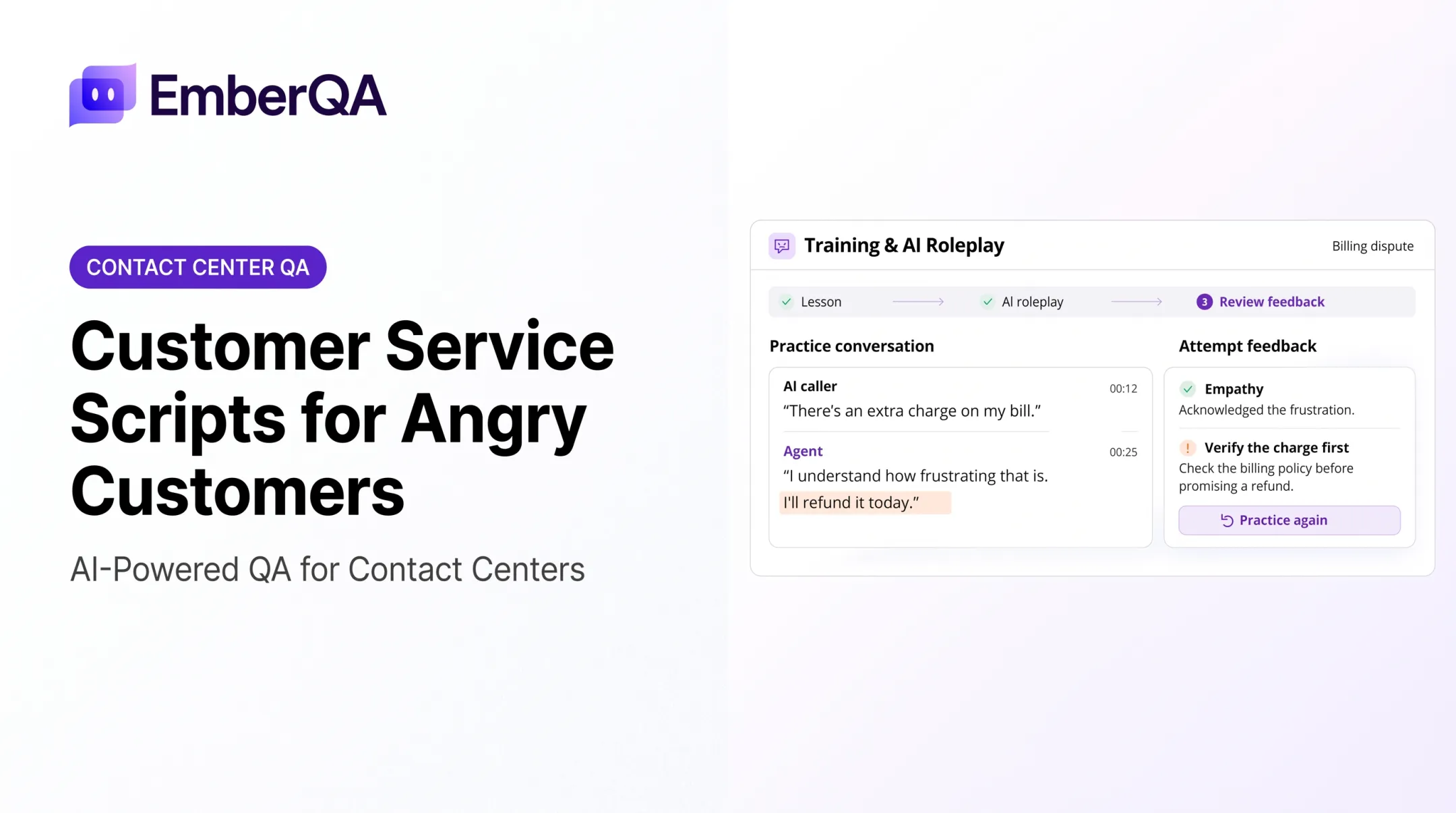
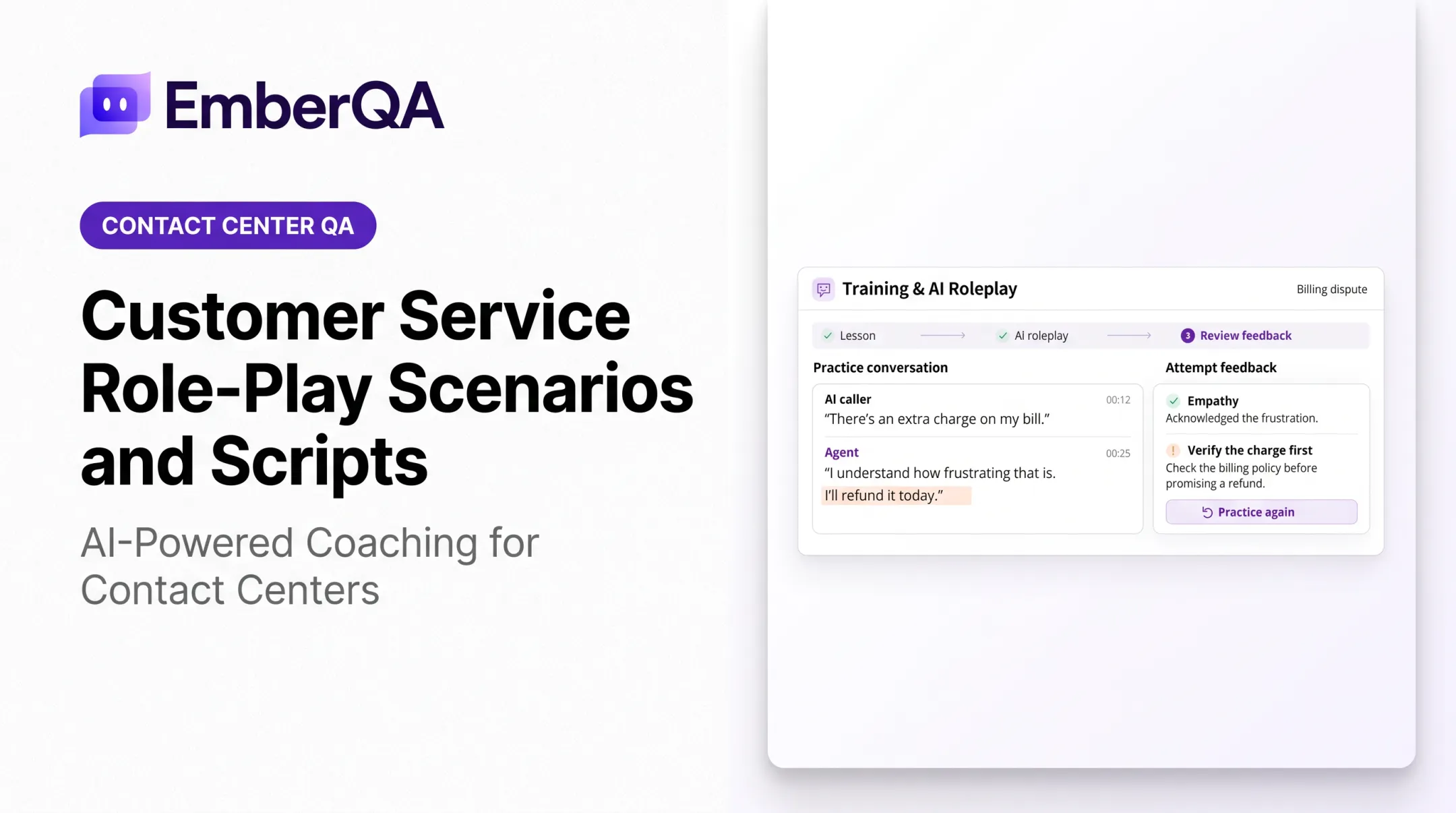
EmberQA closes that gap by automatically scoring 100% of your customer interactions (calls, chats, and emails) against your custom scorecards. You see pattern-level evidence instead of a handful of sampled calls. One answering service, ECA, used EmberQA to increase its QA coverage from less than 1% of calls to 100%, giving managers full visibility into agent performance.

With a system like EmberQA, you can:
- Apply the same rubric to every agent and interaction
- Surface compliance risks or severe customer frustration in real time
- Spot recurring coaching needs around empathy, ownership, and positive language
- Convert QA findings into training aimed at where agents actually struggle
When every interaction is in view, managers spend less time policing isolated calls and more time coaching the behaviors that improve customer outcomes.
Conclusion: Make Empathy Actionable Through Positive Language
The most effective customer service interactions combine emotional acknowledgment with a clear, reliable plan of action. Positive scripting means staying respectful, transparent, and accountable under pressure. When an agent can confidently say, "I understand why this is frustrating, and here is what I am going to do about it," they build trust and de-escalate tension.
Encourage your team to practice these frameworks, adapt the phrases to fit your brand voice, and follow through on every commitment. Build the same standards into QA scorecards and coaching sessions so positive language becomes a measurable skill agents use on every interaction.
Frequently Asked Questions
What are some positive empathy statements I can use in customer service?
Good examples include: "I can see how frustrating that must be," "You're right to expect this to work correctly," and "Thank you for your patience while I look into this." Always connect the statement to a specific action you will take.
What are some empathy statements I can use without saying sorry?
Try phrases focused on acknowledgment and action, such as: "I understand why that was disappointing," "Thank you for bringing this to our attention," or "That shouldn't have happened. Here's what I can do to help."
What is positive scripting in customer service?
Positive scripting is the practice of using constructive, solution-oriented wording that focuses on what can be done for a customer, rather than on negative limitations, blame, or things you cannot do.
How do you write an empathy statement for an angry customer?
First, acknowledge their feeling ("I can hear how frustrating this is"). Then, confirm you understand the core issue. Avoid arguing and quickly pivot to a realistic action you can take to move toward a resolution.
What should customer service agents avoid saying?
Agents should avoid dismissive phrases ("Calm down"), blaming language ("You should have..."), vague promises, and dead ends like "That's our policy" without offering an explanation or alternative.
How can managers coach empathy statements without making agents sound scripted?
Use scripts as flexible frameworks, not rigid lines. Focus your QA and coaching on the behaviors—like active listening, tone, personalization, and follow-through—rather than just checking if an exact phrase was used.