Introduction
Most contact centers hand new agents a thick PDF, call it training, and hope for the best. Then a customer asks something the manual never covered, and the agent improvises.
A well-structured customer service training manual gives agents a consistent reference for policies, workflows, customer communication, and escalation decisions. Without one, teams face predictable problems:
- Inconsistent onboarding across new hires
- Unclear ownership of manual sections
- Outdated procedures nobody flagged for update
- Uneven service quality across shifts
- Little visibility into whether training shows up in live interactions
This guide walks through the essential sections a template needs, how to customize it for your team, and how to build a scenario library agents actually use.
It also covers connecting the manual to quality assurance and coaching, plus the maintenance habits that keep it from becoming a stale document nobody trusts.
By the end, you'll have a practical starting point for building or revising your own template, whether you run an in-house team, a BPO, or a multi-site operation.
Key Takeaways
- Build templates around standards, product knowledge, workflows, soft skills, compliance, and escalations—with real examples.
- Customize by role, channel, product, segment, and risk instead of one generic manual.
- Tie every section to role-play, coaching, and QA so training becomes consistent on-the-job behavior.
- Assign each section an owner, version date, and review trigger so agents never follow outdated guidance.
What Is a Customer Service Training Manual, and Who Needs One?
A customer service training manual is an internal guide that prepares new and existing agents to represent your organization, use support tools correctly, follow approved procedures, and handle customer interactions consistently. It's the resource that turns "here's our product" into "here's exactly how you respond when a customer says X."
How It Differs From Other Resources
Teams often blur the line between four related tools. They can work together, but each has a distinct job:
| Resource | Primary purpose |
|---|---|
| Training manual | Sequences skills, procedures, and practice for readiness |
| Knowledge base / job aid | Gives a quick answer during a live contact |
| Policy document | States the official rule, independent of training |
| QA scorecard | Defines how a scored interaction is judged |
The Association for Talent Development (ATD) recommends building one job aid per task, using familiar terminology and clearly separated steps. That way agents can find an answer fast during a call rather than digging through a full manual mid-conversation.
Who Actually Needs One
This isn't limited to large enterprise call centers. Teams that benefit most include:
- In-house contact centers managing multiple product lines or queues
- Outsourced BPOs proving quality standards to client brands
- Answering services covering multiple client accounts with different scripts
- Multi-site operations needing one consistent standard across locations
- Insurance and financial services teams with licensing or compliance obligations
A manual supports far more than new-hire onboarding. It also backs:
- Refresher training and cross-training between queues
- New product launches and process changes
- Supervisor coaching sessions
- Preparation for quality audits
One important boundary: the manual should document approved practices and decision limits, not encourage agents to "use good judgment" on regulated, contractual, or safety-sensitive issues. Where a rule exists, state it clearly and point to the escalation path instead.
Choose the Right Customer Service Training Manual Template Structure
The right format depends on your team's size, channels supported, customer complexity, and how often things change. There's no single correct structure, but four common options each fit different situations.
- Linear handbook: Works for small, stable teams with one product line and few exceptions
- Modular knowledge base: Suits larger teams that need agents to jump straight to a specific procedure
- Role-specific playbook: Fits organizations where tier-1 and tier-2 agents, or sales versus service reps, need different content
- Client-program template: Standard for BPOs and answering services running distinct standards per client account
For most growing teams, the practical answer is a core manual plus separate appendices for product lines, policies, client accounts, regions, or escalation tiers. This keeps shared behaviors consistent while letting the specifics change without touching the whole document.
Front Matter Every Template Needs
Before the actual content, include a short front-matter page with:
- Manual title and intended audience
- Owner and approval contact
- Version number and effective date
- Next review date
- Summary of what changed since the last version
Keep the body of the manual equally lean. A 200-page document might feel thorough, but agents can't search it during a live call. Modular sections with clear links to the right appendix help agents find what they need under time pressure, which matters far more than completeness on paper.
What to Include in a Customer Service Training Manual Template
A complete customer service training manual template needs six core content areas.
About the Team and Standards
Start with a shared definition of what “good” looks like:
- Brand promise and service standards
- Tone of voice and supported channels
- Hours of operation
- Agent responsibilities and role boundaries
Every later section builds on this baseline.
Product and Service Knowledge
Include approved product descriptions, common customer needs, eligibility or account rules, troubleshooting steps, known limitations, and links to authoritative internal resources. Don't restate the full knowledge base here; link to it instead.
Policies and Standard Operating Procedures
Cover authentication, privacy, refunds, cancellations, credits, documentation requirements, service-level expectations, and accessibility. Any industry-specific compliance content, such as debt collection communication rules or state-specific insurance claims handling, should be verified with legal or compliance stakeholders before it ever reaches a training deck.
Communication and Soft Skills
Train agents on:
- Active listening and empathy
- Plain language and confirming understanding
- Appropriate personalization
- Hold and transfer etiquette
- Written-channel standards
- Approved opening and closing language
Scenario Library Template
This is often the most-used section. Build each entry with these fields:
- Customer situation
- Likely underlying need
- Required steps
- Sample language
- Prohibited responses
- Documentation requirement
- Escalation trigger
- Desired outcome
Answering services often score agents against this same kind of structure. Professional greetings, hold handling, caller verification, message accuracy, tone, and pacing become required elements in both training and QA.
FAQs and Escalation Paths
Round out the template with FAQs, troubleshooting flows, tool instructions, contact directories, and escalation paths. Mark clearly which content is customer-facing and which is internal-only, since these often get confused when documents are shared across teams.
How to Create and Customize the Manual
Building a manual from scratch, or overhauling an old one, follows a repeatable process.
- Define purpose and audience first. Decide whether it supports new-hire onboarding, ongoing reference, a specific client program, a regulated workflow, or all of these through separate modules.
- Gather source material broadly. Pull input from operations, product, compliance, legal, training, QA, workforce management, and experienced agents. Reconcile conflicting instructions and designate one owner for final sign-off.
- Map the customer journey. Identify the highest-risk and highest-volume interaction types, then prioritize the workflows, questions, and escalation situations agents must handle confidently.
- Convert policies into usable instructions. State the trigger, decision rule, agent action, documentation requirement, exception, and escalation route. Skip vague phrasing like "use good judgment" wherever a clearer boundary exists. Example: "If the customer disputes a charge under $50, issue a courtesy credit and log it in the CRM; over $50, transfer to Tier 2."
- Write realistic examples across channels. Include strong responses, weak responses, de-escalation language, and clear cues for when an agent should pause or seek help.
- Pilot before rollout. Test the draft with both new and experienced agents. Watch where they hesitate or interpret instructions differently, then revise wording, navigation, and examples before formal launch.

This mirrors the analyze-design-develop-implement-evaluate cycle instructional designers have used for decades. Build content around observed gaps, test it with real users, and revise based on what actually confuses people, not assumptions.
Make the Manual Actionable With Practice, QA, and Coaching
A manual that just sits in a shared drive doesn't change behavior. It needs to connect to how agents practice and how their work gets reviewed.
Pair Procedures With Practice
Each major procedure should come with a practice activity:
- Role-play
- Call-flow walkthroughs
- Tool simulations
- Knowledge checks
- Shadowing
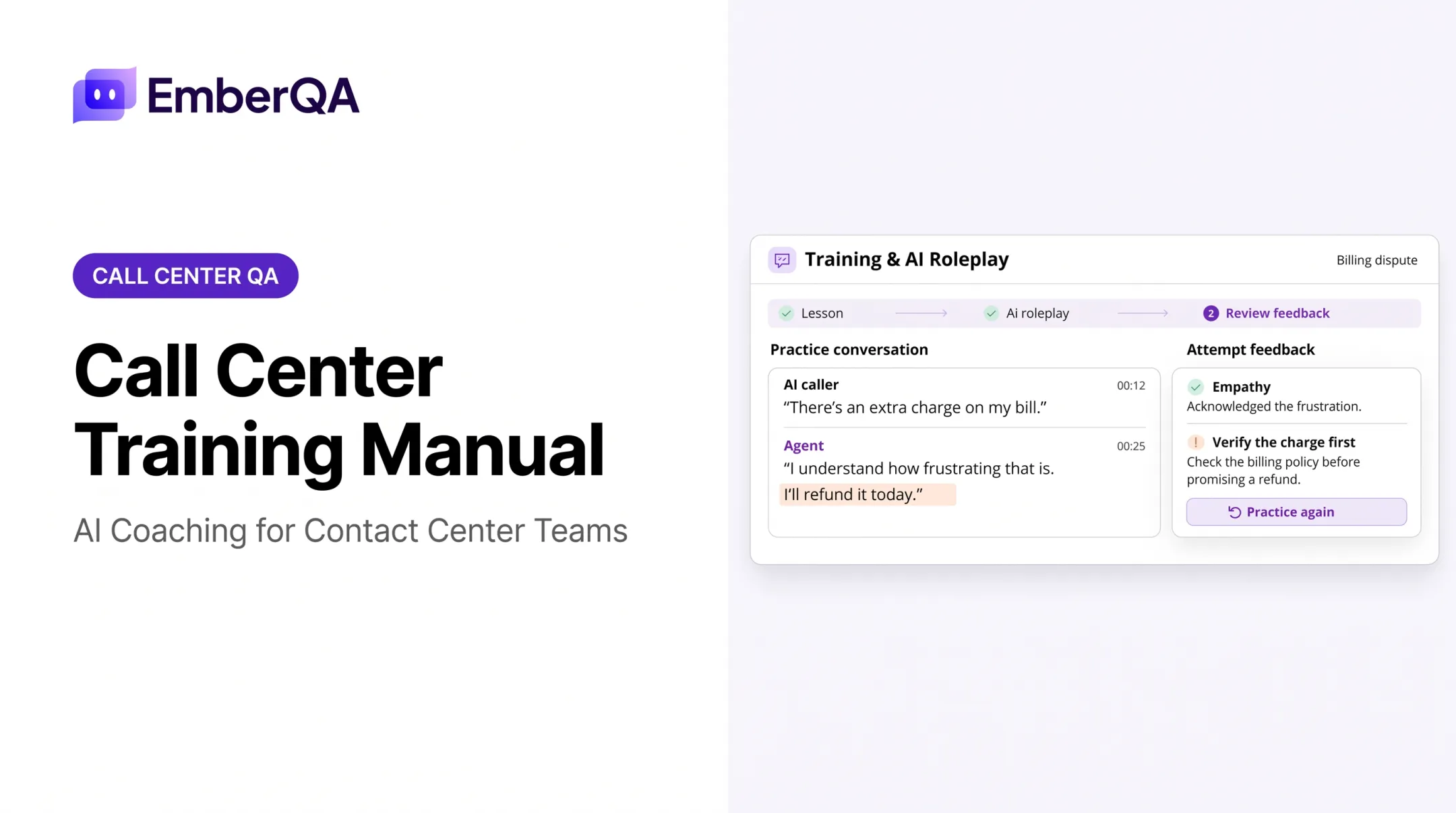
Define what proficiency looks like before an agent handles the workflow unsupervised. Platforms like EmberQA pair lessons and quizzes with AI mock-caller roleplay so agents rehearse realistic scenarios before taking live contacts.
Connect Sections to Measurable Behaviors
Tie manual content to observable actions, not vague goals:
- Verifies caller identity before sharing account details
- Logs the full interaction in the required fields
- Applies the correct policy for the issue type
- Diagnoses the root issue before offering a fix
- Acknowledges the customer's concern without over-promising
- Escalates within the stated time window when thresholds are met
Research benchmarks for your contact type instead of borrowing a figure from another industry. SQM Group's 2024 benchmark found an average 69% first-call resolution rate among participating North American inbound service centers, but that figure reflects a specific sample and shouldn't be treated as a universal target for every queue or channel.
Let QA Reviews Test the Manual, Not Just the Agent
Quality reviews should use a consistent rubric to identify policy misses, communication gaps, recurring customer friction, and coaching priorities. Many manuals stop at describing the standard and never check whether live interactions meet it.
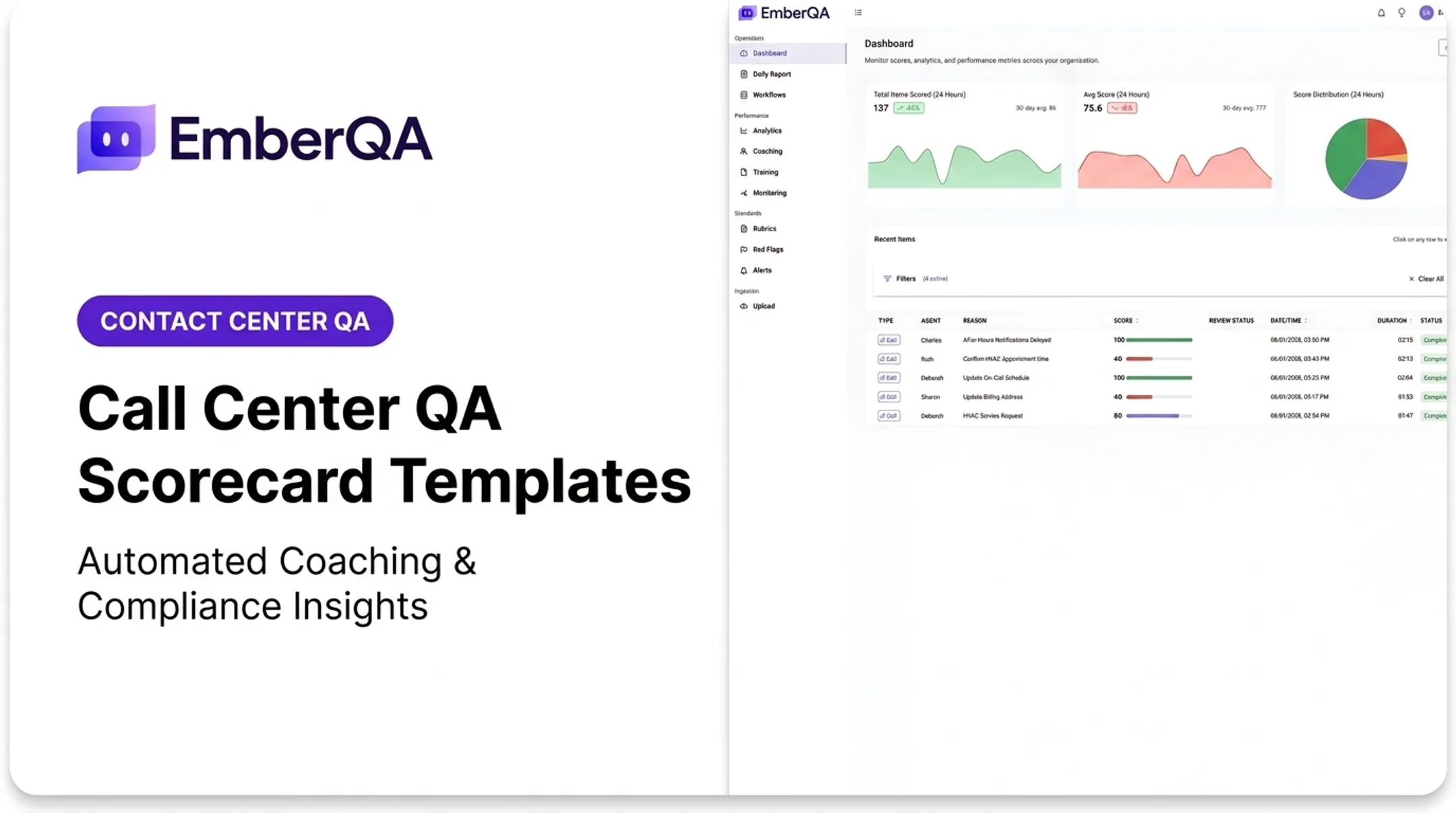
Contact centers that need this visibility often use a platform like EmberQA to score every recorded interaction—calls, SMS, emails, and documents—against custom scorecards.
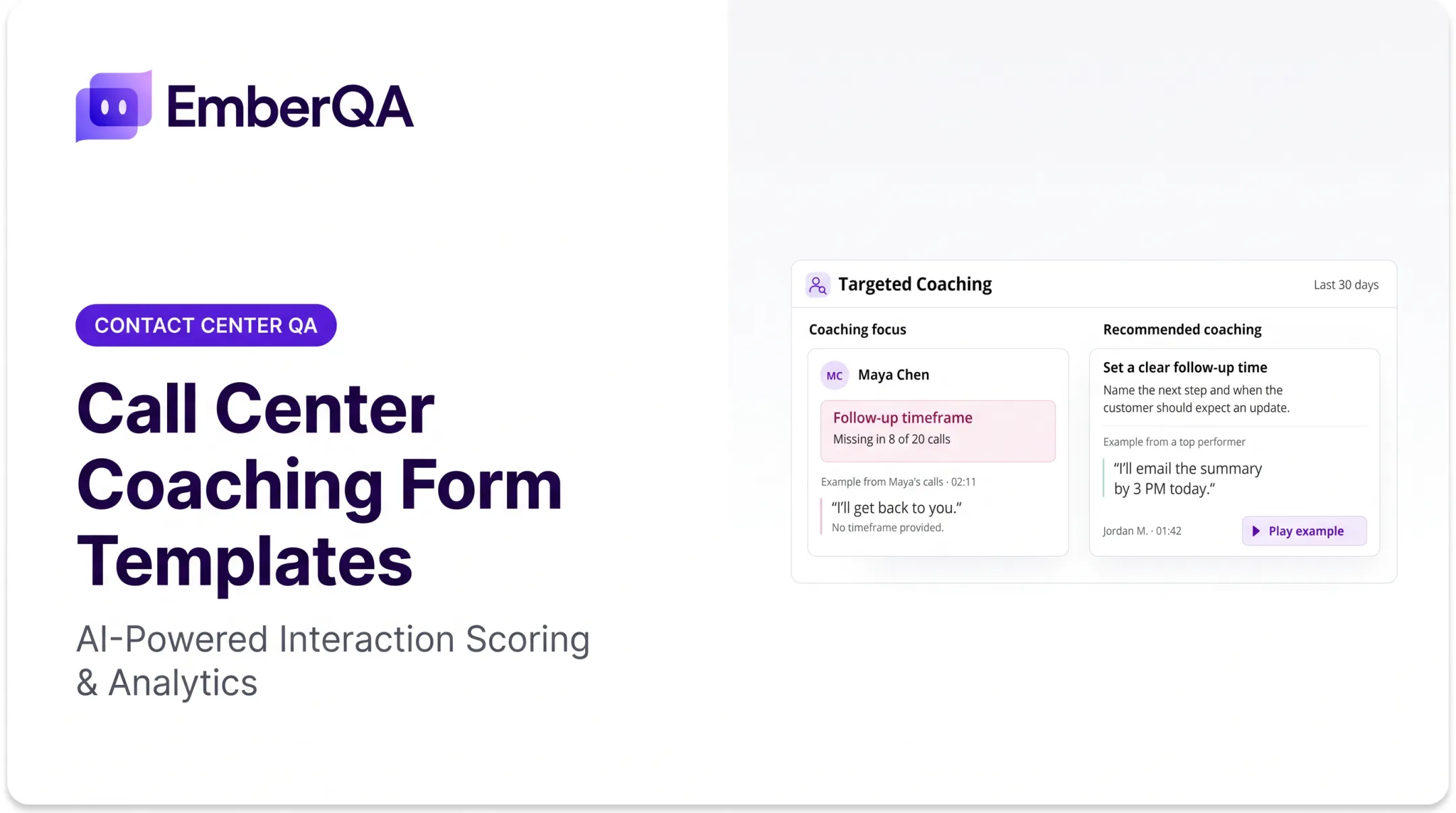
Instead of sampling a handful of calls per agent each month, teams get red-flag alerts on urgent issues and spot recurring patterns that point to a coaching priority or a manual section that needs rewriting.
Close the Loop
Build a feedback mechanism into the template itself. Capture:
- Agent comments
- Supervisor observations
- Customer feedback
- QA findings
- Change requests
Assign an owner to review submissions on a set cadence. Turn recurring findings into manual updates, new practice scenarios, clearer instructions, revised FAQs, or a focused coaching module.

Keep the Customer Service Training Manual Current
An outdated manual is worse than no manual. Agents trust it right up until it's wrong.
Set Review Triggers, Not Just a Calendar Date
Schedule reviews around events, not just dates:
- Product or UI changes
- Policy updates
- New compliance guidance
- New customer segments or client programs
- Recurring QA failures pointing to the same gap
- System migrations
Assign Governance Fields to Every Section
| Field | Purpose |
|---|---|
| Section owner | Who's accountable for accuracy |
| Approval authority | Who signs off on changes |
| Last reviewed date | Transparency for agents and auditors |
| Next review date | Forces a check-in even without a trigger |
| Version history | Tracks what changed and when |
Communicate Changes and Test Findability
Push updates through channels agents actually see:
- Release notes
- Brief team huddles
- Microlearning modules
- Acknowledgment steps for affected agents
Then test the manual itself. Ask agents to locate specific answers under realistic time pressure and report dead ends, duplicate instructions, or broken links.
Keep temporary alerts separate from permanent manual changes. An urgent operational announcement, like a short-term system outage workaround, shouldn't quietly become a second, conflicting source of truth.

Conclusion: Turn the Template Into a Living Training System
A customer service training manual earns its keep when it gives agents clear actions for real situations, not when it simply collects information nobody reads under pressure.
Start practically:
- Define your audience
- Build modular sections
- Add scenarios and escalation rules
- Validate content with the stakeholders who own each policy
- Connect the manual to QA and coaching from day one
Once the manual is live, the harder question is whether it's actually working. Interaction-level QA insight—EmberQA scoring every customer interaction against your scorecards—helps contact center leaders see whether training produces consistent customer-facing behavior and where the manual still needs work.
Treat the template as a living system: ship clear guidance, measure real interactions, and revise the sections agents still miss under pressure.
Frequently Asked Questions
What should be included in a customer service training manual?
Include service standards, product knowledge, policies, workflows, communication guidance, scenarios, escalation paths, tools, compliance rules, and a named owner for updates. Every section should give agents a clear action, not just background.
How do you create a customer service training manual?
Define your audience and purpose, then gather approved material from operations and compliance. Map key workflows, draft modular content, pilot it with real agents, and set a review process tied to specific change triggers.
What is the difference between a training manual and a customer service handbook?
A training manual focuses on instructional, practice-based content that builds a skill. A handbook typically holds broader reference information, like employment policies. Many organizations combine both, as long as the roles stay clear.
How often should a customer service training manual be updated?
Update it whenever a meaningful product, policy, compliance, or workflow change occurs, rather than waiting for a fixed schedule. Supplement trigger-based updates with a scheduled review, such as quarterly, to catch anything missed.
How can training manuals improve customer service performance?
Clear guidance paired with realistic practice supports more consistent processes, stronger agent confidence, and fewer avoidable errors. Validate any performance claims against your own QA and resolution data rather than assuming results.
Should a customer service training manual include role-play scenarios?
Yes. Role-play helps agents practice empathy, troubleshooting, de-escalation, documentation, and escalation decisions before they face comparable situations with real customers. Pair each scenario with clear proficiency criteria so practice translates into readiness.