Introduction
A five-minute customer service call can turn into a legal problem fast. If a caller wasn't properly informed before you hit record, you may have a privacy violation on your hands, not just a QA file.
The tricky part? US call recording rules aren't one law. They're a patchwork of federal statutes and state-specific requirements. A call between a rep in Texas and a customer in California can trigger different standards for the exact same conversation.
This guide breaks down what disclosure and consent actually mean, how one-party and all-party rules work, and how to build a repeatable disclosure process for your contact center. We'll also cover adaptable scripts you can adjust for your own workflows.
This article is educational content, not legal advice. Recording laws change, and courts interpret them differently across jurisdictions. Verify current requirements with qualified counsel before rolling out any recording policy.
Key Takeaways
- Disclosure and legal consent are separate—satisfying one does not satisfy the other.
- State rules range from one-party to all-party consent; some states also require specific notice.
- Interstate calls carry extra risk: either party's state law may apply.
- AI transcription, sentiment scoring, and voiceprints can require disclosures beyond basic recording.
- A written policy, trained agents, and audits matter more than any single disclosure script.
What Is Call Recording Disclosure—and Why Does It Matter?
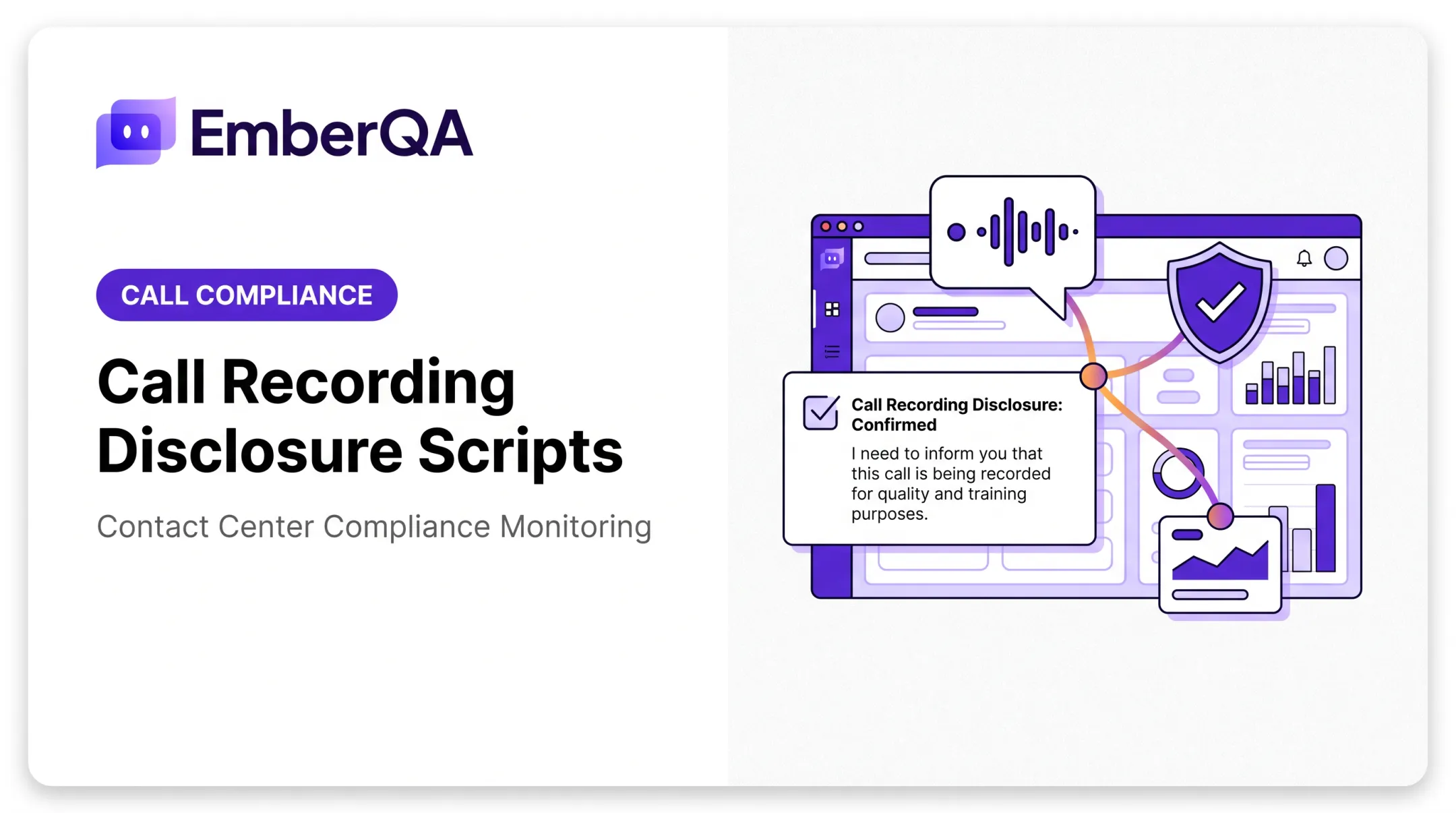
Call recording disclosure is a clear notice telling someone a conversation is being recorded. Consent is separate: it's the legal permission required under a specific statute. The bar for what counts as consent shifts depending on jurisdiction, call purpose, and how the recording is captured.
Telling someone "this call may be recorded" is disclosure. Whether that disclosure legally satisfies consent requirements in, say, Pennsylvania versus Nevada is a completely different question.
What a Useful Disclosure Actually Communicates
A solid disclosure typically covers:
- That the call is being recorded
- Why it's being recorded (training, quality assurance, compliance)
- Whether transcription or AI analysis is part of the process
- How the caller can decline or opt for an unrecorded alternative, where one exists
Skipping any of these doesn't necessarily break the law, but it does weaken your documentation if a dispute ever comes up.
The Real Risks of Getting This Wrong
Non-compliance can expose a business to civil claims, regulatory scrutiny, and in some states, criminal exposure.
In Commonwealth v. Hawk, a Pennsylvania appeals court upheld convictions tied partly to an undisclosed recording involving a prosecutor. That ruling was nonprecedential and involved in-person conversations, not a contact center scenario.
Beyond legal exposure, poor disclosure practices damage customer trust. They can also render a recording useless as evidence if a court finds it was captured unlawfully.
One Call, Multiple Data Questions
Here's something a lot of teams miss: recording, transcription, sentiment analysis, and speaker identification aren't the same activity, even though they originate from the same call. Each one can raise its own privacy question.
A caller told "this call is being recorded for quality purposes" hasn't necessarily been told their voice is being analyzed for sentiment or matched against a voiceprint database. That gap matters more as AI tools get layered onto standard call recording.

How US Call Recording Consent Rules Work
The federal baseline comes from 18 U.S.C. § 2511(2)(d), which permits a call participant, or someone with a participant's prior consent, to record a conversation, as long as the purpose isn't criminal or tortious. This is a one-party consent standard. It doesn't require a spoken disclosure script.
State statutes layer on top of that baseline—and they don't all agree.
One-Party vs. All-Party Consent
- One-party consent states: Only one person on the call needs to know it's being recorded. That can be the business itself.
- All-party consent states: Every participant must consent before recording begins. This is often called "two-party consent," even though it applies to calls with three or more people too.
States with all-party or heightened consent rules include:
- California, Florida, Illinois, and Maryland
- Massachusetts, New Hampshire, Pennsylvania, and Washington
- Other states with notice-based or contested rules
Each statute has its own quirks:
| State | Requirement Type | Notable Detail |
|---|---|---|
| California | All-party (confidential calls) | Separate rule for cellular/cordless calls under Penal Code 632.7 |
| Washington | All-party | A recorded announcement to everyone counts as valid consent |
| Connecticut | All-party or notice-based | Allows a recorded verbal notice or a repeating tone instead of explicit consent |
| Florida | All-party | Prior consent from every participant required |
| Michigan | Contested interpretation | Eavesdropper rule; participant-recording application is disputed |
Statutes change, and court interpretations shift. Don't treat any state list, including this one, as permanent. Check current statutory text before finalizing a policy.
Interstate Calls: Why Location Matters More Than You'd Think
When your agent is in a one-party state and the customer is in an all-party state, which law applies? There's no single federal answer.
Kearney v. Salomon Smith Barney is a useful guidepost. The California Supreme Court applied California's all-party consent law to calls between Georgia-based employees and California clients, going forward.
The practical takeaway from that 2006 decision: if you don't know where a caller is located, following the stricter applicable standard is a reasonable risk-management approach. That isn't a universal legal rule, but it lowers exposure when jurisdiction is unclear.

Notice, Implied Consent, and Explicit Consent Aren't Interchangeable
- Notice tells someone recording is happening but may not equal legal consent on its own.
- Implied consent treats staying on the line after notice as agreement—state law still decides whether that holds.
- Explicit verbal consent requires the caller to affirmatively agree, often documented in the call itself.
- Written or affirmative consent goes further, requiring a clear "yes" captured in some verifiable form.
Situations That Need Extra Review
These edge cases often break a generic disclosure script:
- Recording after the call has already started — retroactive disclosure usually doesn't cover earlier audio.
- Adding a third participant — that person needs their own notice under all-party rules.
- Voicemail and conference calls — all-party statutes typically apply to every participant, including on multi-party lines.
- Payment information capture — separate PCI DSS rules apply (more on this below).
- Recording employees or internal calls — workplace monitoring often triggers separate employment-law notice requirements.
Inbound and Outbound Call Recording Disclosure Scripts
Use these as starting points only. Match each script to your jurisdiction, recording purpose, and legal counsel before going live.
Inbound Automated Message
"Thanks for calling [Business Name]. This call may be recorded for quality assurance and training purposes. If you'd prefer not to be recorded, press 1 to speak with a representative through an unrecorded line, or say 'agent' to continue."
Place this near the top of the call flow. Disclosure buried inside a long menu is easy to miss and weakens consent.
Outbound Agent Script
"Hi, this is [Agent Name] with [Business Name]. Before we get started, I want to let you know this call may be recorded for quality purposes. Let me know if you'd rather I not record, and I can note that instead. Is now still a good time to talk?"
Deliver disclosure before any substantive discussion—not after the caller has already shared details.
Explicit-Consent Version
"This call will be recorded to help us process your request. Do you consent to being recorded?"
The agent should document the response, whether it's a yes or a no, in the CRM or call notes.
Mid-Call Recording Example
If an agent needs to start recording partway through a call:
"I'd like to pause and let you know I'm going to start recording this part of our conversation for accuracy. Is that alright with you?"
Stop, ask, and wait for a clear response before recording starts. Do not enable recording until the caller answers.
What to Avoid
- Vague language like "this call might be monitored" without stating recording explicitly
- Disclosing recording after sensitive information has already been shared
- Framing the alternative as unavailable when one actually exists
- Saying "for quality purposes" while using the data for marketing or other unrelated purposes
Whatever script you use, keep the stated purpose accurate and log the disclosure or consent outcome with the interaction record.

How to Implement a Call Recording Disclosure Process
A script alone isn't a program. You need a structure behind it.
Build a Written Policy
Document the following:
- Purpose of recording (QA, training, compliance)
- Call types affected (inbound, outbound, transfers, conference calls)
- Applicable jurisdictions and consent standards
- Approved disclosure scripts
- Opt-out handling procedure
- Retention, access, and deletion rules
- Who owns policy updates
Map Every Call Flow
Walk through every channel and direction:
- Inbound and outbound
- Transfers and conference calls
- Voicemail and callbacks
- Internal calls
For each path, mark exactly where disclosure, a consent prompt, or a recording block must happen.
Standardize the Agent Workflow
- Disclose before recording starts or before substantive conversation begins.
- Pause immediately if a caller objects.
- Switch to the approved unrecorded alternative.
- Document consent or refusal where required.
- Escalate anything unclear to a supervisor.
Train With Real Scenarios
Role-play interstate calls, upset callers, language barriers, mid-call recording requests, and transfers. Re-certify agents after any policy, system, or legal change, not just at onboarding.
Configure Technical Safeguards
- Automated notification triggers
- Role-based access to recordings
- Redaction or pause functions for sensitive data
- Retention and deletion rules tied to your policy
- Documented testing of every call path, not just the common ones
Audit Regularly
This is where most programs fall apart. Manual sampling catches a fraction of calls, which means disclosure failures can run for months before anyone notices.
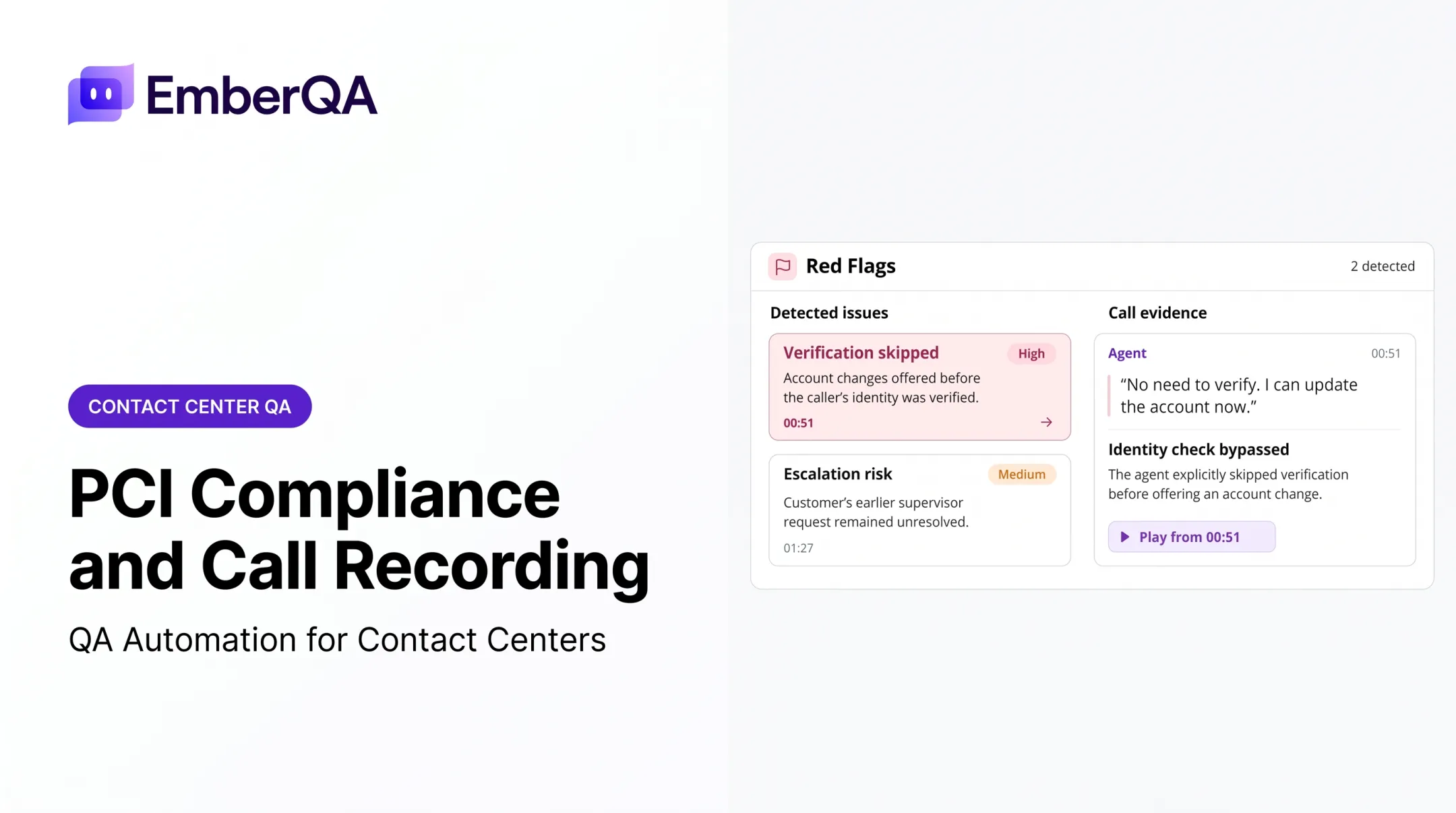
Closing that gap means scoring disclosure on every interaction, not a random sample. EmberQA's call center quality scorecards apply custom rubrics across full call volume, flag privacy and escalation risks automatically, and turn recurring disclosure misses into targeted agent coaching.

Set Up Change Management
Revisit the policy when any of these change:
- You enter a new state
- You add AI transcription
- You switch vendors
- You launch a new call flow
- You receive a legal complaint
A disclosure policy that isn't reviewed after those shifts goes stale fast.
AI, Transcription, and Contact-Center QA Considerations
Saying "this call may be recorded" doesn't automatically cover what happens after the recording exists. If the call gets transcribed, summarized, scored for sentiment, or matched against CRM data, your notice should reflect that.
Match Disclosure to Actual Processing
Ask yourself:
- What data gets retained, and where is it stored?
- Who has access, and for how long?
- How are deletion requests handled?
- Does any vendor use your call data to train its own models?
If the answer to any of these questions changes, your disclosure language probably needs to change too.
Higher-Risk Use Cases Need Legal Review
Some categories carry extra weight:
- Health information: HIPAA safeguards may apply if ePHI is involved.
- Payment card data: PCI DSS prohibits storing card verification codes after authorization, even encrypted, per PCI SSC guidance.
- Voiceprints and speaker ID: Illinois BIPA treats voiceprints as biometric identifiers, requiring written notice and a signed release before collection.
- Employee monitoring: states like New York and Connecticut impose separate workplace notice rules.
- Minors or vulnerable customers: often warrant extra caution regardless of state minimums.
Where Comprehensive QA Fits In
Manual review of 2-3% of calls leaves a lot of blind spots. EmberQA's automated call scoring analyzes calls, transcripts, and structured data together, applying consistent scoring instead of relying on whoever happened to grab a sample that week.
That doesn't replace legal review. It gives managers a faster way to confirm disclosure procedures are followed across every agent and shift.
Automated red-flag alerts can surface a missed disclosure the same day it happens, instead of weeks later in a routine audit.
Before publishing any AI-related policy, research current federal and state rules on privacy, biometric data, and employment monitoring. Don't assume AI tools fall under one uniform standard. They don't yet, and the rules are still shifting state by state.

Conclusion
A legally safer disclosure process depends on more than one script. Build it around:
- Accurate jurisdictional research
- Clear notice and the right consent standard
- An accessible opt-out path
- Trained agents and technical controls
- Audits that run on a schedule
A single disclaimer at the start of a call is not a compliance program. That gap widens once calls cross state lines or involve AI transcription, regulated data, or employee monitoring.
Practical next steps:
- Inventory your current call flows
- Compare them against your approved disclosure language
- Test whether objections get honored in practice, not just on paper
- Bring unresolved questions to counsel before scaling recording volume
Once your legal and policy foundation is set, EmberQA can help operationalize the ongoing review side: scoring every interaction, flagging disclosure gaps, and turning findings into coaching your agents can act on.
Frequently Asked Questions
Do you have to disclose recording a phone call?
Federal and state consent laws control this, and some industries add their own rules. When jurisdiction is unclear, tell every participant and follow the stricter standard, then confirm with counsel.
Can you provide an example of a call recording disclosure statement?
A practical script: "This call may be recorded for quality assurance purposes and may involve automated transcription. If you'd prefer not to be recorded, let us know and we'll use an alternative process."
Can anyone record my call without my permission?
Rules vary by state. One-party consent does not make every recording lawful, especially for workplace monitoring, private communications, sensitive data, or cross-state calls with conflicting standards.
Can my employer record my conversations without me knowing?
Employers still have to follow consent laws, privacy rules, employment statutes, and company policy. Check your state's notice requirements and whether personal calls are captured on the same systems.
What should a call recording disclosure include?
A clear notice that recording is happening, the purpose, any transcription or AI analysis involved, and how the participant can decline or request an alternative.
When should you disclose that a call is being recorded?
Before recording starts and before any substantive or sensitive information is shared. If recording starts or resumes later in the call, a new disclosure is typically needed at that point.