The problem: "AI sales agent" gets used for all three approaches, and buyers often can't tell which one a vendor is actually selling.
Many sales leaders share the same worries. Can an AI system actually hold a useful sales conversation, or does it just read a script? Where does a human rep still need to take over? How should a manager measure whether the deployment is working? And what compliance exposure comes with letting software make outbound calls?
This article breaks down what AI sales agents actually do, how they operate across a call's lifecycle, where they create value, how to roll one out responsibly, and what U.S. compliance rules apply before you launch outbound AI calling.
Key Takeaways
- AI sales agents qualify leads, book meetings, and update CRM—not act as robocallers or analytics tools.
- Pair automation with human escalation, clear knowledge limits, and ongoing quality review.
- Measure qualification accuracy, compliance, and handoff quality, not just call volume.
- Review telemarketing, recording-consent, and disclosure rules before outbound AI launch.
What Are AI Agents for Sales Calls?
An AI sales agent is software that interprets spoken language, makes or receives calls, follows a defined sales objective, pulls from approved information, and takes action, all within set limits. The definition is broad on purpose: buyers usually mean one of four different tools.
The four categories buyers confuse most often:
- Autonomous voice agents — conduct portions of the conversation directly, qualifying leads or setting appointments without a human on the line.
- AI sales assistants — sit alongside a human rep, feeding them prompts, research, or objection-handling suggestions in real time.
- Conversation intelligence platforms — transcribe and analyze calls during or after the conversation, surfacing buying signals and coaching moments.
- AI quality assurance systems — score interactions against a rubric, flag risks, and support coaching, without conducting any calls themselves.
Confusing these four leads to mismatched expectations and, sometimes, compliance blind spots.
Not the Same as a Robocaller
A traditional robocaller plays a fixed recording no matter what the recipient says. An AI sales agent listens, interprets the response, and adjusts its next line accordingly. It can qualify a lead, offer to schedule a callback, or route the person to a human rep based on what they actually said.
That contextual flexibility matters for the sales experience, but it doesn't change the compliance picture. The FCC's February 2024 declaratory ruling confirms that AI-generated voices fall under the same "artificial or prerecorded voice" restrictions as traditional robocalls under the TCPA. Being interactive doesn't exempt a system from consent requirements.
Where Humans Still Matter
Even in heavily automated deployments, human reps remain essential for:
- High-value negotiations and pricing exceptions
- Sensitive or emotionally charged conversations
- Ambiguous requests the agent can't confidently resolve
- Any interaction crossing a defined confidence or policy threshold
Core capabilities to expect
Any credible AI sales agent stack should cover:
- Speech recognition and natural-language understanding
- Text-to-speech output
- Knowledge retrieval from approved sources
- Workflow automation and CRM connectivity
- Call transfer to a human rep
- Audit logging for review and compliance
If a vendor is missing one of these, treat it as a hard gap in demos and security review—not a nice-to-have.
How AI Agents Work During the Sales Call Lifecycle
Understanding the mechanics matters more than the marketing pitch. Here's what actually happens across a call.
Before the Call Starts
The agent imports lead and account context, checks suppression and eligibility lists, and selects the right campaign script. Just as important: it's restricted to a defined set of approved information so it can't improvise pricing or policy details later in the call.
Opening the Conversation
A compliant opening includes identity disclosure, the purpose of the call, and any required recording notice. It should also give the recipient a clear, immediate path to reach a human or end the call.
Vapi's recording-consent documentation outlines this as either a verbal-consent request or a stay-on-line notice. Which method satisfies your state's law depends on where the call lands.
During the Live Conversation
This is where the agent earns its keep:
- Recognizes intent and sentiment — parses questions, objections, and qualification signals as they come up.
- Retrieves approved answers — pulls from a defined knowledge base rather than generating pricing or availability details on the fly.
- Asks qualification questions — captures structured responses and determines the next workflow step.
Taking Action and Escalating
After (or during) the call, the agent can schedule meetings, send approved follow-up materials, create CRM tasks, and route qualified leads to a rep. It should also escalate automatically when it hits low confidence, a complaint, a regulated topic, or an explicit human request.
Closing the Loop
Every call generates a transcript and outcome that teams review against a rubric. Recurring objections or failure patterns feed back into prompt updates, knowledge base edits, and training materials. The process is an ongoing cycle rather than a one-time setup.

Sales Use Cases, Benefits, and Limitations
Not every sales workflow suits an autonomous agent. These use cases usually do.
Highest-value use cases:
- Lead qualification and prioritization against defined criteria
- Appointment setting, rescheduling, confirmations, and reminders
- Follow-up with inbound leads who requested information
- Re-engagement of dormant leads using pre-approved messaging
- Initial information gathering before a human sales conversation
Retell AI's case study on ISpeedToLead reports 20 to 30 sales demos booked per week through AI-driven outbound calling. That figure is one deployment's result, not an industry benchmark, but it shows what a narrow, well-defined workflow can deliver.
What Teams Actually Gain
- Operationally: more calling capacity, faster response, consistent messaging, less admin work
- For customers: shorter waits, clearer follow-up, standardized disclosures
- For managers: broader review coverage and coaching from real conversations, not guesswork
Where Things Break Down
AI sales agents fail in predictable ways:
- Unnatural-sounding responses
- Incorrect qualification decisions
- Hallucinated product or pricing claims
- Weak handling of frustration or emotion
- Accent misunderstandings
- Duplicate CRM entries
- Pushing after a clear no
Choosing the Right Model
| Situation | Best fit |
|---|---|
| Narrow, repeatable, low-complexity workflow | Autonomous agent |
| Trust, judgment, or negotiation is central | Human-assisted AI |
| Goal is coaching, compliance, or visibility into human calls | Conversation intelligence or QA |
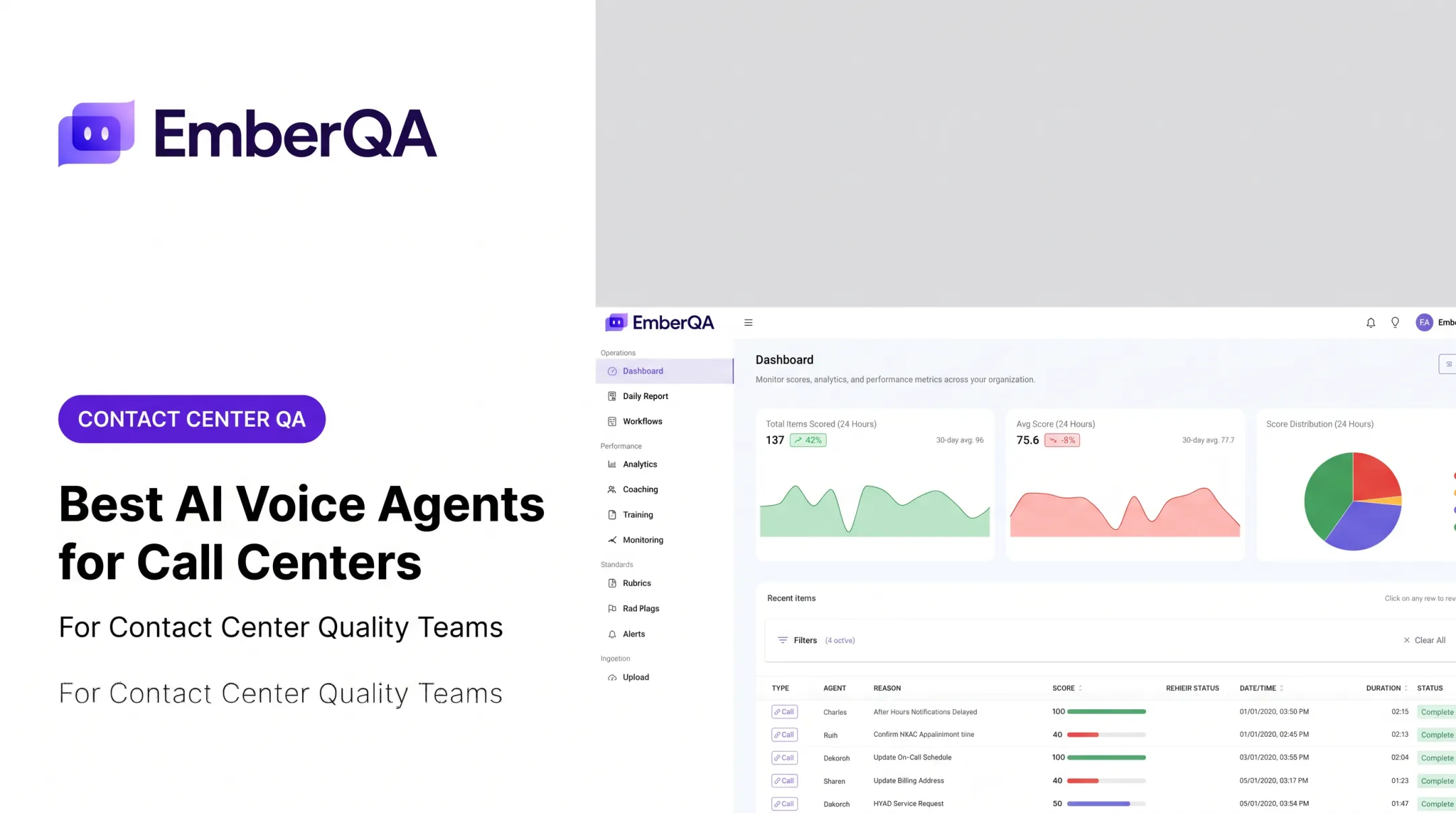
That third row is where a platform like EmberQA fits. It doesn't place the sales call.
Instead, it scores every available interaction—AI agent calls, human rep calls, or chat transcripts—against consistent criteria. It surfaces red flags like hostile behavior or privacy violations, then turns recurring patterns into targeted coaching. For teams running mixed AI and human calls, that oversight layer is often the missing piece.
How to Implement and Evaluate an AI Sales Agent
Rolling out an AI sales agent works best as a narrow, well-tested pilot rather than a full-scale launch.
Start Narrow
- Pick one clearly bounded use case (appointment setting, not full-cycle closing)
- Define the target customer or lead segment precisely
- Document prohibited actions explicitly
- Establish a human handoff path before you go live
Prepare Your Systems
Get the operating stack in place before the first live call:
- Approved knowledge content and scheduling rules
- Mapped CRM fields and disposition codes
- Suppression lists, recording settings, and escalation contacts
- A clear data-retention policy
Test Before You Scale
- Run internal simulations with adversarial questions and objection scenarios
- Test pronunciation and language handling across your actual lead base
- Confirm failure recovery works when the agent gets confused
- Have reps review sample transcripts before wider rollout
- Run a limited pilot before full deployment
Pilot results only matter if the platform can support what you learned. Weigh vendors on:
- Conversation quality and latency
- Knowledge controls and how easily you can update the agent
- CRM and dialer integrations, plus clean transfer capability
- Auditability and security
Measuring What Matters
Track outcomes that tie to revenue and risk—not raw dials:
- Connection and completion rates
- Qualification accuracy and appointment quality
- Transfer rate, opt-out handling, and compliance findings
- Customer sentiment, CRM accuracy, and revenue contribution
Call volume alone tells you almost nothing.
Continuous QA is what keeps the pilot honest. Compare AI-handled outcomes with human-handled calls, investigate outliers, and feed findings back into prompts and escalation thresholds.

That loop is ongoing work, not a one-time audit. Tools like EmberQA help teams score every interaction, surface red flags, and review mixed AI-and-human call traffic so coaching and compliance stay consistent as you scale.
Legal, Privacy, and Human-Oversight Requirements
Whether an AI sales call is legal depends on the campaign, call direction, recipient consent, disclosures made, recording rules, Do-Not-Call obligations, and how personal information gets handled. None of this is a "check one box and you're done" situation. Get qualified legal counsel involved before launching outbound AI calling, not after.
What's Actually Established vs. Proposed
The FCC's 2024 ruling confirms AI-generated voices are subject to the TCPA's prerecorded-voice restrictions, requiring prior express consent for most telemarketing calls.
Separately, an FCC proposal from August 2024 would add AI-specific disclosure requirements, but that's a proposal, not an enacted rule. Don't treat "you must announce this is AI" as settled law everywhere; check current requirements before launch.
For telemarketing broadly, the FTC's Telemarketing Sales Rule guidance requires prompt disclosure of the seller's identity, the sales purpose, and the nature of the offer on covered outbound calls.
Recording Consent Varies by State
California requires all-party consent to record a confidential call. New York requires just one party's consent. If you're calling across state lines, federal one-party consent rules don't override a stricter state law on the other end of the line.
Recording is only one piece. Privacy obligations also apply to how you store, access, and retain call recordings, transcripts, and related customer data—build that path into compliance design, not as an afterthought.

Practical Safeguards Worth Building In
- Disclose AI identity where required or simply where it builds trust
- Immediately honor every request for a human or for no further contact
- Restrict agent access to sensitive personal data
- Log every action the agent takes for audit purposes
- Prevent the system from making claims it can't support
Those controls still need a human layer. Human oversight isn't optional for regulated products, vulnerable customers, complaints, adverse decisions, or high-value negotiations. Any interaction involving real uncertainty deserves a human backstop.
About the "30% Rule"
You may have heard of a "30% rule" limiting how much of a sales call AI can handle. No FCC ruling or FTC rule establishes this as a universal legal requirement.
It may reflect a specific vendor's internal guideline or a misunderstanding of another rule entirely. Don't treat it as binding law without checking the specific source someone's citing.
Frequently Asked Questions
Are companies using AI for sales calls?
Yes, in several forms: autonomous qualification and appointment-setting, real-time coaching for human reps, call transcription, CRM automation, and quality assurance scoring. Allego's 2025 survey of revenue-enablement leaders found 60% use AI for real-time feedback during sales calls.
Are AI sales calls legal?
Legality depends on consent, telemarketing rules, recording requirements, disclosures, Do-Not-Call obligations, and applicable state and federal privacy laws. Have legal counsel review your specific setup before launching outbound AI calling.
What is the 30% rule for AI?
There's no established FCC or FTC rule capping AI at 30% of a sales call. If someone cites this figure, ask for the specific source. It's likely a vendor guideline rather than a legal requirement.
What is the difference between an AI sales agent and a sales-call assistant?
An autonomous agent conducts defined parts of the call itself. A sales-call assistant supports a human rep in real time with prompts, research, or transcription while the person stays on the line and drives the conversation.
How do you measure whether an AI sales agent is working?
Look beyond call volume to qualification accuracy, appointment quality, escalation performance, customer sentiment, compliance findings, CRM accuracy, and opt-out handling. Human review of sampled calls should confirm the numbers match reality.