Many contact centers, BPOs, answering services, and regulated customer-facing teams share the same problem: they don't review enough calls to know what's really going on. According to ICMI, manual QA reviews cover less than 1% of total call volume at most companies. That means the vast majority of interactions never get a second look.
This checklist is built for U.S. teams that need consistent interaction quality across every call, agent, and site: contact centers, BPOs, answering services, insurance and financial services teams, and multi-location operations. Call audits often get grouped with QA and call monitoring, but they aren't the same thing. Here's how the process actually works, what to evaluate, and how to turn findings into action.
Key Takeaways
- Run audits from clear objectives through sampling, calibrated scoring, evidence-based feedback, and re-auditing.
- Score CX, agent behavior, resolution, compliance, documentation, and technical call quality on every checklist.
- Use KPI trends to spot what is happening; use call audits to explain why.
- Let AI expand coverage and flag risk; keep humans on coaching and calibration.
What Is a Call Audit and Why Is It Used?
A call audit is the review of a completed inbound or outbound call using a documented scorecard. The goal is straightforward: determine what happened, whether it met defined standards, and what should improve.
That sounds simple, but the term gets confused with related activities constantly.
Call Audit vs. Call Monitoring vs. Quality Assurance
- Call monitoring usually means listening live, often so a supervisor can step in during the call itself.
- Quality assurance (QA) is the broader program: evaluation forms, coaching, calibration, and reporting over time.
- A call center audit casts a wider net, examining workforce, technology, and processes beyond individual interactions.
- A call audit sits inside QA. It's the scored review of one specific recording.
Why Organizations Audit Calls
Teams run call audits to:
- Identify coaching needs before they surface as a CSAT drop
- Verify adherence to scripts, compliance rules, and internal processes
- Improve customer experience by catching friction points early
- Uncover recurring issues across agents, teams, or locations
- Create a defensible record of quality decisions for clients or regulators
Those goals only hold up when coverage is high enough to matter. The gap between call volume and review capacity is real: many teams still evaluate just two or three calls per agent per week. That's not enough data to catch a compliance issue before it repeats across hundreds of interactions.
This is part of why answering services like ECA have moved away from spot-checking a handful of calls. Using EmberQA, ECA scores every recorded interaction against its existing quality categories, closing the sampling gap without adding reviewer headcount.
How the Call Audit Process Works
A defensible call audit follows the same five steps, whether it's done manually or with automated support.
- Set the audit objective and scope. Decide whether you're reviewing customer service, sales, collections, compliance, resolution quality, or CRM accuracy. Then narrow the focus to a specific campaign, team, location, or client account.
- Select representative interactions. Combine random sampling with targeted pulls: escalations, complaints, repeat contacts, high-risk transactions, new-hire calls, or interactions flagged by customers or systems. Document your selection criteria and confirm recording permissions before you start.
- Build, validate, and calibrate the scorecard. Use observable questions, clear scoring definitions, and weighted criteria where it matters most. Add critical-fail rules for serious risks. Have multiple reviewers score the same sample calls together first and resolve disagreements before the real audit begins.
- Review, score, and document evidence. Assess the recording, transcript, disposition, and CRM notes together. Record timestamps or direct quotations that support each finding. Don't rely on general impressions or a single overall score.
- Analyze patterns and act. Group issues by agent, team, process, product, or compliance category. Assign an owner and deadline for coaching, script updates, workflow fixes, or escalation.

Where AI Fits Into the Workflow
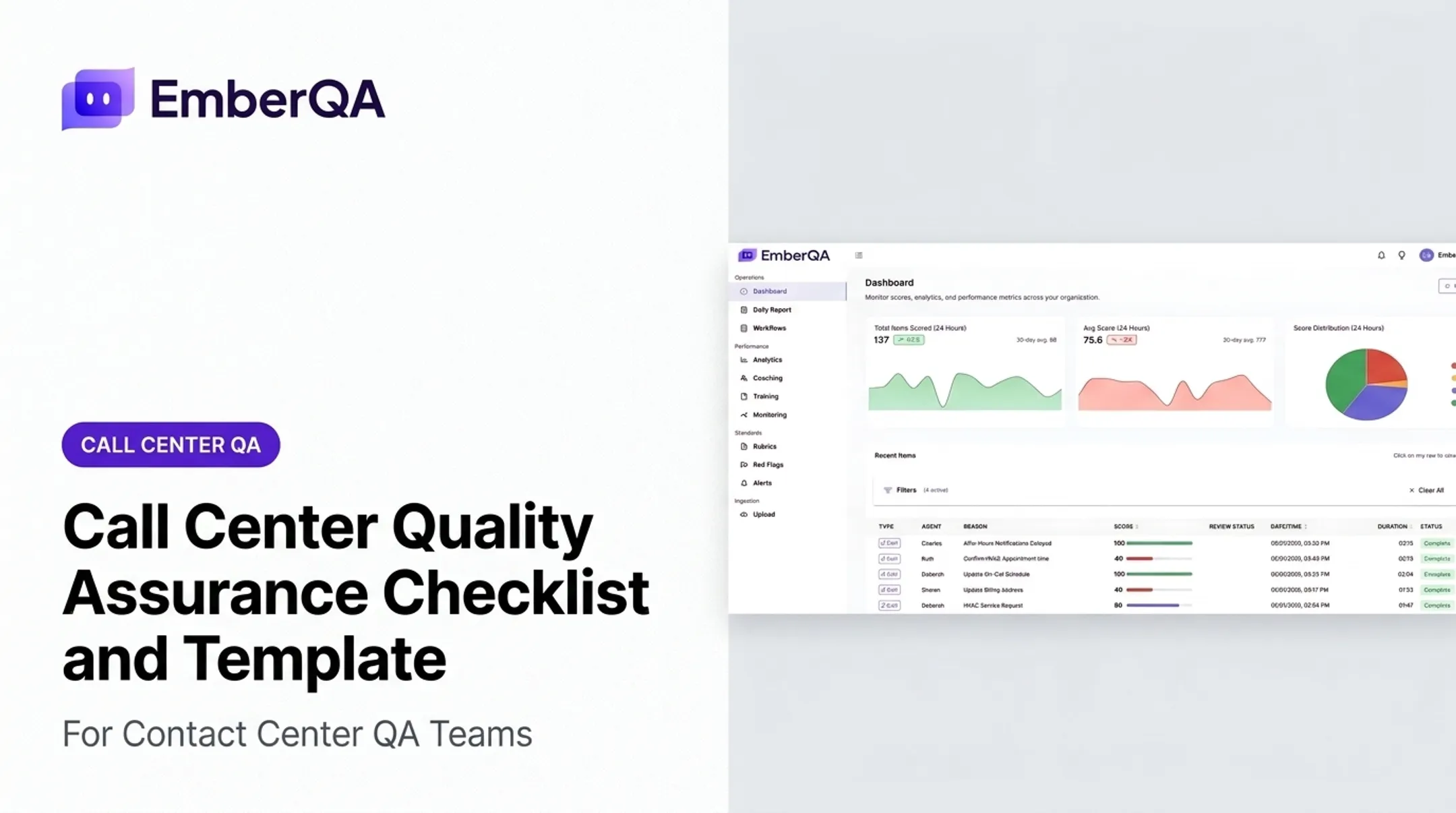
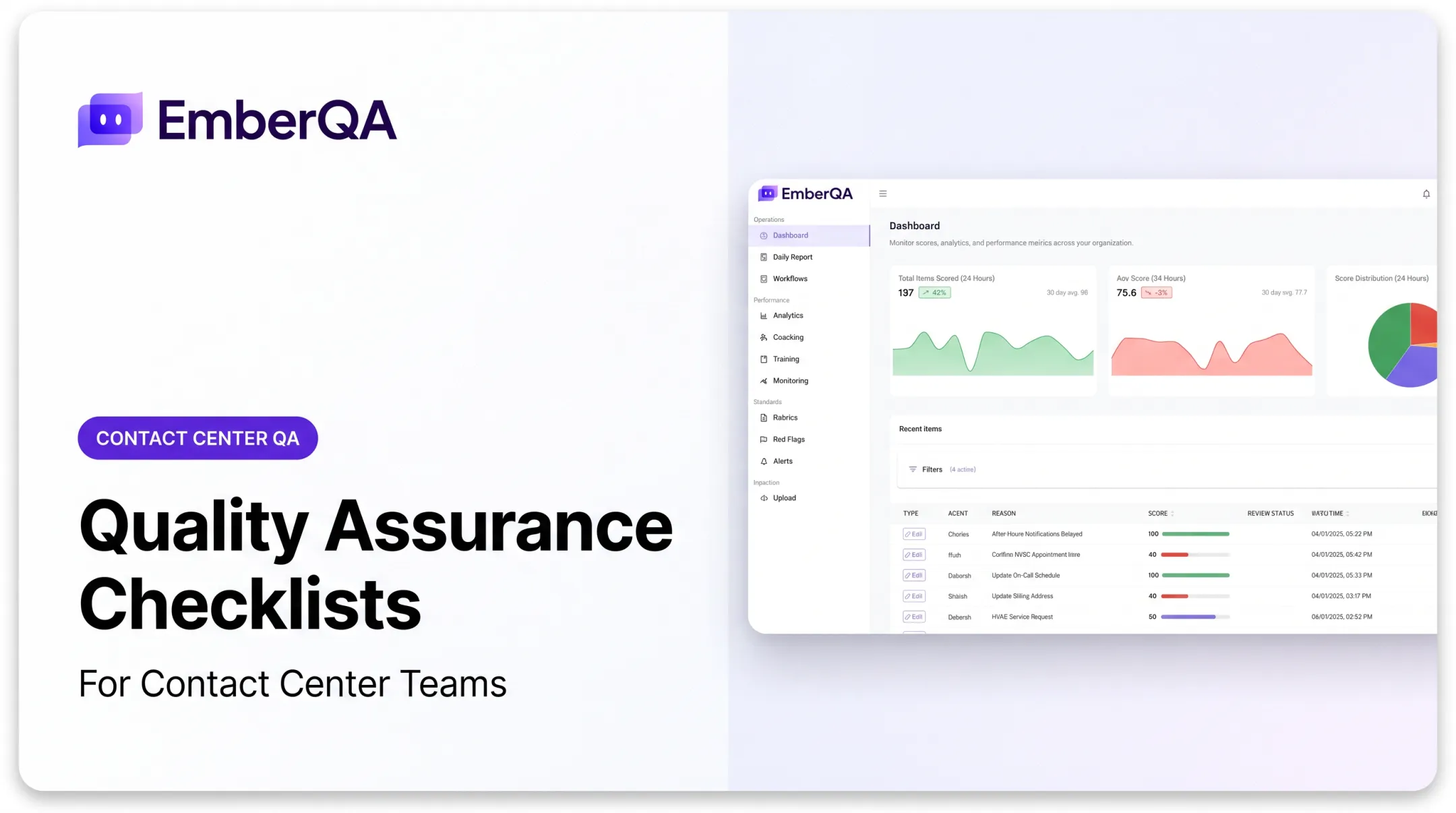
This is where a platform like EmberQA changes the math. Instead of a reviewer sampling 1% of calls, EmberQA applies a consistent rubric to every recorded interaction across calls, SMS, emails, and documents.
It surfaces red flags like privacy violations, improper advice, or hostile behavior for immediate supervisor attention.
Human reviewers still own the nuanced calls: disputed scores, coaching conversations, and calibration decisions. AI expands what gets looked at; people decide what it means.
Call Audit Checklist: What to Evaluate
A useful checklist covers six areas. Skip any of these, and your audit will miss real risk.
Customer experience and etiquette
- Greeting and identity confirmation
- Professionalism, empathy, and active listening
- Clarity, tone, and de-escalation when needed
- Personalization and a clear, respectful close
Communication and knowledge accuracy
- Appropriate clarifying questions, not assumptions
- Current, correct information — no confusing jargon
- Clear next steps explained to the customer
- No unsupported promises or misleading claims
Call handling and issue resolution
- Hold and transfer practices, and routing accuracy
- Ownership of the issue rather than a hand-off
- Script or workflow adherence, and first-contact resolution where relevant
- Escalation decisions and customer confirmation that the issue was addressed
Compliance and risk controls
- Recording disclosure and consent, where applicable
- Authentication and handling of sensitive information
- Required disclosures, complaint procedures, and approved language
- Escalation of potential violations
Recording consent isn't uniform across the country. A legal guide from the Reporters Committee for Freedom of the Press identifies 11 states that generally require all-party consent to record a call. States like Connecticut and Nevada add further wrinkles.

If your operation spans multiple states, your compliance checklist needs to reflect that variation, not a single national rule.
Documentation and follow-up
- Disposition and CRM record accuracy
- Case notes and commitments a colleague could pick up cold
- Follow-up tasks actually logged, not just mentioned
Sales, service, and technical criteria
- Needs discovery and ethical upsell or cross-sell behavior
- Audio quality, dropped calls, and background noise
- System failures that prevented the agent from serving the customer
Where Call Audits Apply and What Affects Results
Call audits show up across inbound service, outbound sales, collections, claims, healthcare and education support, answering services, outsourced BPO programs, and multi-site operations.
The scorecard should shift with the risk level. An insurance sales call carries different compliance weight than a routine appointment reminder.
Common audit triggers:
- Recurring QA reviews on a set schedule
- New-hire ramp-up periods
- Campaign launches or client-program reviews
- Complaint investigations and post-escalation reviews
- Re-audits after coaching or process changes
What makes audit results reliable:
- Recording and transcript quality
- Representative sampling, not just convenient calls
- Reviewer calibration and clear scoring definitions
- Language, accent, and interaction context
- Separation of critical compliance failures from lower-risk coaching moments
Benchmarks vary widely by industry, so treat them as context, not a universal target. SQM Group's 2024 research found an aggregate 69% first-call-resolution rate across surveyed inbound service centers, with results ranging from 43% to 88% depending on the sector.

That spread is the point: pull your own benchmark for your industry rather than assuming one number applies everywhere. BPOs need that same program-level comparison when reporting to clients. EmberQA's client reporting tools let outsourcers track agent, team, and location trends against each client program's own targets instead of a generic industry average.
Common Issues, Misconceptions, and Limitations
A high overall score doesn't prove a good customer experience. Weighted averages can hide a single critical failure, recurring friction, or wildly inconsistent performance between teams. Treat critical-fail items separately from general coaching points.
Process design creates other blind spots. Watch for these common mistakes:
- Auditing only convenient or easy-to-access calls
- Using vague scoring criteria that different reviewers interpret differently
- Penalizing harmless deviations from a script
- Treating average handle time as a standalone quality measure
- Confusing correlation between a KPI and a behavior with proof of causation
Scoring automation has limits of its own. AI can widen coverage and improve consistency, but it can still misread context, sentiment, accents, or nuanced compliance situations. Human review, calibration, and a clear dispute-escalation path still matter, no matter how much scoring is automated.
A full audit isn't always the right tool. Skip it, or use something lighter, when:
- The interaction is low-risk and exploratory, with no meaningful business question attached
- You don't have usable consent or recording access
- A live monitoring session, customer survey, or system investigation would answer the question faster
Signs your process is running on autopilot:
- Scorecards with no connection to business goals
- Excessive review of low-risk calls
- The same finding repeated with no assigned owner
- Feedback delivered without supporting evidence
Conclusion
A call audit process is a repeatable cycle:
- Define scope
- Select interactions
- Apply a calibrated checklist
- Document evidence
- Act on patterns
- Verify the changes worked
The strongest audits balance customer experience, agent development, operational performance, and compliance. None of that comes from chasing a single score.
Technology can expand visibility and cut manual review time, as ECA and Spot On Schedulers found when they moved from checking a handful of calls to scoring every interaction with EmberQA. Criteria, human judgment, and coaching follow-through are still what turn that audit data into improvement.
Frequently Asked Questions
What are the 5 stages of a call audit process?
Preparation and scope, call selection, scoring and evidence collection, findings analysis, and follow-up or re-auditing. Each stage feeds the next, so skipping a stage or its documentation weakens the whole cycle.
What are the 5 key performance indicators of a call center?
CSAT, first-call resolution (FCR), average handle time (AHT), service level, and abandonment rate are commonly tracked. The right mix depends on your center's goals and industry.
What should be included in a call audit checklist?
Etiquette, communication, knowledge accuracy, issue resolution, compliance, documentation, and technical call quality. Each area should have observable, scored criteria rather than general impressions.
How often should calls be audited?
Frequency depends on call volume, risk level, staffing, and audit objectives. Set a documented recurring schedule, then add targeted reviews for high-risk or unusual interactions as they come up.
What is the difference between a call audit and quality assurance?
A call audit reviews one specific interaction. Quality assurance is the wider program covering standards, calibration, coaching, reporting, and continuous improvement across all interactions.
Can AI automate the call audit process?
AI can handle transcription, interaction search, scoring, and red-flag detection at scale. Human reviewers should still validate nuanced findings, manage calibration, and deliver coaching conversations.