Introduction
Picture a contact center handling thousands of calls, chats, and emails every week across multiple locations. Now ask: how many of those interactions actually get reviewed for quality?
For most teams, the honest answer is a small fraction. Traditional QA programs often review only 2%–5% of interactions, according to COPC's research on AI quality monitoring.
The vast majority of customer conversations go unchecked. That gap gets riskier as teams add channels, vendors, and compliance obligations.
Some QA programs still rely on documented processes and manual scorecards. Others use AI to analyze calls, chats, emails, and documents at scale.
This guide walks through the main solution types, how to choose one, implementation steps, measurement approaches, and what modern QA looks like for contact centers.
Key Takeaways
- Effective QA combines clear standards, consistent evaluation, actionable feedback, and continuous improvement
- Manual reviews add context but rarely scale to cover most interactions
- AI-powered QA surfaces patterns and high-risk conversations, while humans still handle calibration and judgment calls
- Choose solutions based on coverage, scoring consistency, workflow fit, security, reporting, and integrations
What Is a QA Solution?
A quality assurance solution is the combination of processes, people, standards, and technology used to make sure interactions, products, or services meet defined expectations. It works as a full system spanning standards, evaluation, coaching, and continuous improvement.
QA vs. QC: Why the Distinction Matters
Quality assurance and quality control get used interchangeably, but they're not the same thing. ASQ defines QA as the part of quality management focused on providing confidence that requirements will be met. QC, by contrast, is more narrowly focused on checking outputs for errors after the fact.
In practice:
- QA builds the standards, training, and processes that prevent problems
- QC catches errors in what's already been produced or said
How This Plays Out in Customer Interactions
For a contact center, a complete QA solution translates standards into scorecards, reviews conversations against those scorecards, identifies gaps, and turns findings into coaching or process changes.
That's a different job from a standalone testing tool. A real QA solution should support planning, evaluation, reporting, corrective action, and ongoing improvement. Flagging a mistake is only the first step.
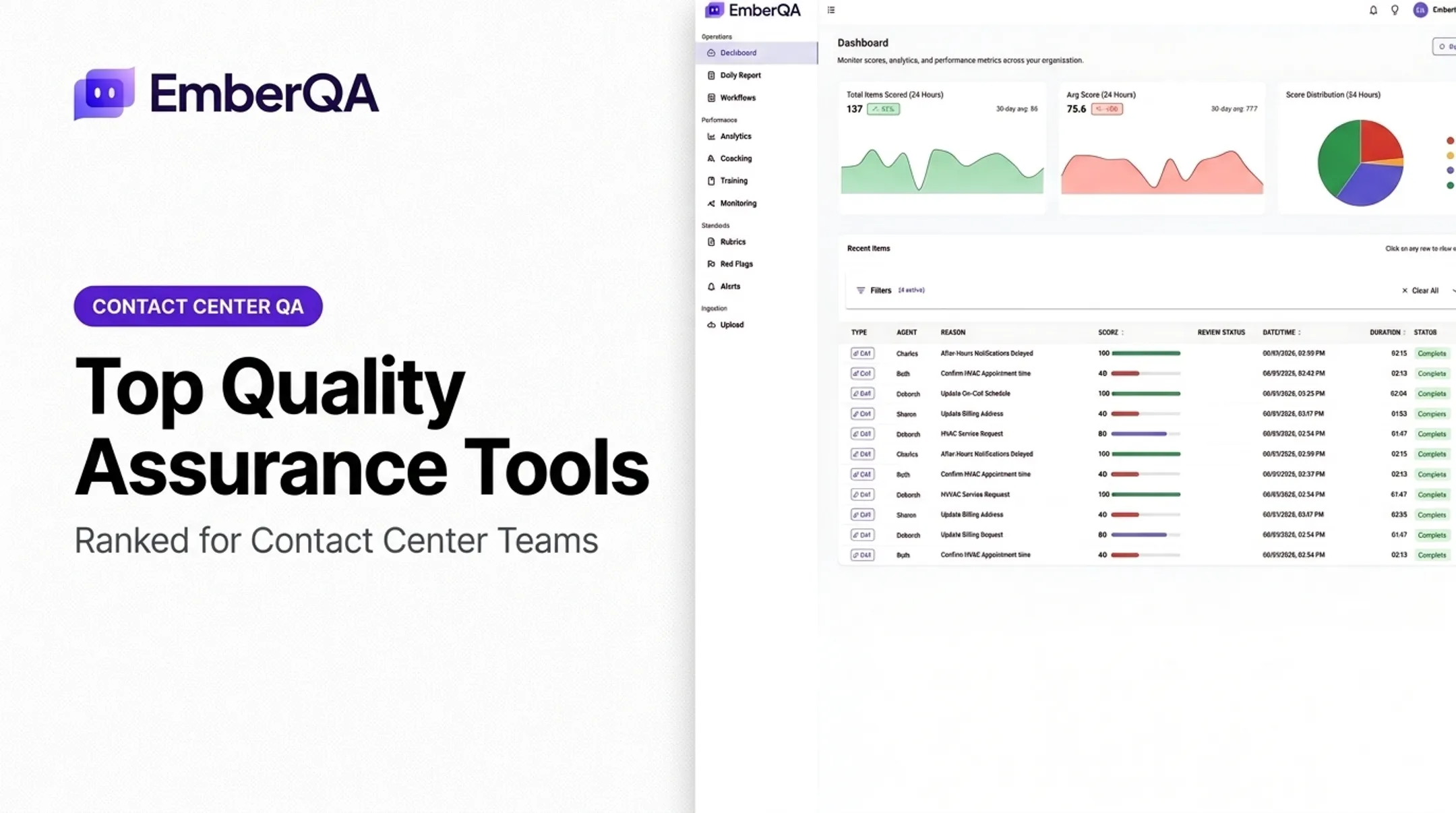
EmberQA, for example, applies custom scorecards, rubrics, metrics, and weights to every scored interaction. Those scores then feed analytics, coaching recommendations, and training, so findings drive action instead of sitting in a spreadsheet.
Types of Quality Assurance Solutions
Not all QA solutions work the same way. The right fit depends on interaction volume, risk tolerance, staffing, and how much coverage you actually need.
Manual Interaction Reviews
Supervisors or QA analysts listen to calls or read transcripts, then score them against a rubric. This approach delivers strong contextual judgment: humans catch nuance that's hard to codify.
The tradeoff: coverage. An older ICMI study found many centers monitored only 1%-3% of total interactions, which leaves most conversations unchecked. Small samples can miss recurring problems entirely.
AI-Powered Interaction QA
AI-powered systems can analyze transcription and interaction data across every call, chat, or email, not just a sample. These systems typically include:
- Rubric-based scoring applied consistently across agents and teams
- Trend detection across large volumes of interactions
- Red-flag identification for compliance or escalation risks
- Prioritization that routes high-risk interactions to human reviewers first
Patterned behaviors like greetings or required disclosures are easier for AI to score reliably than subjective outcomes like customer trust or resolution quality. Pairing automation with human judgment still matters.
Managed or Outsourced QA
Some organizations bring in outside expertise for QA program assessment, extra review capacity, or multi-client reporting. That support helps during rapid growth or when internal bandwidth is limited.
Hybrid QA
Most practical setups land here: automation handles broad monitoring and flags likely issues, while people validate findings, coach agents, calibrate reviewers, and dig into complex cases. This model captures automation's reach without giving up human oversight entirely.

A quick note: interaction QA is different from software-testing QA, manufacturing QA, or supplier-quality QA. Those disciplines evaluate different objects against different standards. The right solution always depends on what you're actually assessing.
How to Choose a Quality Assurance Solution
Before comparing vendors, get specific about what you actually need.
Start With Business Requirements
Define the channels, teams, locations, client programs, and compliance obligations the solution must support. A single-site team with one channel has very different needs than a multi-vendor BPO managing dozens of client programs.
Evaluate Coverage and Scalability
Can the platform cover the share of calls, chats, emails, and SMS you need without adding manual workload?
ICMI's 2024 research found only 25% of contact centers were truly omnichannel, even though most handle multiple channels. Judge coverage on:
- Every channel you actually use, not phone-only sampling
- Volume you can score without hiring more reviewers
- Room to add locations, vendors, or client programs later
A QA tool that only covers phone calls leaves real gaps.
Assess Scoring and Workflow Fit
Look for:
- Configurable rubrics that match your standards, not a generic template
- Consistent application of criteria across reviewers
- Office- or program-specific workflows for multi-location teams
- Reviewer calibration and dispute handling
- Coaching assignment built into the workflow, not bolted on
Scoring fit only holds up if the same platform can satisfy your risk and compliance bar.
Review Risk, Compliance, and Security
Requirements vary by industry and data type. Map controls to what you actually handle:
- HIPAA for protected health information
- GLBA and the FTC Safeguards Rule for financial customer data
- PCI DSS for stored card details
- State recording-consent laws for call and message capture
Match QA access, retention, and alerting to those obligations—not a generic checklist.
Examine Reporting and Actionability
Dashboards should surface recurring patterns across agents, teams, locations, and clients, not only isolated scores. If reporting cannot show why scores move—script gaps, disclosure misses, handle-time tradeoffs—it is not actionable.

Build a Vendor Comparison Checklist
Once requirements, coverage, scoring, risk, and reporting are clear, pressure-test vendors on operations and proof:
- Implementation support and onboarding process
- Data handling, retention, and access controls
- Integrations with existing CRM, ticketing, and workflow tools
- Searchability of past interactions and scores
- Customer references and pricing structure
How to Implement and Measure a QA Solution
Rolling out a new QA solution works better as a staged process than a single big-bang launch.
Establish Your Baseline
Document your current sampling rate, review time per interaction, scorecard definitions, escalation practices, and coaching workflow. You need this snapshot to measure whether the new solution actually improves things.
Design the Rubric
Build scoring criteria around observable behaviors: required disclosures, accuracy, resolution quality, empathy, and process adherence. Adapt the rubric to your industry. An insurance sales call and a debt collection call carry different compliance risks.
Pilot Before Full Rollout
Test the solution with one team, channel, or client program first. Compare automated findings against expert human reviews to check scoring reliability and catch rubric gaps early.
ECA is a useful proof point: it moved from manually reviewing under 1% of calls to scoring 100% with EmberQA, applying its existing quality categories to every interaction. A clean pilot result like that is the green light for broader rollout.
Close the Loop
A QA solution only creates value if findings turn into action:
- Route urgent issues for immediate escalation
- Assign coaching for recurring behavior patterns
- Document corrective actions taken
- Confirm whether coaching actually changed later performance
Train Everyone Involved
Managers, QA analysts, and agents all need to understand how scores are determined, how disputes get handled, and that findings support improvement, not punishment.
Measure With Balanced Indicators
Track these indicators together—no single metric tells the whole story:
- Coverage across interactions
- Review consistency between scorers or models
- Issue-detection rates on known risk categories
- Coaching completion and follow-through
- Compliance outcomes
- Customer-experience signals
Schedule Regular Calibration
Customer expectations, products, and regulations shift. Revisit scorecards, alerts, and workflows on a regular cadence so scoring stays aligned with current products, policies, and risk.

Modern QA Solutions for Contact Centers
High-volume contact centers face a specific version of this problem: manual sampling simply can't keep pace with call volume, and small samples miss patterns that only show up across hundreds of interactions.
Beyond Limited Sampling
Technology that analyzes a much larger share of interactions catches things a 2% sample never will. Recurring compliance gaps, agent-specific coaching needs, and process breakdowns only surface when coverage is broad enough to show the pattern.
Red Flags That Prompt Action
Automated red-flag alerts surface urgent issues so supervisors can investigate quickly instead of finding problems weeks later in a routine review. Common triggers include:
- Hostile behavior
- Improper advice
- Privacy violations
- Escalation risks
Turning Patterns Into Coaching
Recurring issues across interactions often point to knowledge gaps or inconsistent processes rather than isolated agent mistakes. That distinction changes how managers intervene: they fix the process or train the skill instead of treating every miss as a one-off performance issue.
EmberQA is built around this exact problem. As an AI-powered quality assurance platform for contact centers and customer-facing teams, it offers:
- Automated scoring of every interaction, not a sample
- Custom scorecards with configurable rubrics, metrics, and weights
- Searchable, comparable calls and transcripts
- Red-flag detection for compliance and escalation risks
- Office- or program-specific QA workflows
- CRM verification alongside call data
Spot On Schedulers, for example, used EmberQA to review 100% of calls across 18 dental offices, with each office scored against its own process and CRM data checked alongside the call itself.
This kind of approach fits BPOs juggling multiple client programs, insurance and financial services teams managing compliance risk, and enterprise contact centers running across several sites or vendors. Teams still stuck on small manual samples can see gaps, risks, and coaching needs that sampling never surfaces.
Frequently Asked Questions
What is a QA solution?
A QA solution is the combination of processes, standards, people, and tools used to evaluate and improve quality. In contact centers, this typically includes interaction reviews, scorecards, alerts, reporting, and coaching workflows.
What are the main types of quality assurance solutions?
Manual, AI-powered, outsourced/managed, and hybrid QA are the four main models. The best fit depends on your interaction volume, risk level, staffing, and desired coverage.
How does an AI-powered QA solution differ from manual QA?
AI can analyze and prioritize a much broader set of interactions consistently. Human reviewers still handle contextual judgment, calibration, escalation decisions, and personalized coaching.
What should a contact center look for in a QA solution?
Look for coverage across channels, configurable scorecards, red-flag detection, strong reporting, integrations with existing systems, security controls, and solid implementation support.
How can a QA solution improve agent performance?
Consistent evaluations and trend-based insights help managers pinpoint specific behaviors, assign focused coaching, track improvement over time, and recognize strong performers.
How long does it take to implement a quality assurance solution?
Timelines vary based on data access, integrations, rubric complexity, and team size. Starting with a defined pilot use case and validating the workflow before scaling is the most reliable approach.