Introduction
Most contact centers still evaluate customer interactions the old-fashioned way: a QA specialist listens to a small handful of calls each month and hopes those calls represent everything happening on the floor.
That approach worked when call volumes were manageable. It doesn't hold up anymore. Sparse sampling leaves compliance gaps, coaching blind spots, and uneven scoring across the floor.
Communication monitoring is the structured observation, recording, analysis, or review of interactions to support quality, security, compliance, risk management, or operational decisions.
This article focuses primarily on US contact centers and customer-facing teams. The same principles also apply to employee communications and network activity in other contexts.
You'll learn how monitoring differs from surveillance, what channels and objectives shape a program, how the monitoring workflow actually functions, and what legal and ethical guardrails matter. The payoff is better quality, compliance, and coaching decisions from the interactions you already capture.
Key Takeaways
- Treat monitoring as purpose-driven and policy-governed; surveillance is broader and less transparent
- US consent and recording rules vary by state, industry, and communication channel
- Manual sampling covers a fraction of interactions, leaving blind spots in QA and compliance
- Automated scoring needs human review before it drives coaching or employment decisions
- A written policy on scope, access, and retention protects the business and its customers
Types of Communication Monitoring and Surveillance
Monitoring describes ongoing observation and analysis tied to a stated purpose. Surveillance tends to imply something broader, more intensive, or covert. The line between them isn't really about the technology. A speech analytics platform can support responsible QA or enable invasive tracking, depending entirely on governance: what's collected, who sees it, and why.
Monitoring by Channel
Contact centers typically monitor across several channels:
- Voice calls and recorded conversations
- Video meetings and screen-share sessions
- Email and SMS threads
- Live chat and social messaging
- Written account notes and CRM records
Monitoring by Objective
Programs are usually built around four distinct goals:
- Quality monitoring evaluates accuracy, empathy, process adherence, and resolution quality
- Compliance monitoring checks required disclosures, approved scripting, consent steps, and conduct rules
- Security and risk monitoring flags unauthorized access, data exposure, or fraud indicators
- Performance monitoring tracks response times, transfer rates, and recurring interaction patterns
Comparing Monitoring Methods
| Method | Strength | Limitation |
|---|---|---|
| Manual sampling | Deep human judgment on select calls | Covers a small fraction of volume |
| Rules-based monitoring | Consistent, scalable keyword triggers | Misses nuance and context |
| Automated speech/text analysis | Reviews far more interactions | Needs human validation |
| Human-in-the-loop review | Combines scale with judgment | Requires clear escalation ownership |
Monitoring by Frequency
How often you review interactions should match risk and purpose:
- Continuous monitoring for high-risk compliance channels
- Scheduled sampling for general QA
- Event-triggered review when specific red flags appear
- Retrospective review for audits and disputes
Choose frequency by purpose, risk level, and channel—not by habit.
Why Communication Monitoring Matters to Modern Organizations
Manual review simply can't keep pace with interaction volume. Industry QA standards acknowledge this directly.
COPC's Customer Experience Standard requires monthly sample sizes that reflect statistical implications and unbiased selection. Sampled scores are not full coverage.
COPC's 2022 global benchmarking survey found that 95% of surveyed executives used recorded monitoring and 79% used speech analytics. That measures tool adoption, not the share of interactions actually reviewed.
The Real Business Case
Effective monitoring ties to concrete outcomes:
- More consistent QA scoring across agents and shifts
- Faster identification of urgent compliance or safety issues
- Coaching based on specific, documented behavior
- Stronger documentation for internal reviews or disputes
The Risks of Doing It Poorly
Poorly designed monitoring creates its own problems:
- Alert fatigue from too many low-value flags
- Inconsistent interpretation across reviewers without calibration
- Employee distrust when purpose isn't communicated
- Biased scoring when rubrics aren't tested for fairness
- Decisions made on incomplete context, such as a single flagged phrase
Monitoring should always tie back to a defined goal and action plan. Interaction data collected without a clear purpose is accumulation, not quality assurance.
How Communication Monitoring Works
A monitoring program generally follows a clear sequence:
- Define the objective
- Identify in-scope channels
- Establish notice and permissions
- Collect or access interactions
- Apply rules or models
- Generate alerts and scores
- Conduct human review
- Take action
- Audit the program periodically

Data Inputs and Minimization
Programs typically draw on:
- Recordings and transcripts
- Metadata, timestamps, and disposition codes
- Agent and customer identifiers
- CRM fields
Collect only what is relevant to the stated purpose. Skip data that has no bearing on the objective.
Surfacing Interactions for Review
Rules, keyword detection, sentiment analysis, and scoring rubrics can flag interactions automatically. But automated signals still require validation. A keyword hit isn't proof of wrongdoing; it's a starting point for human judgment.
Alert Triage
Not every flag deserves the same response. Effective programs separate:
- Urgent red flags requiring immediate supervisor review (potential compliance breach, hostile behavior)
- Coaching opportunities for targeted feedback during regular sessions
- Informational trends worth tracking but not requiring individual action
Each category needs a defined owner, escalation path, and documentation requirement.
Example workflow: A call gets automatically flagged for a possible missed disclosure. An authorized reviewer listens to the flagged segment, confirms the issue, documents the finding, and assigns targeted coaching to the agent. That's the difference between a useful alert and noise.
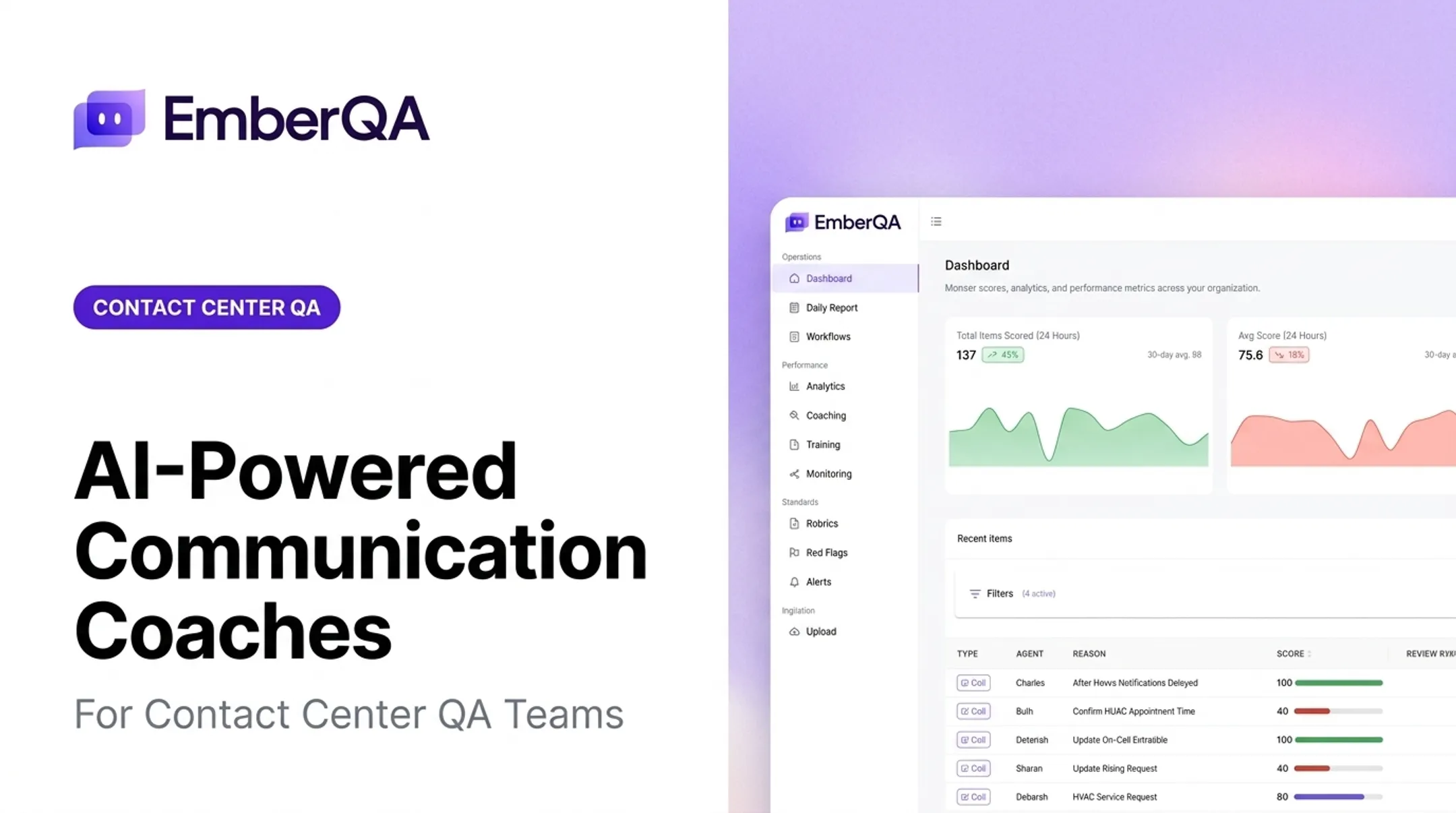
EmberQA's collections QA product works this way in practice: it scores every customer interaction rather than sampling, and can push updates automatically to CRMs, ticketing systems, dashboards, and supervisors when a rubric-based flag appears.
Dashboards showing recurring issues by agent, team, or location help managers spot patterns, but not every variation should trigger discipline. A single low score might be noise; a pattern across dozens of calls is signal.
Legal, Privacy, and Ethical Guardrails
US communication-monitoring obligations vary by federal law, state law, industry, employment context, and channel. This section is not legal advice. Review your specific situation with qualified legal and privacy counsel.
Consent Requirements Vary Sharply by State
Under 18 U.S.C. § 2511(2)(d), federal law permits call interception with one party's consent, absent a criminal or tortious purpose. Several states go further:
- California requires all-party consent to record a confidential communication, including phone calls (Penal Code 632)
- Florida, Illinois, Maryland, Pennsylvania, and Washington also impose all-party consent requirements for covered communications
- Connecticut allows a recorded verbal notification or warning tone as an alternative to explicit consent
If your contact center handles calls across multiple states, the strictest applicable rule for each call typically governs.

Sector-Specific Rules
Industry rules often stack on top of general wiretap and privacy law:
- Debt collection: Regulation F requires collectors who record calls to retain each recording for three years, though it doesn't mandate recording every call
- Financial services: The FTC Safeguards Rule requires an information-security program covering access controls and vendor oversight
- Insurance: State-adopted NAIC privacy regulations govern disclosure of consumer financial and health information
- Healthcare: HIPAA's Security Rule applies to electronic protected health information, generally limiting use to the minimum necessary
Policy and Privacy-by-Design
A written monitoring policy should define:
- Purpose and scope of monitoring
- Channels covered and notice methods
- Retention periods and access rights
- Employee and customer complaint processes
Pair the policy with privacy-by-design controls:
- Restrict access by role
- Mask or redact sensitive fields
- Encrypt stored and transmitted recordings
- Set retention limits and delete data securely when no longer needed
Human Oversight Isn't Optional
Don't treat automated scores as infallible evidence for termination or regulatory conclusions. Require contextual human review before those decisions stick.
Build an ethics checklist that covers:
- Proportionality of monitoring to the stated purpose
- Bias testing across scorecards and models
- False-positive tracking and remediation
- A clear appeal path for flagged employees or disputed scores
Building a Responsible Communication Monitoring Program
Start with a documented business problem, not a tool purchase. Inconsistent QA scores, unresolved compliance exposure, or blind spots in high-risk interactions are legitimate starting points. "We should monitor more" is not.
Core Program Components
- Accountable program owner and cross-functional stakeholders
- Approved monitoring objectives tied to business need
- Data inventory and scoring rubric
- Escalation process with defined owners
- Access controls and retention schedule
- Training and periodic review cadence
Pilot Before You Scale
Test the program on a defined interaction set. Compare automated findings against expert manual review. Calibrate scoring until reviewers align.
COPC's 2022 survey found 89% of organizations reported a calibration process, and 86% called theirs effective. Those figures sit close enough to breed false confidence. Confirm calibration produces consistent scores, not just scheduled meetings.

What to Measure
Track both outcomes and program health:
- Review coverage and alert precision
- Issue-resolution time and coaching completion rates
- Score consistency across reviewers
- Privacy incidents and employee feedback
Published benchmarks for these metrics are limited, so calibrate against your own baseline rather than assuming industry-wide targets apply to your operation.
AI-Powered Monitoring for Contact Centers
AI-assisted QA platforms can help teams move past the sampling problem described earlier. EmberQA, an AI-powered quality assurance platform built for contact centers and customer-facing teams, is one example of how this works in practice. It's not a substitute for legal advice, and it's not designed to justify covert employee surveillance.
Core Capabilities
EmberQA analyzes calls, chats, emails, and documents against organization-specific rubrics rather than relying on random sampling. Its collections QA product, for instance, scores every customer interaction instead of a subset. Key workflows include:
- Automated scoring that applies consistent criteria across agents, teams, sites, or client programs
- Red-flag detection that surfaces privacy violations, improper advice, escalation risks, or hostile behavior for prioritized human review
- Searchable, comparable interactions that help managers spot recurring language and coaching themes
- CRM verification, comparing call content against associated case records when configured and permitted by policy
One documented example: a company using EmberQA's workflow went from reviewing under 1% of calls manually to scoring 100% of them automatically. Every call produced a searchable transcript, a rubric-based score, and the reasoning behind that score.

From Flag to Coaching
The practical coaching loop works in four steps:
- Identify a recurring behavior across flagged interactions
- Validate it against representative transcript examples
- Give the agent specific feedback tied to that evidence
- Track improvement on subsequent calls
Questions to Ask Any AI Monitoring Vendor
Before adopting any platform, contact-center leaders should ask:
- Which channels does it support, and can rubrics be configured to our standards?
- How explainable are the scores, and is there an audit trail?
- What role-based access and data retention controls exist?
- Has the scoring model been validated for bias, and is human review built into the workflow?
- Can we export or delete data on request?
The NIST AI Risk Management Framework offers useful voluntary guidance here, calling for ongoing testing and defined human oversight roles for AI systems used in operational decisions. It's not a legal mandate, but it's a reasonable checklist for evaluating any vendor.
Conclusion
Communication monitoring earns its value when interaction data becomes fair, timely, actionable decisions. Watching more activity does not create that value on its own.
The principles that make this work stay consistent:
- Define a purpose before you monitor
- Monitor proportionately to that purpose
- Communicate clearly with employees
- Protect the data you collect
- Validate automated findings
- Keep humans in the review loop
- Connect every insight to coaching or remediation
If your team still relies on limited manual sampling to evaluate customer interactions, there's a real gap between what you're catching and what's happening on your calls. EmberQA helps contact-center and customer-facing teams analyze more interactions, flag risks earlier, and coach agents from evidence rather than guesswork.
Explore what it looks like for your team with a demo.
Frequently Asked Questions
What is communication monitoring?
Communication monitoring is the structured observation, recording, or analysis of calls, messages, or other interactions for a stated business, quality, security, or compliance purpose. It is tied to defined policy, not open-ended observation.
What are the different types of monitoring?
Monitoring can be organized by channel (calls, chat, email), by objective (quality, compliance, security, performance), or by method (manual, rules-based, AI-assisted). Frequency ranges from continuous to scheduled, event-triggered, or retrospective review.
What is the difference between communication monitoring and surveillance?
Monitoring is typically purpose-limited and policy-governed. Surveillance can imply broader, more intensive, or covert observation. The same tool can be either, depending on transparency and governance.
Is communication monitoring legal in the United States?
Legality depends on the communication type, parties involved, state consent laws, industry, and employment context. Federal law allows one-party consent in many cases, but several states require all-party consent. Get qualified legal guidance for your specific situation.
What types of communication can organizations monitor?
Calls, video meetings, email, SMS, live chat, social messaging, transcripts, metadata, and CRM notes are all common examples. Scope should stay necessary, disclosed where required, and controlled by written policy.
How can contact centers use AI to monitor communications responsibly?
AI can score interactions, detect red flags, and surface coaching patterns at scale. Responsible use requires configured rubrics, human review of flagged items, privacy controls, bias testing, and clear employee communication about what's monitored and why.