The pressure to make this shift is real. Zendesk found that 67% of consumers now want an AI assistant to handle their customer service queries in an AI-assistant-first future. Customers expect relevance immediately, not after three follow-up emails.
This guide breaks down the AI capabilities driving modern engagement, where they deliver the most impact across the customer lifecycle, and how to evaluate platforms without ignoring the risks that come with automating high-stakes customer relationships.
Key Takeaways
- Real-time AI personalization relies on predictive, generative, and agentic models
- Manual QA reviews under 5% of conversations, so most interactions go unchecked
- 67% want AI for routine queries; 86% still value humans for complex issues
- Select platforms for real-time data, omnichannel coverage, and measurable ROI
What Is AI Customer Engagement?
AI customer engagement uses data, machine learning, and automation to deliver personalized interactions at the right moment across the customer journey. Instead of applying the same scripted sequence to every contact, an AI system reads real-time signals—call and chat behavior, ticket history, prior outcomes—and decides what a specific customer needs next.
Traditional engagement runs on static rules: send this email on day three, escalate a ticket after 24 hours untouched. Dynamic, AI-driven engagement adapts when the customer's situation changes mid-journey. A repeat caller with an open issue gets treated differently than a first-time contact that resolves on the spot.
For CX and contact center leaders modernizing their workflows, this shift means:
- Moving from fixed cadences and static rules to signal-triggered outreach
- Treating every touchpoint (call, chat, email) as data that informs the next decision
- Building feedback loops so engagement sharpens with each interaction, not just at quarterly reviews
The Core AI Capabilities Powering Modern Customer Engagement
Predictive AI: Anticipating Needs and Intent
Predictive AI evaluates a customer's past behavior, purchase history, and support interactions to forecast what happens next: renewal likelihood, churn risk, or propensity to buy. It scores every account against these outcomes instead of waiting for a rep to notice a pattern manually.
One McKinsey analysis of B2B sales transformations found that after introducing new lead-scoring and routing, alongside specialized sales roles and improved outreach sequences, one organization saw lead-to-appointment conversion double and appointment-to-opportunity conversion increase fivefold.

That lift reflects the whole intervention, not lead scoring in isolation, but it shows how prioritized, data-informed outreach compounds.
Predictive models also catch churn early. A payments processor built a model to predict which merchants might reduce their business within seven days, giving account teams a real window to intervene before revenue slipped away.
Generative AI: Scaling Personalized Content Creation
Generative AI scales the content side of engagement. It drafts subject lines, email variants, and in-app messaging tailored to a customer's segment or recent behavior, at a volume no copywriting team could match manually.
But generative output needs guardrails. Salesforce's responsible-AI guidance calls for accuracy checks, bias and safety testing, and human review before scaling content into production. Skip those steps and brand voice erodes fast.
Practical guardrails worth building:
- Lock tone and terminology into a style guide the model references
- Route new message types through marketing or compliance review before automating
- Audit generated content on a set schedule, not only at launch
Most mature teams treat generative AI as a draft engine, not a publish button.
Agentic AI: Autonomous Decision-Making and Real-Time Orchestration
Agentic AI decides the next action, channel, and timing, then executes it. Teams get next-best-action automation without manually configuring every rule.
Gartner predicts agentic systems will autonomously resolve 80% of common customer service issues by 2029, cutting operational costs by roughly 30%. That's a forecast about where investment is heading, not a current benchmark to promise stakeholders this quarter.
The feedback loop matters more than the label. When a customer responds well to a particular offer or timing, the system weights that pattern higher for similar customers going forward.
When they don't respond, it tries something else. Over time, engagement decisions get sharper without a strategist rewriting the playbook every month.
High-Impact Strategies for AI-Driven Engagement Across the Lifecycle
Top-of-Funnel Personalization and Dynamic Onboarding
AI analyzes where a visitor came from and how they're behaving in real time to serve tailored recommendations and onboarding paths—not one generic welcome flow for every signup.
Customers expect this immediacy. Salesforce Research found 73% of customers expect companies to understand their unique needs, and Zendesk's 2025 data shows 61% expect AI-driven interactions to feel personally tailored. That expectation starts at the first interaction, not the fifth purchase.
For onboarding specifically, this looks like:
- Adjusting welcome flows based on signup source (paid ad, referral, organic)
- Surfacing setup steps relevant to the plan or use case selected
- Triggering check-ins based on actual product usage, not a fixed day-3/day-7 calendar
Once the first session feels personal, the next test is whether help arrives as fast as the welcome did.
24/7 Intelligent Support and Virtual Assistants
Conversational AI agents resolve routine questions instantly across web chat, SMS, and messaging apps—without a human touching the ticket. Common wins include:
- Order status and delivery updates
- Password resets and account access
- Appointment changes and simple scheduling
That same demand for instant help is pushing more teams toward AI-first support. The harder problem is triage.
When self-service is not enough, smart routing should pass the issue to a human specialist with context already attached:
- Prior messages in the thread
- Account history and recent actions
- Logged sentiment and urgency cues
Handoff quality decides whether AI support feels helpful or frustrating.
Speed alone does not keep customers. The signals inside those same conversations also show who is about to leave.
Proactive Retention and Churn Prevention Workflows
Early warning signs show up before a cancel: usage drops, ticket volume spikes, and sentiment turns negative. Models trained on interaction patterns—including QA and conversation signals contact-center teams already capture—can flag at-risk accounts while there is still time to act.
A US airline used predictive insights to tailor compensation after service disruptions. It reported a 210% improvement in identifying at-risk customers and a 59% drop in churn intention among high-value accounts (intention, not confirmed churn, but a strong leading indicator).

Automated workflows can then trigger win-back offers or educational content before the account walks.
Elevating Engagement Quality with Conversation Intelligence and Interaction Analysis
Moving Beyond Limited Sampling to 100% Interaction Coverage
Most QA teams work from a small sample. Managers pull a handful of calls per agent each month, score them, and hope the sample reflects reality.
McKinsey research found manual quality assurance historically covered less than 5% of conversations, leaving the other 95% completely unreviewed.
That gap isn't just a QA inconvenience. Compliance issues, coaching opportunities, and early churn signals sit buried in calls nobody ever listens to. ECA hit the same wall: useful feedback stayed buried in recordings nobody had time to revisit.
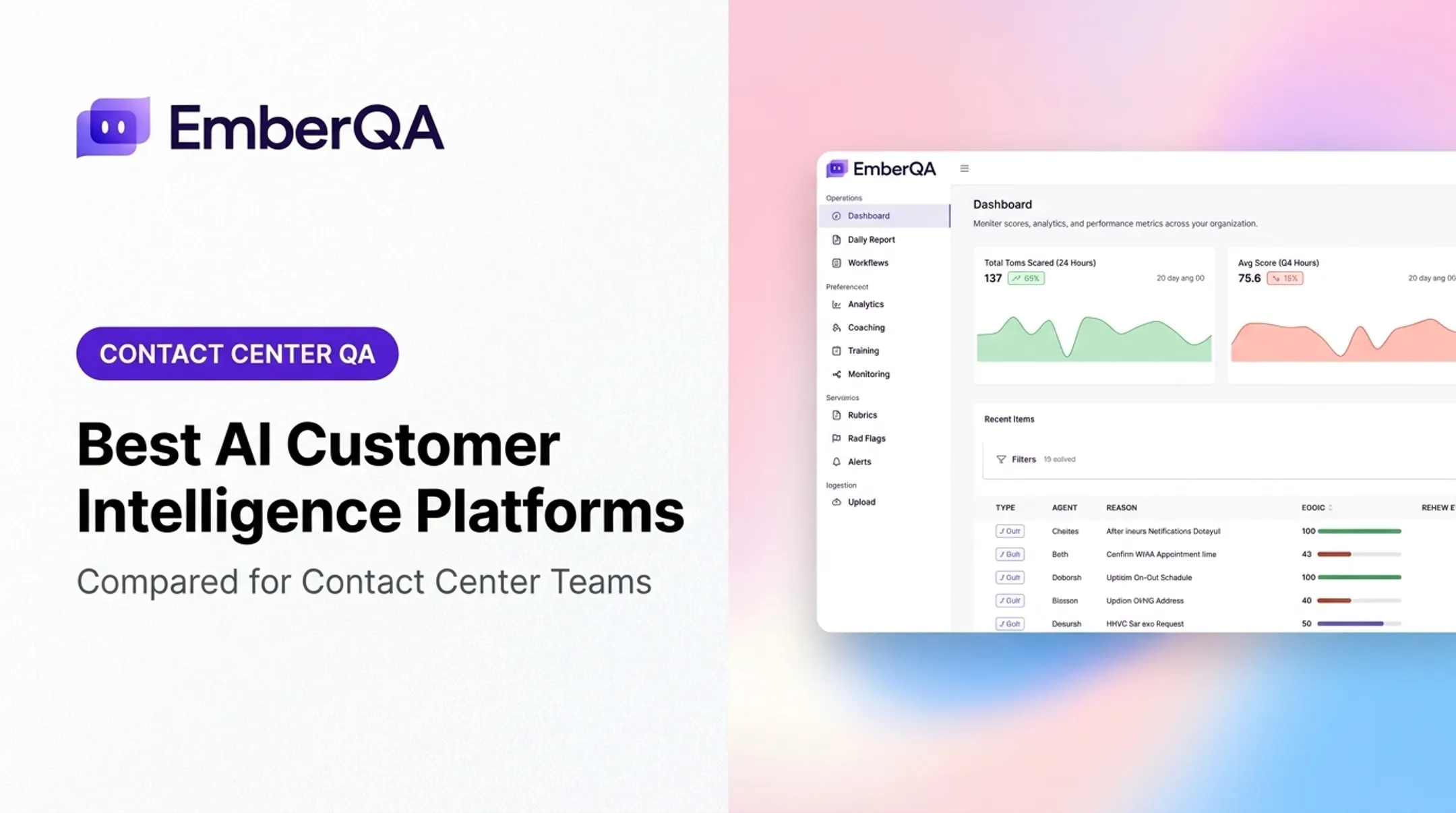
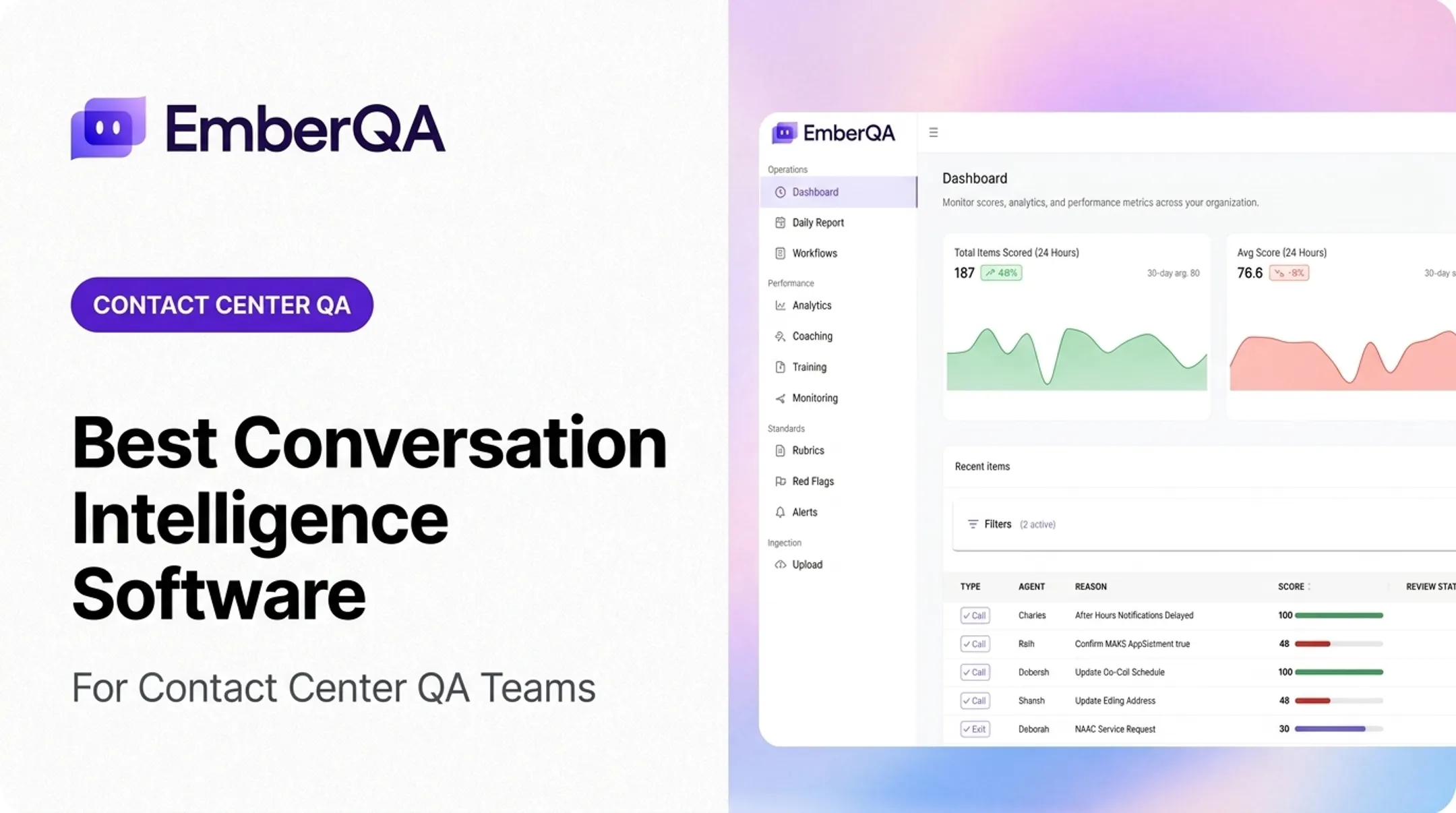
EmberQA's automated QA scores every call, SMS, email, and document against custom scorecards, closing that coverage gap without adding review hours. Instead of sampling 5% and guessing about the rest, teams get objective scoring, evidence-linked explanations, and red flag detection across 100% of interactions.
Real-Time Risk Detection and Agent Coaching
Automated red flag detection changes how fast problems surface. Instead of catching a compliance issue in a monthly audit weeks later, EmberQA flags hostile behavior, privacy violations, improper advice, or escalation risk as soon as they're detected. Supervisors get the alert immediately.
That speed matters for two reasons:
- Compliance risk gets addressed before it becomes a regulatory problem, not after
- Coaching becomes specific and current, tied to a real recent call, not a vague quarterly trend
EmberQA's coaching tools aggregate interaction data into rubrics that surface recurring gaps alongside top-performer examples. Managers then build coaching plans around real patterns instead of hunches.

Key Criteria for Selecting AI Customer Engagement Platforms
Data Integration and Real-Time Bi-Directional Sync
An engagement platform is only as good as the data feeding it. Native, bi-directional CRM and customer data platform connectivity keeps profiles current, so agents and automation work from the same live record—not data that's three weeks stale.
Spot On Schedulers uses EmberQA for this kind of integration. The platform reviews call data alongside CRM records to catch gaps between what was said and what got logged, a mismatch that matters for accuracy and compliance alike.
Omnichannel Orchestration vs. Point Solutions
A platform that coordinates calls, email, web, and mobile from one system beats a patchwork of standalone tools. Point solutions create blind spots: the chatbot doesn't know what happened on the phone call an hour earlier.
Look for:
- A single customer view across channels, not siloed dashboards
- Consistent scoring or personalization logic applied platform-wide
- One place to audit interaction history, not five
Measurable Revenue and Performance Attribution
Engagement tools need to tie back to metrics leadership already tracks: First Contact Resolution, Customer Lifetime Value, and CSAT.
One industry survey of contact centers found that 84% measure average handle time and 77% measure quality. Only 14% track deflection and 13% track self-service accessibility.
If a platform can't show its effect on resolution or retention, it's hard to justify beyond a pilot.
Overcoming Key Challenges: Privacy, Data Quality, and Hybrid Workflows
Data Governance and Regulatory Compliance
Privacy frameworks are getting more specific about automated decisions, not just data collection. California's updated CCPA regulations, effective 2026, expand rights to access, delete, and correct personal data. Automated-decisionmaking requirements for significant decisions follow in 2027.
GDPR's Article 22 already restricts decisions based solely on automated processing when they produce legal or similarly significant effects, and requires a path to human review.
For engagement platforms, that means:
- Anonymizing or pseudonymizing data used in model training where possible
- Documenting when and how automated decisions affect a customer
- Building in a human review path for significant decisions, not just a support queue
Maintaining High Data Quality and Hygiene
Personalization is only as good as the data behind it. Salesforce's 2025 research found data leaders estimated 26% of their organizational data was untrustworthy, and 89% of leaders running AI in production reported inaccurate or misleading outputs. More than eight in ten cited a fragmented customer view as a direct consequence.

Continuous validation and automated deduplication aren't optional maintenance tasks. They're what keeps an AI engagement engine from making confidently wrong decisions at scale.
Balancing Automated Efficiency with Human Empathy
Even with clean data and clear governance, not every interaction should go to a bot. PwC's 2025 survey of over 5,500 US consumers found 86% considered human interaction moderately or very important to their brand experience, even as AI adoption grows.
Draw a clear line instead. AI handles repetitive, low-stakes tasks. Emotionally charged situations—a denied claim, a billing dispute, a cancellation—route to a human fast, with full context already attached.
EmberQA's training tools use AI roleplay scenarios, like practicing a billing dispute with built-in empathy feedback, to prepare agents for exactly these moments.
Frequently Asked Questions
How does AI improve customer engagement?
AI delivers real-time personalization, instant 24/7 support, and predictive outreach based on individual behavioral signals instead of static, one-size-fits-all messaging. It adjusts timing, channel, and content as a customer's situation changes.
What are the best AI tools for customer engagement?
Key categories include conversational AI platforms for self-service, journey orchestration engines for next-best-action decisions, and interaction QA tools like EmberQA that score every call, chat, and email for compliance and coaching.
What is a customer engagement model?
A customer engagement model is the structured framework a business uses to manage relationships, communications, and value delivery across every touchpoint, from first contact through renewal or churn.
How do businesses balance AI automation with human agent interaction?
AI handles repetitive, low-stakes self-service tasks, like status checks or password resets, while complex or emotionally sensitive interactions route to human reps with full context attached. The line is drawn by stakes, not convenience.
What metrics measure the ROI of AI customer engagement?
Essential KPIs include CSAT and NPS gains, reduction in average handle time, churn rate decreases, and conversion lift. Track these against your own baseline rather than industry-wide benchmarks, since implementation scope varies widely.