Introduction
Most contact centers still grade customer interactions the way they did a decade ago: a manager grabs a handful of calls, scores them against a gut feeling of "good service," and moves on. That approach breaks down fast at scale.
Gartner notes that traditional manual QA typically covers just 2% to 5% of assisted service interactions — meaning the vast majority of conversations never get reviewed at all. Informal reviews and thin manual samples leave compliance risks, coaching opportunities, and customer experience gaps invisible.
A quality assurance checklist fixes this by turning subjective judgment into a repeatable process. This guide covers what a QA checklist is, what it should measure, how to build one for a contact center, and how technology can expand coverage beyond a small manual sample.
Key Takeaways
- A strong QA checklist converts vague standards into specific, observable, measurable criteria
- Cover the full interaction lifecycle: greeting, verification, resolution, documentation, and closing
- Use checklist data to drive coaching, trend analysis, and process fixes
- Revise the checklist when policies, products, regulations, or customer expectations change
What Is a Quality Assurance Checklist and Why Does It Matter?
A quality assurance checklist is a structured set of criteria used to evaluate whether an interaction, process, or output meets an established standard. Instead of a reviewer deciding on the fly whether an agent "did well," the checklist spells out exactly what counts as meeting the bar.
Checklist, Scorecard, Test Case, or Audit?
Teams often use these terms loosely, but the American Society for Quality (ASQ) draws real distinctions between them:
- Checklist: confirms important steps or actions were taken
- Scorecard: rates performance against predefined criteria, often with numeric scoring
- Test case: verifies a specific function or scenario behaves as expected (more common in software QA)
- Quality audit: an independent, evidence-based review of process adherence, broader in scope than a single interaction
A checklist and a scorecard often overlap in contact center QA, but an audit is a different animal entirely — it examines controls and governance, not just one call.
Why this matters operationally: a checklist gives every reviewer the same yardstick. Teams get:
- Clearer expectations for agents
- More reliable evaluations across shifts and sites
- Faster flagging of urgent issues
- Coaching aimed at the right behaviors, not whatever a manager happened to notice that day
One caveat: a checklist supports judgment, it doesn't replace it. Complex escalations, vulnerable customers, and unusual circumstances need a human reviewer who can weigh context the checklist can't capture.
What Should a QA Checklist Measure?
Every criterion on a checklist needs to pass a simple test. Ask whether it is:
- Observable in the interaction itself
- Relevant to the customer journey
- Tied to a business or compliance objective
- Worded so two different reviewers reach the same conclusion
Five Categories Worth Scoring
- Customer experience — professionalism, empathy, active listening, tone, clarity, ownership of the interaction
- Process accuracy — correct information given, workflow followed, systems used correctly
- Resolution quality — request addressed, expectations set accurately, no unnecessary transfers
- Compliance and risk — disclosures made, authentication completed, privacy protected, prohibited language avoided
- Documentation — complete notes, correct disposition codes, follow-ups logged, CRM updated
Defining Outcomes
Reviewers need clear rules for marking each item:
| Outcome | What it means | Evidence to record |
|---|---|---|
| Pass | Criterion fully met | Timestamp or quote supporting it |
| Fail | Criterion not met | Specific gap observed |
| Partial | Some but not all elements present | What was missing |
| N/A | Criterion didn't apply to this interaction | Reason it's exempt |
Separate critical-fail items, such as a missed fraud escalation or a privacy violation, from routine coaching points. A high overall score should never hide a serious compliance failure.
Weighted scoring helps here: assign heavier weight to categories tied to legal or safety risk. Validate that weighting with QA leaders and operations before rollout, not after the first bad audit.
Contact Center QA Checklist: Criteria to Include
Treat the following as a starting point, not a finished product. Adapt it to your channel mix, client programs, and regulatory environment.
Greeting, authentication, and setup:
- Approved greeting and organization identification used
- Customer verified through the required process
- Reason for contact correctly identified and key details confirmed
Communication and customer experience:
- Active listening demonstrated, no interrupting
- Tone matches the situation; empathy shown where needed
- Plain-language explanations, no unsupported promises
Accuracy, process, and system use:
- Information provided is correct and current
- Workflow followed, approved resources used
- CRM fields completed accurately and match the conversation
Resolution, ownership, and escalation:
- Request resolved or moved forward with clear next steps
- Realistic follow-up timelines set
- Escalations handled with enough context passed to the next team
Compliance, privacy, and risk:
- Required disclosures and consent obtained
- Personal information handled securely
- Suspected fraud or vulnerability escalated appropriately
Compliance criteria aren't theoretical. In a 2025 proposed settlement, the FTC alleged that Citizens Disability made tens of millions of illegal and misleading calls, including calls to numbers on the Do Not Call Registry.
That case is a reminder that "check the compliance box" items aren't just paperwork. Research the specific federal, state, and client requirements that apply to your program rather than copying generic language.
Documentation and closing:
- Notes and dispositions accurately reflect the interaction
- Outcome summarized, approved closing language used
Turning vague standards into observable criteria
"Be helpful" isn't gradable. Rewrite it as an observable rule:
- Pass: Agent offers a specific next step or solution before ending the call
- Fail: Customer must ask a follow-up question to get direction
Two reviewers can now score the same interaction the same way.
How to Create and Implement a QA Checklist
Building a checklist that survives contact with real calls takes more than writing down good intentions.
- Start with objectives and risk priorities. Pull input from QA, operations, training, compliance, and frontline agents before finalizing criteria. Agents often know exactly where the current process breaks down.
- Map criteria to the interaction lifecycle. Order items the way a call actually unfolds, and separate universal criteria from client-, channel-, or location-specific ones.
- Define scoring rules up front. Decide whether each item is binary, weighted, or comment-based, and confirm no scoring method can bury a critical failure inside a decent overall score.
- Pilot and calibrate. Run the draft against a representative sample, compare reviewer results, and revise wording that produces inconsistent scores. Calibration sessions matter here. Even experienced reviewers drift without them.
- Connect results to coaching. Recurring findings should feed targeted coaching plans and workflow fixes, not just sit in a spreadsheet.
- Treat it as a living document. Update after policy changes, new complaint patterns, or regulatory shifts, and log who approved each version.

This is where EmberQA fits into the process for teams that outgrow manual scorecards. Spot On Schedulers, which manages call quality across 18 dental offices, uses EmberQA to score each call against that specific office's process rather than a one-size-fits-all rubric, while also checking CRM data against the actual call.
Office-specific criteria and universal criteria coexist in the same system instead of living in separate spreadsheets.
Types of QA Checklists and Related Quality Documents
Not every quality document serves the same purpose. Mixing them up creates confusion about what a checklist is actually supposed to verify.
One clear split is by timing:
- Pre-interaction/readiness checklist — confirms staffing, tool access, and knowledge resources are in place
- Interaction evaluation checklist — scores a customer interaction against service, accuracy, and compliance criteria
- Post-interaction checklist — verifies notes, dispositions, and follow-up actions were completed
- Release/change checklist — confirms new scripts or system updates are ready before customers see them
Timing is only one lens. QA and QC answer different questions.
QA vs. QC: ASQ frames quality assurance as process-focused and preventive, while quality control checks completed outputs for defects. A QC checklist might simply verify that required fields or disclosures are present after the fact. It is a final check, not a process safeguard.

The same idea applies when you separate audits from day-to-day scoring.
Audit vs. routine QA review: A quality audit evaluates broader process adherence, evidence, and controls across a defined scope. A QA review usually scores individual interactions. Use both together: audits catch systemic risk, while QA reviews surface individual coaching needs.
How to Scale QA Checklists With Technology
Spreadsheets work fine when you're reviewing a handful of calls a week. They fall apart across high call volumes, multiple sites, or BPO client programs where every account needs its own reporting.
That gap is exactly why COPC's 2022 benchmarking found that 79% of surveyed contact center executives had adopted speech analytics for QA, though tool adoption alone doesn't mean every interaction gets scored. Coverage still depends on how the tool is configured and used.
What AI-Assisted QA Can Do
- Apply the same rubric across far more interactions than a manual team could review
- Surface red flags: hostile behavior, improper advice, privacy violations, as they happen
- Make calls searchable and comparable across agents, teams, and time periods
- Spot recurring coaching patterns that individual spot-checks would miss
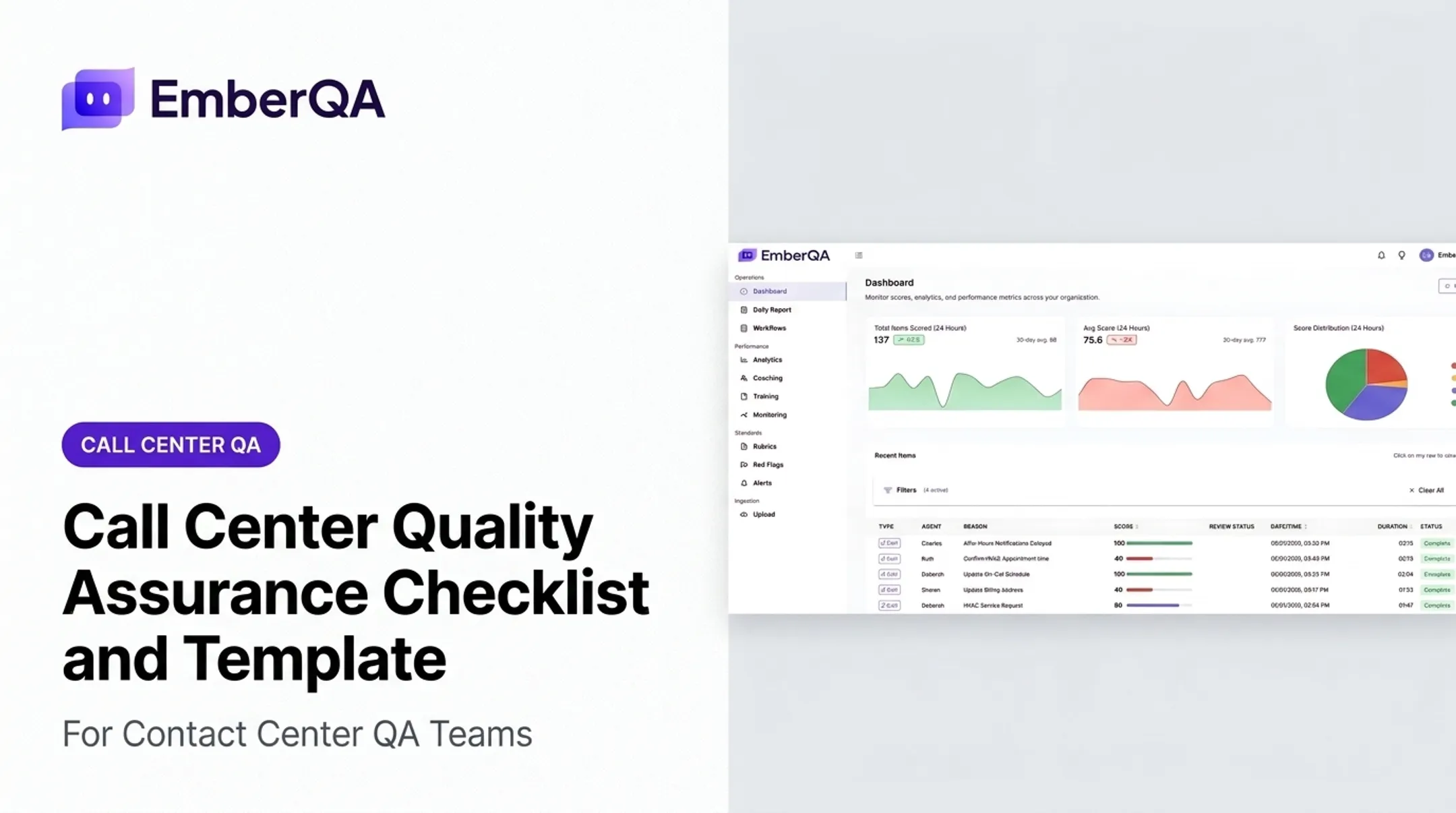
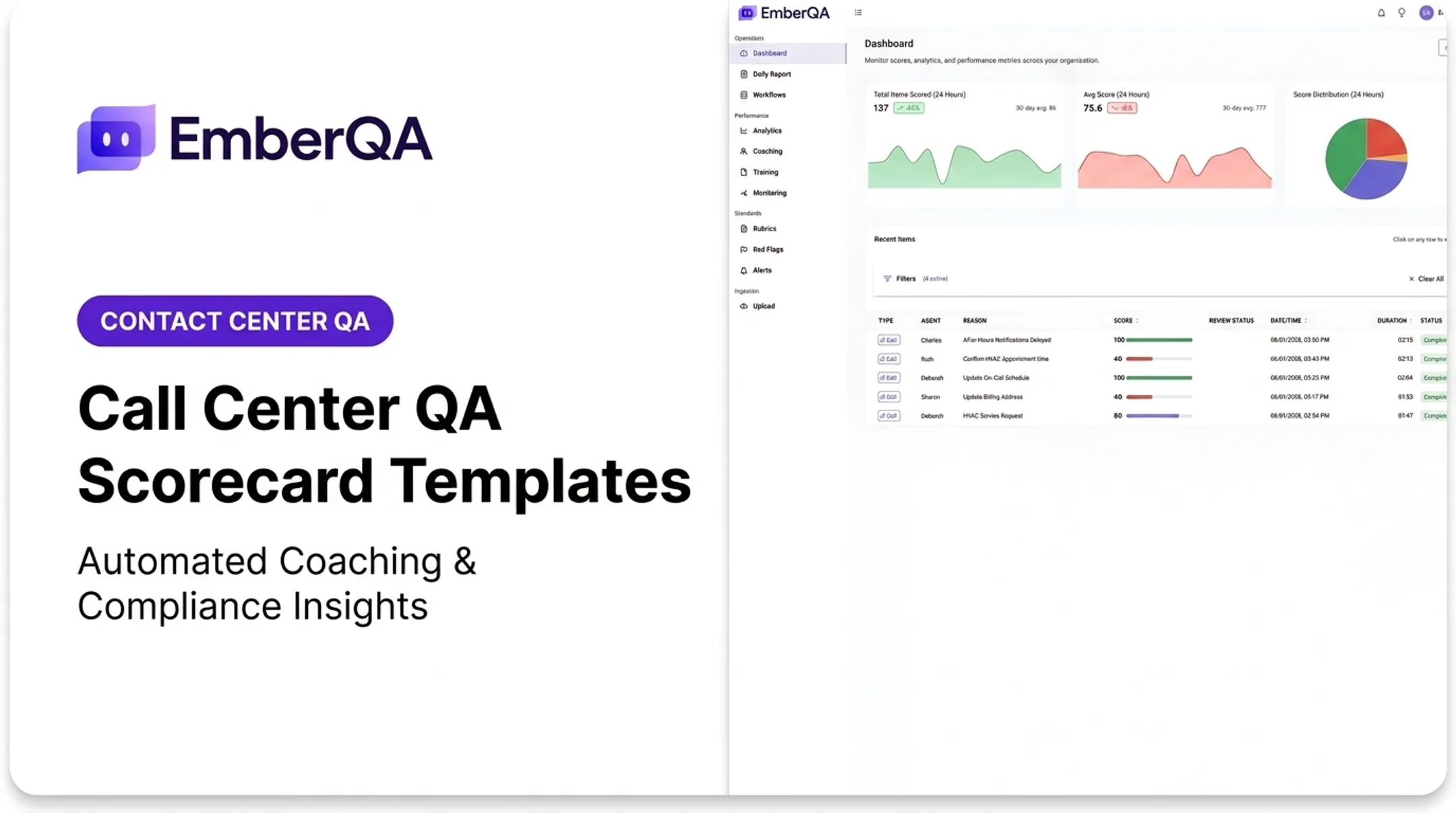
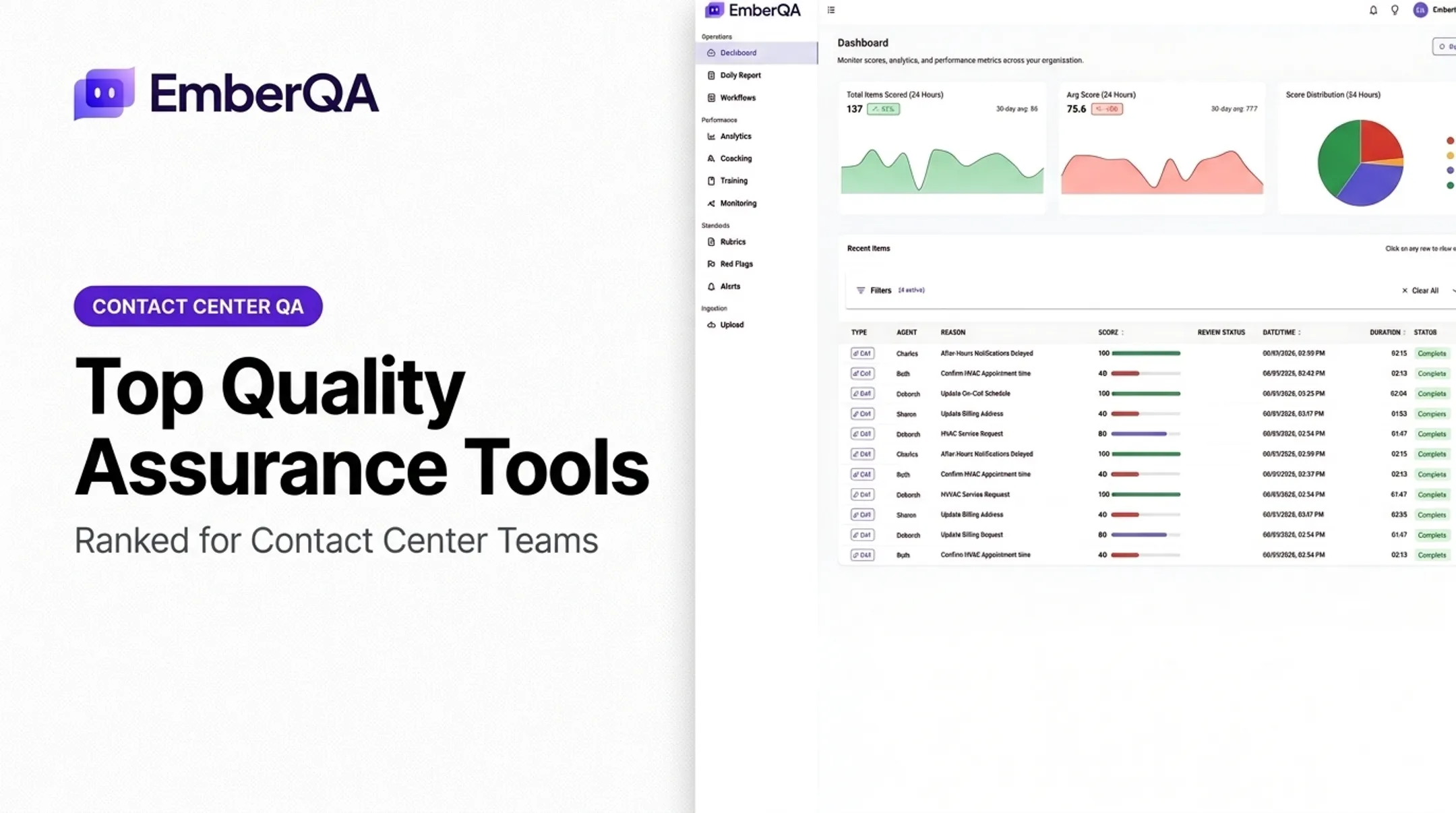
EmberQA is built around this idea. Its platform scores calls, SMS, emails, and documents against custom rubrics and flags urgent issues in real time. It also supports office- or program-specific QA workflows instead of forcing every account into one identical scorecard.
ECA, for example, went from reviewing under 1% of calls manually to scoring 100% of calls automatically. Every interaction became searchable and comparable against the same rubric, replacing what managers had mostly held as institutional memory.

Pro-tier coaching features ($89 per agent/month) add recurring missed-metric insights and AI-generated coaching recommendations tied to specific interaction evidence.
Human review still matters. Automated scoring works best with safeguards:
- Rubric validation against real-world outcomes, not just rule compliance
- Regular reviewer calibration sessions
- Audit trails showing why a score was assigned
- Human escalation paths for ambiguous or high-risk cases
- Periodic checks for inconsistent or biased scoring patterns
Technology expands coverage. It doesn't replace the judgment calls that keep a QA program credible.
Frequently Asked Questions
What are QA checklists?
A QA checklist is a structured set of criteria for checking whether a service, process, or interaction meets defined standards. In a contact center, for example, that means scoring a call for greeting, accuracy, resolution, and compliance.
What are the 5 principles of quality assurance?
Commonly cited principles include customer focus, process consistency, prevention of errors, continuous improvement, and evidence-based decisions. Contact center teams usually turn these into scorecard criteria on QA checklists for calls and other interactions.
What is an example of QA?
A typical contact center QA example is scoring a customer call on authentication, information accuracy, tone, resolution, documentation, and compliance disclosures.
What is a QC checklist?
A QC checklist verifies that a completed interaction or output meets defined requirements after the fact, such as confirming required fields or disclosures were included. QA activities are generally preventive and process-focused instead.
What is a quality audit checklist?
A quality audit checklist guides a broader, evidence-based review of processes, controls, and compliance across a defined scope. It's more comprehensive than a single interaction score, and typically involves independent evaluation.