Most centers respond by sampling. A manager pulls a handful of calls per agent per month and calls it quality assurance. The problem is that a handful of calls tells you almost nothing about the other 200 an agent handled that same period. Compliance risks, coaching opportunities, and customer-experience gaps hide in the interactions nobody ever reviews.
Conversation intelligence software exists to close that gap. It records or ingests customer interactions, transcribes them, and uses AI to score, flag, and summarize what happened — then routes those findings into coaching and operational workflows.
This article compares five platforms built for contact centers and customer-facing teams, and walks through how to evaluate coverage, scoring flexibility, integrations, compliance support, and total business value.
Key Takeaways
- Automated scoring beats sampling by turning every interaction into searchable, comparable QA data—not just a transcript.
- Contact-center QA, sales coaching, compliance monitoring, and CX analysis each need different feature sets.
- Prioritize channel coverage, rubric flexibility, red-flag detection, and integrations over brand name.
- EmberQA suits contact-center QA teams that need scalable, automated scoring across every interaction.
Overview of Conversation Intelligence Software in the US Contact Center Market
Conversation intelligence software is AI-powered technology that captures, transcribes, interprets, and evaluates customer conversations across voice, chat, email, and other channels. Beyond storing the interaction, it analyzes what was said, how it was said, and whether it met a defined standard.
How the Workflow Actually Works
A typical platform moves through six stages:
- Ingestion — calls, chats, emails, or documents come in through integrations or APIs
- Speaker identification — the system separates agent speech from customer speech
- Transcription — audio or text becomes a searchable record
- Analysis — AI identifies topics, sentiment, behaviors, and outcomes
- Scoring — interactions are evaluated against a rubric or scorecard
- Action — red flags trigger alerts, patterns feed coaching, trends populate reports

How It Differs From Adjacent Tools
Buyers often confuse categories, which leads to mismatched purchases. Here's the distinction:
- Call recording stores interactions for playback — no analysis happens
- Speech analytics (traditional) searches or classifies audio by keyword
- Manual QA evaluates a small, human-selected sample
- Conversation intelligence applies broad AI analysis across most or all interactions and connects findings to action
One more split matters for buyers. Some platforms are built for B2B sales conversations (deal coaching, pipeline signals). Others target contact-center quality management (compliance, agent scoring, customer experience).
Confirm which category a vendor actually serves before comparing features side by side. A sales-intelligence tool and a QA platform solve different problems, even when their marketing language overlaps.
The Business Case
Buyers should connect this technology to specific outcomes: broader QA coverage, more objective scoring, faster risk identification, less manual review time, consistent standards across locations, and coaching that targets real gaps instead of guesswork.
The scale of the sampling problem is well documented. Older ICMI research found that one-third to nearly half of contact centers monitored only 1% to 3% of interactions for quality across major channels. More recently, an April 2025 ICMI survey of 113 contact-center professionals found that 54% now report some AI functionality in their operations — though most are still in early stages, with only 6% describing their capabilities as advanced.
That gap between "some AI" and "advanced AI" is where most buying decisions land. Judge platforms on operational fit and actionability: coverage depth, scoring consistency, alert speed, and coaching you can act on—not brand recognition or transcription accuracy alone.
Best Conversation Intelligence Software for Contact Centers and Customer-Facing Teams
Each platform below is scored against the same criteria:
- Interaction coverage and AI analysis depth
- Scoring flexibility and red-flag detection
- Coaching usefulness and integrations
- Compliance readiness, implementation complexity, and scalability
EmberQA
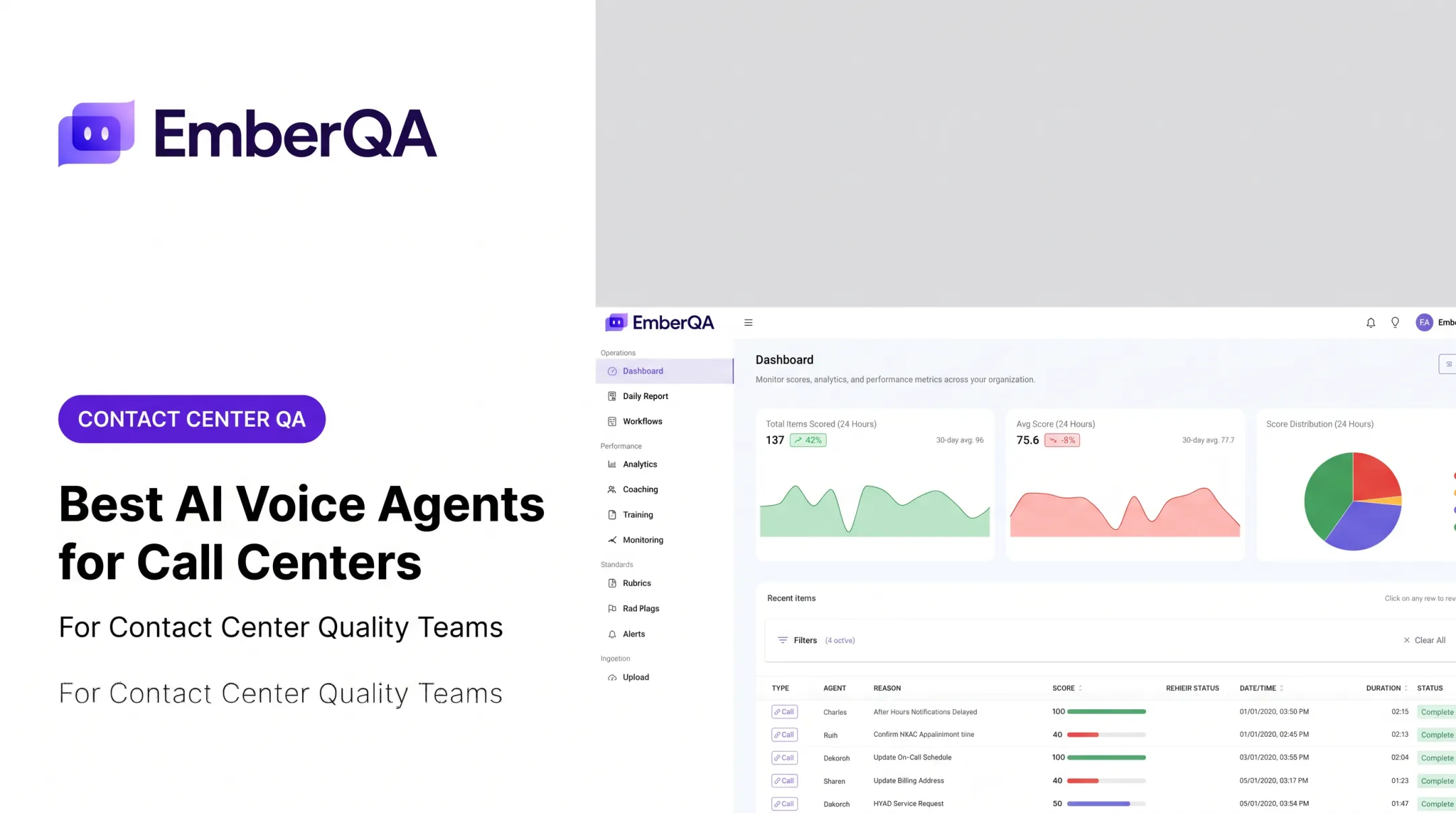
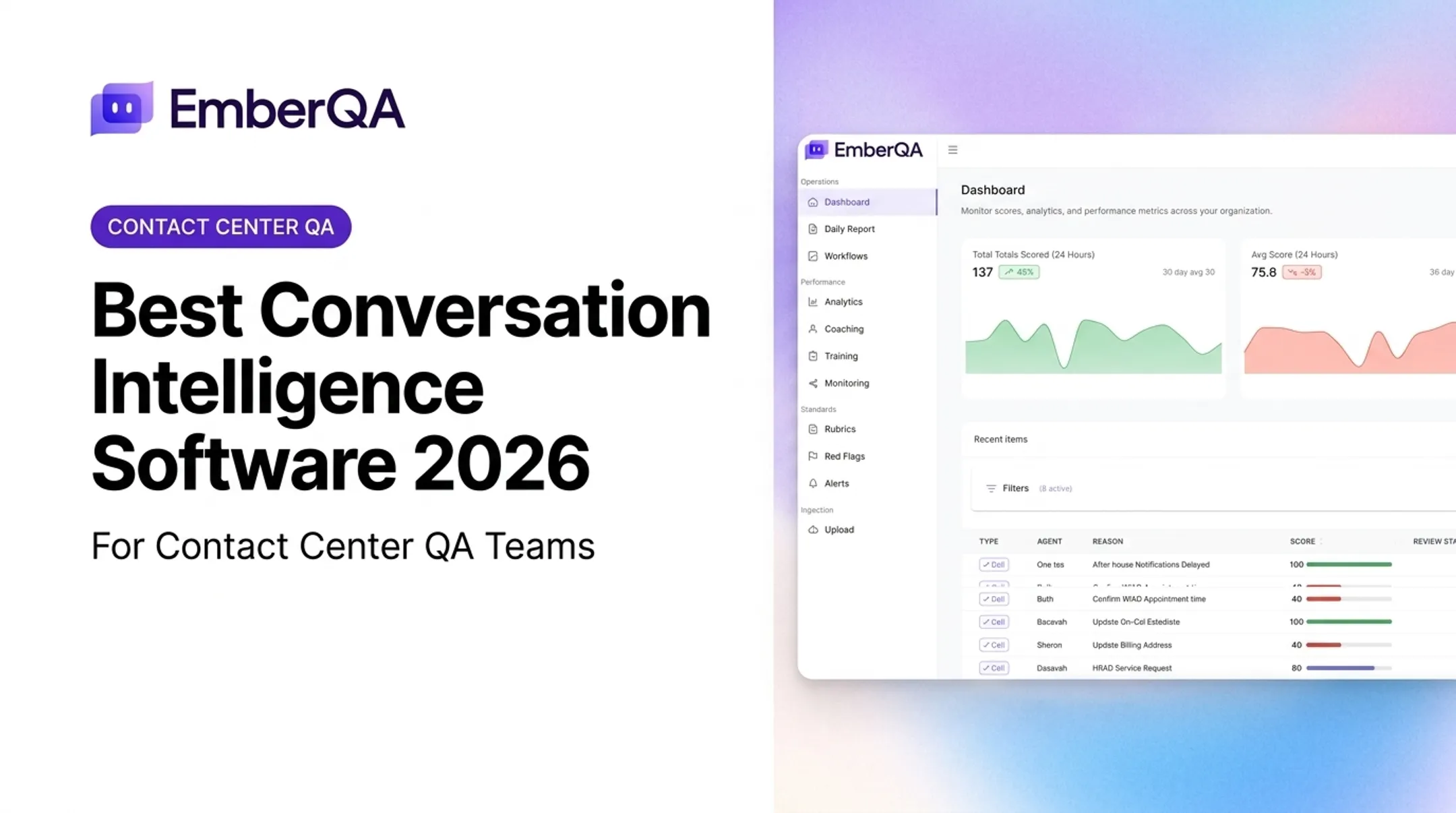
EmberQA is an AI-powered quality assurance platform built specifically for contact centers and customer-facing teams. Rather than sampling a few calls per agent, it applies automated scoring to calls, SMS, emails, and documents against custom QA scorecards.
What makes it stand out for teams outgrowing manual sampling:
- Consistent rubrics applied to every interaction, not just a sample
- Searchable, comparable transcripts with recordings, filters, and metadata
- Red-flag detection for hostile behavior, improper advice, privacy violations, and escalation risk
- Office-specific QA workflows for multi-site and multi-program operations
- CRM data verification alongside call scoring
One customer example illustrates the shift well. ECA, an answering service operation, was manually reviewing less than 1% of calls before adopting EmberQA. Managers could only get through a handful of calls per agent each month, leaving nearly everything else unscored.
After implementation, ECA moved to scoring 100% of calls with more objective, consistent evaluation and reported saving roughly 30 hours per week in manager time previously spent on manual review.
Comparison Snapshot:
| Category | Details |
|---|---|
| Primary use case | Contact-center QA, compliance monitoring, agent coaching |
| Key capabilities | AI scoring, red-flag alerts, custom scorecards, coaching, training/roleplay |
| Channels | Calls, SMS, emails, documents |
| Ideal customer | BPOs, answering services, insurance, financial services/collections, multi-site contact centers |
| Integrations | Supported ingestion and API setup; webhooks to CRMs, ticketing systems, dashboards |
| Pricing | Essentials $49/agent/month; Pro $89/agent/month, unlimited usage on included features |
Pro adds targeted AI coaching and white-glove onboarding for configuring teams, rubrics, and supported integrations. Manager and reviewer seats are free unless their own work is being scored.
Observe.AI
Observe.AI positions itself as a conversation intelligence and quality management platform for contact centers, offering both post-interaction Auto QA and real-time agent assistance as separate capabilities.
According to Observe.AI's own product pages, Auto QA can assess up to 100% of customer interactions using AI, configurable rules, and calibration (verify that claim against your own interaction volume in a trial). Real-Time Agent Assist adds in-conversation prompts, scripts, and supervisor alerts on top of QA.
The platform names integrations including 8x8, Amazon Connect, and Avaya. Its pricing page describes a target range of 100 to 100,000 agents across banking, financial services, insurance, and healthcare, though that range does not necessarily exclude smaller teams.
Comparison Snapshot:
| Category | Details |
|---|---|
| Primary use case | Automated QA plus real-time agent guidance |
| Key capabilities | Auto QA, Real-Time Agent Assist, CRM enrichment |
| Target organization | Mid-market to enterprise contact centers |
| Integrations | CCaaS connectors (8x8, Amazon Connect, Avaya, others) |
| Pricing | Contact sales; no public dollar pricing listed |
CallMiner
CallMiner focuses on conversation analytics with a strong lean toward compliance and risk detection. Its risk-monitoring page describes scanning voice and text in real time, tagging potential violations, and supporting post-interaction trend discovery. That includes collection-specific language checks like Mini-Miranda and right-party-contact rules, plus PCI/PII redaction.
This makes CallMiner a candidate when the priority is deep post-interaction analytics and compliance workflows rather than real-time agent guidance or sales pipeline coaching. It integrates with CRM systems (Salesforce is named specifically) and serves financial services and healthcare among its listed industries.
Independent user feedback is mixed. A G2 reviewer from October 2025 in the insurance sector praised the categorization and trend-detection features but noted cumbersome workflows with large datasets, slow exports, and occasional transcription errors with accented speech. Factor those limits into your implementation timeline.
Comparison Snapshot:
| Category | Details |
|---|---|
| Primary use case | Conversation analytics, compliance risk detection |
| Key capabilities | Real-time voice/text scanning, redaction, trend analysis |
| Target industries | Financial services, healthcare, collections |
| Integrations | APIs, connectors, Salesforce named specifically |
| Pricing | Bundled by user count or interaction volume; contact sales |
NICE CXone
NICE CXone is a broader contact-center platform where conversation intelligence sits alongside routing, telephony, and workforce management. Relevant modules include Quality Management, QM Analytics, Interaction Analytics, and Automated Summary. Each module covers a different piece of the QA and analytics puzzle.
The tradeoff is straightforward: choosing an integrated enterprise suite reduces vendor fragmentation, but buyers may pay for functionality beyond immediate QA needs.
NICE's public pricing page also does not clearly map which QA and analytics modules are included versus add-ons at each suite tier. Confirm that detail with sales before assuming a package includes what you need.
Comparison Snapshot:
| Category | Details |
|---|---|
| Primary use case | Full CCaaS suite with embedded QA/analytics modules |
| Key capabilities | QM, QM Analytics, Interaction Analytics, AI copilot tools |
| Target organization | Enterprises already evaluating a full platform switch |
| Pricing | Omnichannel $110, Essential $135, Core $169, Complete $209, Ultimate $249 per agent/month (published list prices); Ultimate also lists a $0.25-per-session option |
Confirm exact module entitlements with a sales quote — the published pricing doesn't specify which tier includes Interaction Analytics versus treating it as an add-on.
Verint
Verint's conversation intelligence positioning changed recently. Following Calabrio's acquisition of Verint (completed November 26, 2025, per an SEC filing), current product pages list Verint Quality Bot alongside Calabrio QM Intelligence and Calabrio Conversation Intelligence.
Verint describes Quality Bot as AI-assisted scoring across channels, paired with a companion Coaching Bot. Its speech-analytics page covers transcription, theme detection, sentiment, and compliance-risk flagging across voice, chat, email, SMS, and bot conversations.
Verint's appeal is for large organizations layering analytics onto existing infrastructure rather than replacing it. The platform connects to existing ACD, CCaaS, and CRM systems, and supports both cloud and on-premises quality programs. That flexibility helps enterprises with legacy systems they are not ready to retire.
Comparison Snapshot:
| Category | Details |
|---|---|
| Primary use case | Enterprise QA layered onto existing infrastructure |
| Key capabilities | Quality Bot, Coaching Bot, speech analytics |
| Target industries | Banking, telecommunications, retail, public sector |
| Integration approach | Connects to existing ACD/CCaaS/CRM without full replacement |
| Pricing | Contact sales; no public module pricing |
This is a practical shortlist, not a universal ranking. The right choice depends on your interaction volume, regulatory exposure, existing systems, staffing model, and how much automation you actually want.

How We Chose the Best Conversation Intelligence Software
We compared each platform against contact-center-specific needs, then validated capabilities, integrations, and pricing against first-party documentation and reputable third-party sources.
Interaction Coverage and Analysis Depth
- Does the platform analyze all available interactions, or only samples?
- Does it support the channels you actually use: voice, chat, email, SMS?
- Does the AI recognize context, intent, and sentiment, or mainly perform keyword search?
QA, Scoring, and Compliance Workflows
For regulated operations, dig into the specifics:
- Configurable rubrics with calibration and audit trails
- Red-flag monitoring routed to human reviewers
- PII/PCI redaction, retention controls, and data residency documentation
The compliance requirements here aren't optional extras:
- Regulation F: Debt collectors that record collection calls must retain each recording for three years after the call
- FTC Safeguards Rule: Encrypt financial customer data and dispose of it securely no later than two years after last use
- PCI SSC telephone-payment guidance: Keep sensitive card data out of recordings, or delete it securely afterward
A conversation intelligence platform that touches any of these data types must support these retention and redaction requirements, not just claim to.
Coaching and Actionability
Look for:
- Targeted coaching recommendations tied to recurring gaps
- Searchable moments and trend reporting
- Documented customer outcomes, not vendor claims
Observe.AI's published Cox Automotive case study reports 90,000 monthly evaluations, 100% of interactions evaluated, and a 3% QA score improvement. That is a real customer result, not a guaranteed outcome for every deployment.

Integration, Usability, and Total Cost
Confirm native connections to your CCaaS, CRM, telephony, and workforce-management systems. Check whether the platform can support multiple locations, programs, scorecards, and languages without manual reporting workarounds.
Common selection mistakes to avoid:
- Choosing based on transcription accuracy alone
- Confusing sales-intelligence tools with contact-center QA platforms
- Ignoring implementation effort and data governance
- Failing to define success metrics before buying
- Selecting features that supervisors and agents will never actually use
Conclusion
The right conversation intelligence platform should fit your operating model, channels, compliance obligations, and tech stack—not a feature checklist or brand name alone.
Before you commit, run a real evaluation:
- Shortlist two or three vendors and test them on interactions from your own operation
- Compare automated scores with human evaluations side by side
- Verify integrations and data-handling practices directly, not from marketing pages
Set measurable goals up front: coverage percentage, review time saved, risk detection speed, and coaching consistency.
If you run a contact center, BPO, answering service, or regulated customer-facing team still stuck on manual sampling, EmberQA is built for that gap. It analyzes every interaction, surfaces red flags automatically, applies consistent scoring, and turns QA data into coaching that targets recurring gaps.
Frequently Asked Questions
What is intelligent conversation?
Intelligent conversation is AI-assisted analysis of human interactions. Conversation intelligence software transcribes and evaluates those conversations to surface insights for QA, coaching, compliance, and customer experience.
What does conversation intelligence software do?
It ingests interactions, transcribes them, and analyzes topics, behaviors, and risk signals. Automated scoring, alerts, summaries, and trend reports then feed coaching and day-to-day operations.
How is conversation intelligence different from call recording?
Call recording simply stores an interaction for later playback. Conversation intelligence applies AI analysis on top to identify patterns, risks, sentiment, and coaching opportunities automatically.
Can conversation intelligence software replace manual quality assurance?
Automated analysis expands coverage and cuts repetitive manual review significantly. Human QA expertise still matters for rubric design, calibration, edge cases, and complex judgment calls the AI can't make alone.
What features should I look for in conversation intelligence software?
Look for channel coverage, configurable scorecards, objective scoring, red-flag detection, searchable interactions, and coaching workflows. Integrations, security controls, and scalability matter just as much as the AI analysis itself.
Which businesses benefit most from conversation intelligence software?
BPOs, answering services, insurance and financial services teams, collections operations, and enterprise multi-site contact centers see the biggest gains. High-volume or compliance-heavy teams benefit most when they need full-interaction coverage instead of manual sampling.