Introduction: Why Call Recording Compliance Matters
Recording a customer call feels routine until you don't know where the person on the other end is sitting. A caller in California changes the legal picture entirely compared to one in Texas, and most contact centers never check.
That gap creates real exposure: lawsuits, regulatory fines, and damaged trust. Compliance isn't just about playing a disclosure message before the call connects. It also requires:
- Lawful purpose for the recording
- Valid consent from the right parties
- Secure storage and controlled access
- Defined retention periods
- Audit-ready proof each step was followed
This guide walks through US consent rules, industry-specific requirements, and a practical framework for building a compliant recording program. It also covers how quality assurance teams can monitor whether agents are actually following the rules once the system is live.
Key Takeaways
- Consent requirements depend on where every call participant is located, not just where your business operates.
- A compliant program covers the full data lifecycle: notification, capture, transcription, storage, access, retention, and deletion.
- AI transcripts, summaries, and speaker labels can introduce privacy risks the original audio file didn't have.
- Software supports compliance monitoring but never replaces legal review, written policy, or staff training.
What Call Recording Compliance Means
Call recording compliance is the policy, consent practice, technical safeguards, and operational process that let you record, store, retrieve, and delete customer or employee communications lawfully. It's a system, not a switch.
Basic recording just captures audio. Compliance recording adds structure:
- Policy-based capture rules tied to call type and purpose
- Documented consent or notification workflows
- Secure, access-controlled storage
- Defined retention and deletion schedules
- Searchable audit trails for every recorded interaction
Notification Is Not Always Consent
"This call may be recorded" satisfies some state laws but not others. Under California Penal Code Section 632, recording a confidential communication requires the consent of all parties, and an unacknowledged announcement isn't automatically treated as affirmative agreement.
Some states, like Washington, allow a recorded announcement to serve as consent. Others don't. Purpose matters too: quality assurance, training, dispute resolution, fraud prevention, and regulatory recordkeeping can each carry different legal expectations for the same call.
Recording Data Extends Beyond the Audio File
Consent and purpose rules only cover part of the risk. A single recorded call can generate several data assets that all need governance:
- The original audio file
- AI-generated transcripts
- Summaries and speaker labels
- Metadata (timestamps, phone numbers, call duration)
- CRM records referencing the call
- Exported clips shared for coaching or disputes
The FTC's guidance on AI providers, published January 9, 2024, warns companies to honor privacy and confidentiality commitments when using consumer data for further analysis, including AI-driven processing of previously collected data.
Treat transcription and AI analysis as part of the same governance framework as the recording itself—not a separate, lower-risk byproduct.
US Call Recording Laws and Consent
At the federal level, 18 U.S.C. Section 2511(2)(d) permits a call participant, or someone with a participant's prior consent, to record a call for a lawful purpose. This is often called "one-party consent." Several states go further and require every participant's consent, commonly called "all-party consent."
The Interstate Call Problem
Here's the mistake many businesses make: assuming their home state's law governs every call they place or receive. It doesn't work that way.
In Kearney v. Salomon Smith Barney (California Supreme Court, 2006), a Georgia-based firm recorded calls with California clients under Georgia's one-party rule. California courts applied their own stricter rule anyway, based on where the protected party was located.
The practical takeaway: if you can't confirm a caller's location, default to the more protective standard.
States Commonly Flagged for Stricter Consent Rules
States frequently cited as requiring all-party consent for telephone calls include:
- California, Florida, Illinois, Maryland, and Massachusetts
- Montana, Nevada, New Hampshire, Pennsylvania, and Washington
Connecticut, Delaware, Michigan, and Nevada also carry statutory nuances or exceptions that make a simple "all-party" label incomplete. Verify current statutory text and any relevant case law for each state before finalizing your consent procedure, rather than relying on a static list.
Notification Workflows That Actually Work
Inbound calls typically use an automated pre-call announcement, played consistently before the conversation begins, so notice doesn't depend on an agent remembering to say it.
Outbound calls need more planning:
- Build jurisdiction-aware scripts agents use based on the number they're dialing
- Create a recording pause or disablement process for calls where consent isn't confirmed
- Document what happens when a recipient objects mid-call
Transfers, Conferences, and Supervisors Joining Late
A new participant joining a call, whether through transfer, conference, or a supervisor listening in, may need their own disclosure. Document the procedure for each scenario so it's consistent across agents and shifts, not left to individual judgment.
Consent rules are fact-specific and change over time. Review your recording procedures with qualified US legal counsel before deployment, and revisit that review periodically.
Building a Compliant Call Recording Program
Turning legal requirements into daily operations takes a structured rollout, not a single policy document.
A Five-Step Framework
- Map your call flows. Identify participants, states, channels, business purpose, and any regulated data each team handles.
- Select a consent method per call type. Document exactly what happens when someone declines.
- Configure automatic controls. Set up recording, pause/resume, redaction, or exclusion rules so compliance doesn't rely on agent memory.
- Define lifecycle rules. Set retention, deletion, legal hold, export, and access procedures for audio, transcripts, summaries, and CRM copies.
- Test regularly. Preserve evidence that disclosures, recording events, access, and deletions happened as designed.

Security Controls Worth Evaluating
Before enabling recording broadly, check for:
- Encryption in transit and at rest
- Role-based access controls with multi-factor authentication
- Audit logs for access and export activity
- Tamper-evident storage
- Documented incident response procedures
- Vendor data-processing terms covering subprocessors and deletion
Retention Should Match Purpose, Not Default to "Forever"
Securing recordings is only half the job—you still have to decide how long each type stays on file. Quality assurance recordings rarely need the same retention window as recordings tied to a regulatory obligation.
Under CFPB Regulation F, debt collectors aren't required to record calls, but if they do, recordings must be retained for three years after the call. Set retention by the rule that applies to that call type, not a single blanket schedule across the business.
Getting Employees Ready
Technology alone won't carry a compliance program. Build:
- Written policy every agent can access
- Onboarding training on disclosure language
- Recurring refreshers beyond a one-time session
- Escalation paths for objections and sensitive-data disclosures
Quick readiness checklist before you flip the switch:
- Consent method confirmed for each jurisdiction you serve
- Automatic recording controls tested, not just configured
- Retention and deletion rules documented per data type
- Access restricted by role
- Staff trained on approved scripts and objection handling
Industry and Data-Handling Considerations
Requirements shift depending on the industry, and meeting one framework doesn't automatically satisfy another.
| Industry | Notable Requirement | Source |
|---|---|---|
| Debt collection | If calls are recorded, retain for 3 years after the call | CFPB Reg F, Section 1006.100 |
| Medicare Advantage marketing | Full call recording required; audio retained 3 years, transcripts allowed years 4-6 | 42 CFR 422.2274(g)(2)(ii) |
| Card payments | Sensitive authentication data (like CVV) can't be retained after authorization, including in audio | PCI DSS Requirement 3.3.1 |
| Healthcare | Recordings containing electronic PHI need Security Rule safeguards | HHS HIPAA guidance |
| Broker-dealers | Required records generally kept at least 6 years absent a shorter specified period | FINRA Rule 4511 |
Sensitive Data Needs Special Handling
Some information shouldn't end up in a permanent recording at all. Common examples include:
- Payment card numbers and CVV codes
- Health information shared during a call
- Account credentials and security answers
- Government identification numbers
The PCI Security Standards Council has flagged a real failure mode: manual pause-and-resume for payment calls often fails in one direction or the other. Teams either leave card data in the recording or lose required call evidence entirely. Automated pause and redaction rules reduce this risk far more reliably than a training reminder.

Vendor Due Diligence Matters Too
Before choosing a recording or QA platform, confirm:
- Data location and subprocessor list
- Deletion support and customer-controlled access settings
- Audit documentation
Every time a recording or AI-generated summary is copied into a CRM, coaching tool, or data warehouse, that copy needs its own retention and deletion coverage. It doesn't inherit protection automatically.
Using QA Technology to Monitor Compliance
Setting up a compliant recording process is only half the job. The other half is verifying agents actually follow it, call after call, week after week.
Manual spot-checks catch a fraction of interactions. Automated QA closes that gap by reviewing recorded calls against approved disclosure language, consent verification, prohibited-language rules, and escalation criteria at scale.
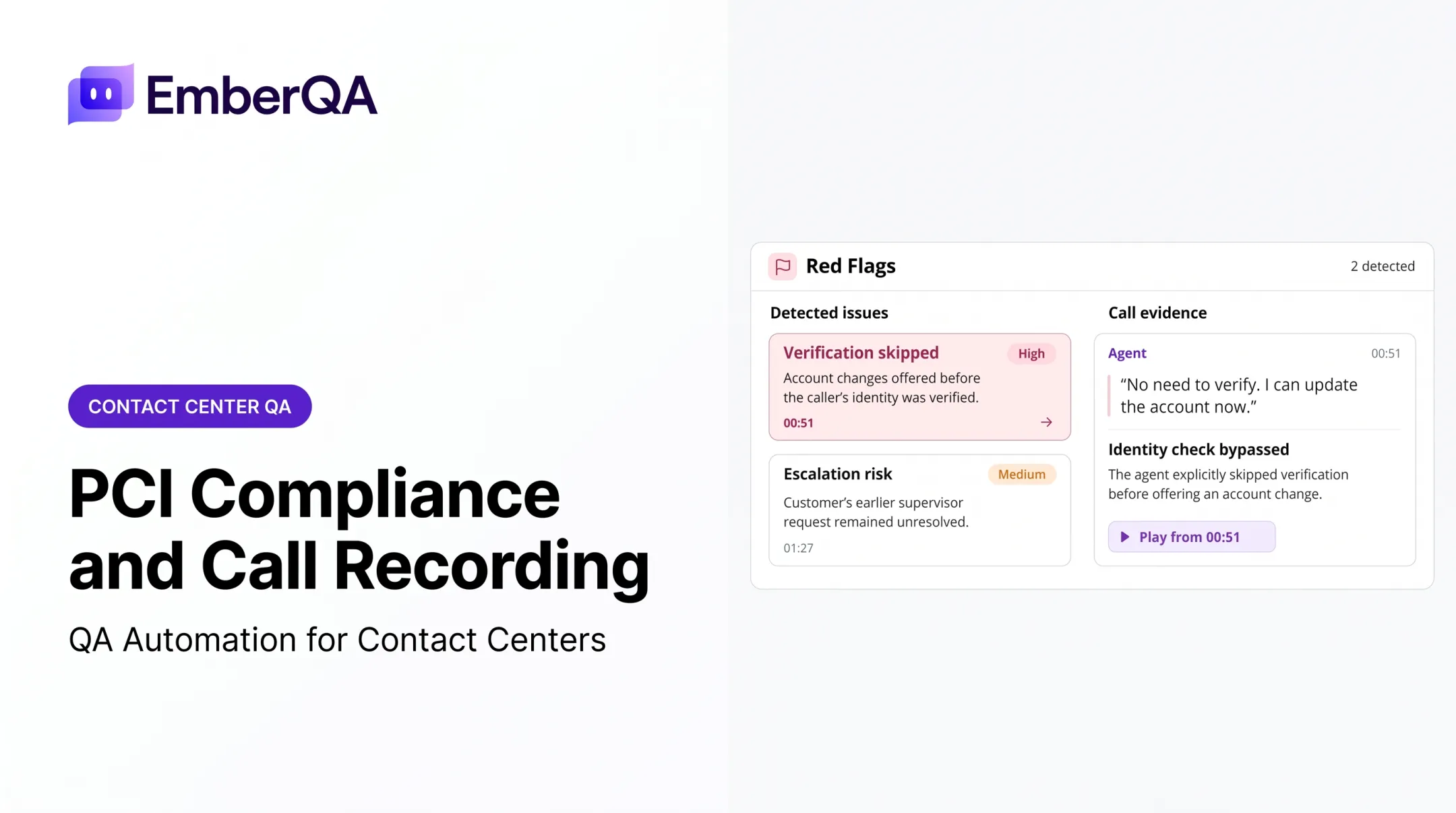
EmberQA applies consistent scoring rubrics across every recorded interaction—not just a manual sample—and surfaces red flags like privacy violations, improper advice, or hostile behavior for supervisor review.
Teams use those signals to spot recurring coaching needs and compliance gaps. The platform supports oversight workflows; it is not legal advice or a substitute for counsel.

Practical benefits for compliance oversight:
- Searchable transcripts and recordings turn a suspected gap into a minutes-long investigation
- Comparable scores across agents and locations highlight where training is falling short
- Trend reporting shows whether a compliance issue is isolated or systemic
- CRM verification checks whether disclosures noted in the system actually happened on the call
That same standard matters most when one review model has to cover many programs and sites, including:
- Contact centers and BPOs
- Insurance carriers and agency teams
- Financial services and collections
- Answering services
- Multi-site operations
Scale alone is not enough. Automated scoring still needs clear governance so results stay defensible.
Governance for AI-Assisted QA
Keep human oversight in the loop:
- Validate scoring rubrics against current policy, not just initial setup
- Review false positives and false negatives regularly
- Restrict access to sensitive call outputs by role
- Document human review of flagged interactions
- Update detection rules whenever laws or internal policy change
Frequently Asked Questions
What is compliance recording?
Compliance recording is call recording built around consent, defined purpose, secure storage, controlled access, retention rules, and deletion, not just saving an audio file. It requires a documented process behind every stage of the recording's lifecycle.
Can employers record calls or Teams meetings without notifying participants?
It depends on jurisdiction, who's on the call, the business purpose, and any applicable workplace or industry rules. There's no universal yes-or-no answer here, so review specific scenarios with legal counsel before recording without notice.
Can Microsoft Teams detect recording, and can I block it?
Teams notifies participants when a built-in meeting recording starts. Admins can limit who may record and turn on an explicit consent prompt (off by default), which is how you control or block recording. Check your Teams admin settings instead of relying on defaults.
What's the difference between one-party and all-party consent?
One-party consent means one participant, including the recording business, knows about the recording. All-party consent requires every participant's agreement. Businesses serving multiple states often apply the stricter all-party standard everywhere to avoid guessing wrong.
What features should a compliant recording system include?
Prioritize controls that cover the full recording lifecycle:
- Configurable consent prompts and automatic record/pause
- Redaction, encryption, and role-based access
- Audit logs plus retention and deletion management
- Searchable storage, with the same protections on integrated copies
Does QA software make a call recording program compliant?
No. QA software like EmberQA helps monitor whether agents follow approved procedures and flags potential issues, but it doesn't replace legal review, written policy, or documented employee training.