That's especially true in U.S. contact centers, BPOs, and regulated service teams handling insurance, lending, or collections. High interaction volume makes manual review nearly impossible to scale, and inconsistent evaluations leave managers guessing which coaching conversations will actually move the needle.
This guide compares five performance improvement tools, from AI-powered QA software to structured methodologies like Six Sigma and Kanban, and explains which operational problem each one solves best.
Key Takeaways
- Match the tool type—software, methodology, or framework—to the specific performance gap you need to close.
- EmberQA gives contact centers automated interaction analysis, consistent scoring, and red-flag detection at scale.
- Choose Six Sigma, PDCA, root cause analysis, or Kanban based on the process gap you are solving.
- Pair measurable objectives with usable data, frontline involvement, and a plan to sustain the gains.
Overview of Performance Improvement Tools in the U.S. Market
Performance improvement tools are systems or methods that help organizations measure current performance, spot gaps, understand root causes, implement changes, and track whether those changes worked. They fall into three categories:
- Methodologies: end-to-end frameworks such as Six Sigma or PDCA that guide a full improvement project from problem definition to control
- Individual analysis tools: techniques built for one task, like root cause analysis for a recurring failure or Kanban for workflow visibility
- Software platforms: technology that automates data collection, evaluation, alerting, reporting, and coaching workflows
Used well, these tools support outcomes such as:
- Higher quality scores and less rework
- Faster issue detection and more consistent processes
- Better customer experiences
- Less manager time spent buried in spreadsheets
Why Contact Centers Need a Different Approach
Customer-facing operations face pressures that most back-office teams don't:
- Volume that makes 100% manual review unrealistic
- Compliance requirements in regulated industries like insurance and financial services
- Multiple sites or vendors that need consistent standards
- Business outcomes tied to quality scores, not just activity metrics
McKinsey's 2024 analysis notes that manual contact-center QA often evaluates less than 5% of conversations. That sample is too thin to drive coaching, compliance, and staffing decisions with confidence.
At the same time, ICMI's 2024 State of the Contact Center survey found that 77% of respondents reported measuring quality in some form. Measuring quality and reviewing enough interactions to trust the results are two different things.
The right tool depends on what's actually broken:
- Incomplete visibility into interactions
- Measurable defects across a process
- An untested improvement idea
- An unclear root cause
- A workflow too congested to manage
Top Performance Improvement Tools
Each tool below was selected against five criteria:
- Practical usefulness day to day
- Ability to generate actionable insight
- Fit for different operational problems
- Scalability across teams and sites
- Relevance to service and contact center environments
EmberQA
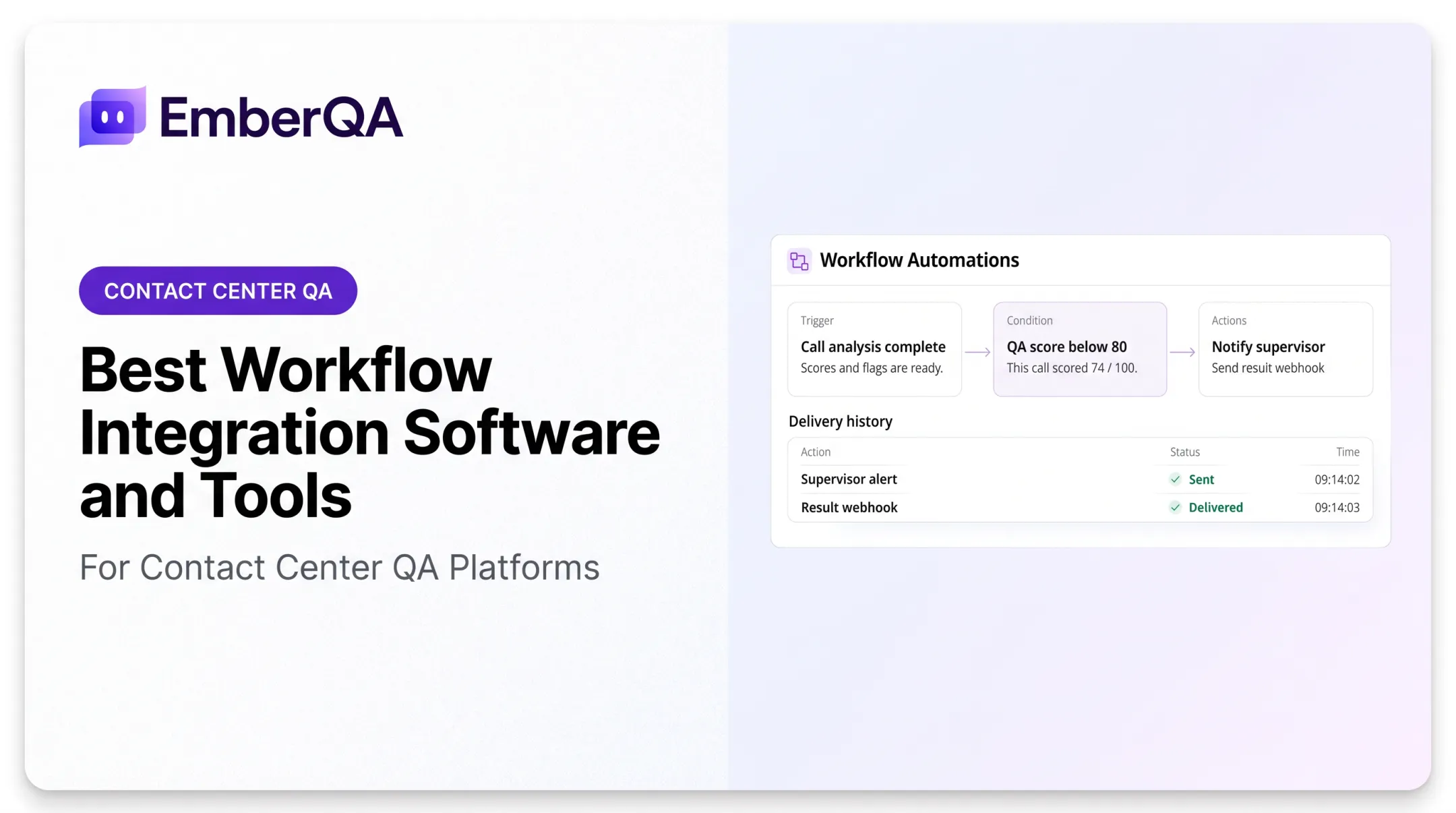
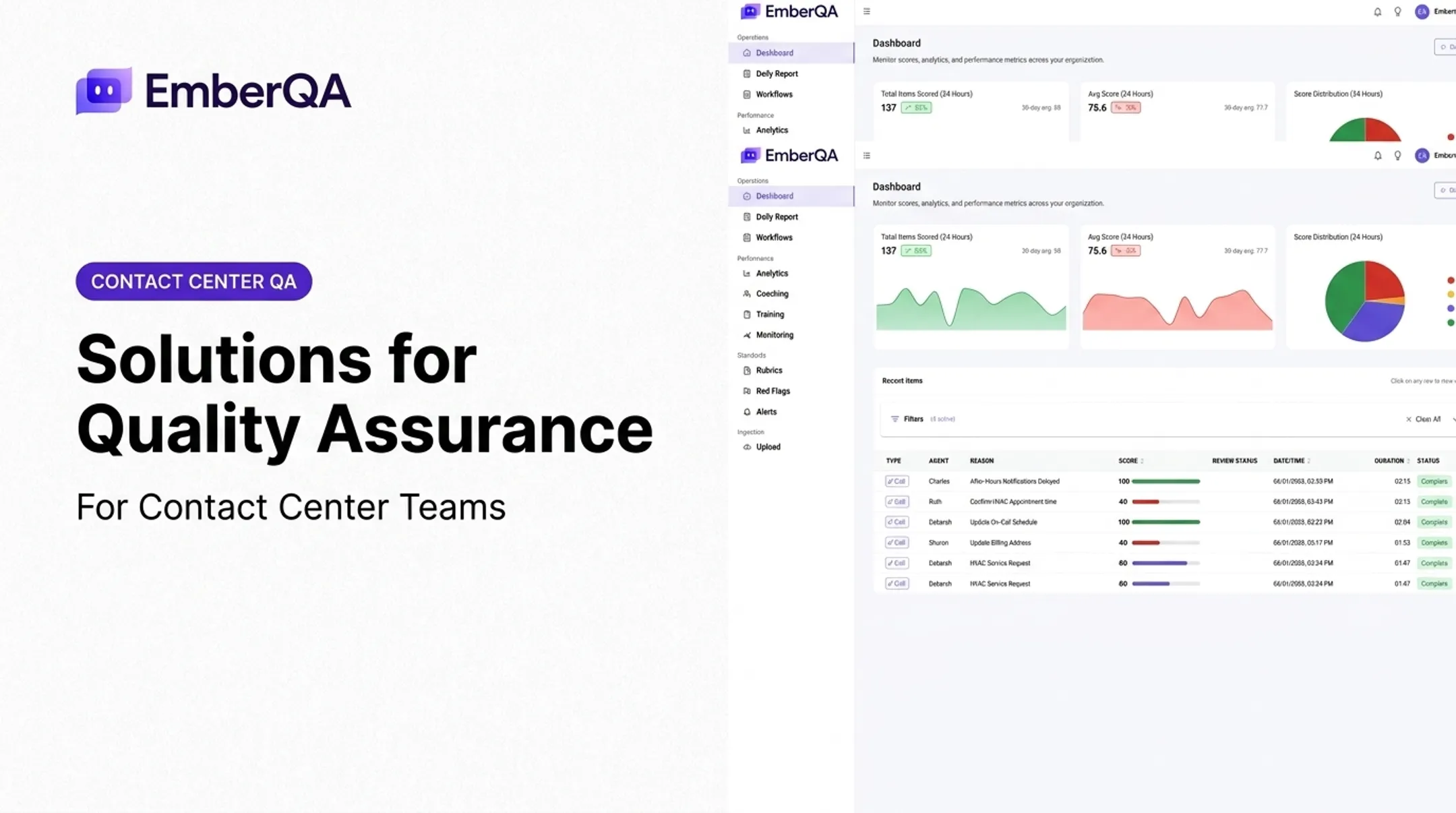
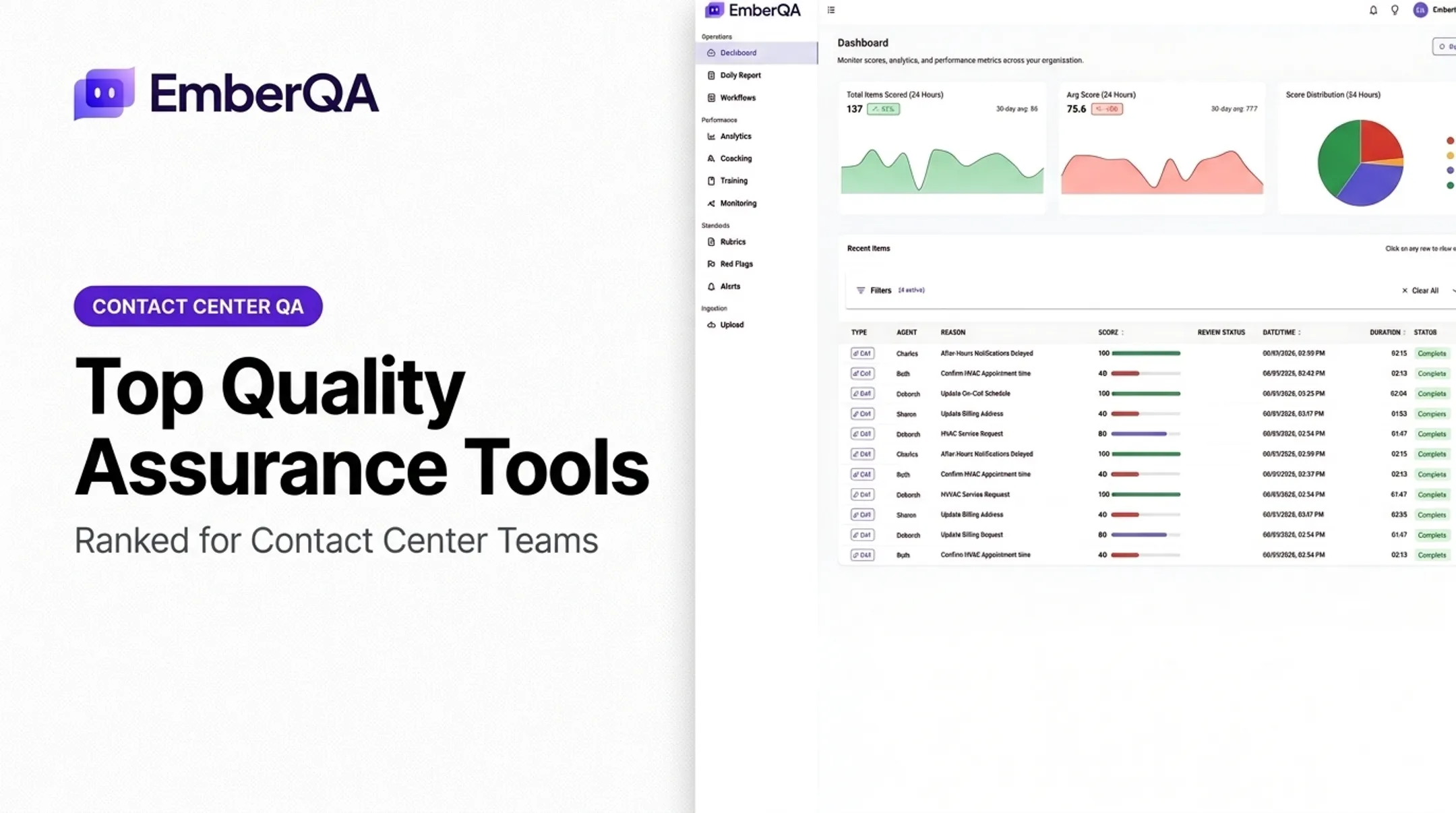
EmberQA is an AI-powered quality assurance platform built for contact centers and customer-facing teams. Instead of sampling a small percentage of calls, it analyzes calls, SMS, emails, documents, and transcripts against custom scorecards, applying the same rubric every time.
What makes it different from a manual QA process:
- Scores every interaction, not a random sample, using consistent criteria across agents, teams, and locations
- Surfaces red flags like hostile behavior, privacy violations, or escalation risk as they happen
- Makes calls searchable and comparable, so managers can pull up patterns instead of scrolling through recordings
- Turns recurring gaps into targeted coaching, connecting QA data directly to improvement plans
Best for: Contact centers, BPOs, answering services, and regulated insurance or financial services teams that need broader QA visibility than manual sampling allows.
Core capabilities: Automated interaction scoring, red-flag detection, searchable interaction data, office-specific QA workflows, coaching insights, and CRM verification alongside the call itself.
Consideration: EmberQA still depends on clear QA criteria, sound data governance, and manager follow-through. Automated scoring surfaces the pattern; a coaching process is what turns it into sustained improvement.
Answering service provider ECA is a useful illustration. Before adopting EmberQA, ECA manually reviewed less than 1% of calls.
After implementation, the team evaluated every call and scored agents more objectively against ECA's own criteria (covering greetings, hold handling, caller verification, and tone). That shift freed up roughly 30 hours per week of manager time previously spent on manual review.
Dental scheduling network Spot On Schedulers applies a similar model across 18 offices, with each location scored against its own process requirements and CRM data checked alongside the call itself.
Six Sigma
Six Sigma is a data-driven methodology for reducing defects, variation, and process inconsistency. It's most commonly organized through DMAIC: Define, Measure, Analyze, Improve, and Control.

While it originated in manufacturing, the same logic applies to service operations. A "defect" can be a repeat contact, an inconsistent quality score, a documentation error, or a compliance miss.
Best for: Organizations with a measurable quality problem, recurring variation, and enough historical data to support structured analysis.
Core tools: DMAIC, process measurement, control charts, Pareto analysis, process capability analysis, and root-cause techniques used within the Analyze phase.
Implementation consideration: Six Sigma requires disciplined measurement, trained contributors, reliable data, and leadership buy-in. Start with one clearly scoped problem rather than applying the full methodology everywhere.
A 2010 iSixSigma case study on a financial-services call center shows why the Measure phase matters. The team's first attempt to score calls failed a reliability test because reviewers interpreted the criteria differently.
After redefining the measures and separating call-taking from research work, first-call resolution rose from 50% to 90%, and weekly escalations dropped from 15 to fewer than one per month. Those are one team's reported results, not a typical outcome. The useful sequence still holds: measure accurately, diagnose the real cause, then redesign the workflow.
PDCA Cycle
PDCA (Plan-Do-Check-Act) is an iterative cycle for testing changes before committing to a full rollout. It's less about analyzing an entire process and more about answering one question: does this specific change work?
A customer-facing team might use it like this:
- Plan a coaching or workflow change tied to a specific problem
- Do a small-scale test with a defined group, such as one team or shift
- Check results against a baseline using real performance data
- Act by scaling, adjusting, or abandoning the change based on what the data shows
Best for: Teams that need a practical, repeatable way to test improvements without an immediate large-scale rollout.
Implementation consideration: Define the measurement period, success criteria, and owner before the pilot begins. Without that groundwork, the "Check" step produces an opinion instead of a decision.
For example, a QA team piloting a revised greeting script might run it with one location for two weeks and compare average QA scores against the prior baseline. Expand only once the scorecard confirms the change improved outcomes.

Root Cause Analysis
Root cause analysis (RCA) is a family of methods for finding the underlying condition behind a recurring problem, rather than patching its symptoms. The right technique depends on how complex the problem is.
| Technique | What it does | Best used when |
|---|---|---|
| 5 Whys | Asks "why" repeatedly to move past the surface issue | The problem is straightforward with a likely single cause chain |
| Fishbone/Ishikawa | Organizes multiple possible causes into categories | Several factors (process, people, systems) could all contribute |
| Pareto analysis | Ranks causes by frequency to find the biggest contributors | You need to prioritize which of many issues to tackle first |
| Fault-tree analysis | Maps combinations of failures leading to a top-level event | The failure involves layered or interacting system breakdowns |
Best for: Repeated quality failures, customer complaints, compliance findings, and problems that keep recurring after quick fixes.
Core process: Define the problem precisely, gather evidence, identify candidate causes, validate the most likely one, implement corrective action, then monitor for recurrence.
Implementation consideration: Involve frontline staff and separate process causes from individual blame. A vague problem statement or an untested assumption usually leads to a corrective action that doesn't fix anything.
Contact center example: A team seeing repeated escalations on billing disputes might use a fishbone diagram to sort candidate causes into training, script, and system categories. Call transcripts and CRM notes then confirm whether the real driver is unclear documentation, not agent performance.
Kanban
Kanban is a visual workflow management method that helps teams see work, limit how much is in progress at once, spot blocked tasks, and improve flow over time.
In QA and coaching operations, a Kanban board can make the improvement pipeline itself visible, tracking flagged interactions, escalations, coaching sessions, and corrective actions as they move through stages.
Best for: Teams managing multiple improvement tasks, coaching queues, escalations, or audits where bottlenecks are hard to spot from a spreadsheet.
Core practices: Visualize each stage of work, set work-in-progress limits, define clear entry and completion criteria, and review flow data regularly.
Implementation consideration: The board needs to reflect the real process, not become a reporting exercise. Assign clear ownership and decide upfront how aging or blocked items will be escalated.
Example: A QA manager tracks flagged interactions on a board with columns for Detected, Under Review, Coaching Scheduled, Corrective Action, and Verified. A WIP limit on the "Under Review" column prevents flagged calls from piling up unaddressed for weeks.

How We Chose the Best Performance Improvement Tools
"Best" doesn't mean one tool wins for every organization. The right choice depends on the performance gap, data maturity, process complexity, team capacity, and desired outcome. We evaluated each tool against four criteria:
- Problem fit — Does it address visibility, variation, root causes, experimentation, or workflow congestion?
- Actionability — Does it produce clear next steps for managers and frontline teams?
- Measurement — Can the organization establish a baseline and verify whether the change worked?
- Scalability — Can it support multiple teams, sites, or vendors without creating excessive manual work?
A Simple Matching Framework
- Reach for EmberQA when interaction-level quality visibility is incomplete or inconsistent.
- Apply Six Sigma when measurable variation or defects run through an established process.
- Use PDCA when the team needs to test and refine a specific change before scaling it.
- Turn to root cause analysis when problems keep recurring and the underlying cause isn't clear.
- Adopt Kanban when improvement work or coaching activity has become hard to track.
Common selection mistakes to avoid:
- Adopting a trendy methodology without a clearly defined problem
- Measuring activity (calls reviewed) instead of outcomes (issues resolved)
- Ignoring frontline input when diagnosing causes
- Relying on incomplete or unreliable data
- Treating performance tools as punitive monitoring instead of improvement systems
Once you pick an approach, run a tight loop:
- Define one clear problem and set a baseline
- Assign ownership
- Review results against that baseline
- Expand only after the approach proves its value
Conclusion
Performance improvement works best when reliable data meets a repeatable process for acting on it. Six Sigma, PDCA, root cause analysis, and Kanban each solve a different type of problem. Pick the wrong one for the situation and you spend effort without fixing anything.
For contact centers and customer-facing teams specifically, the visibility gap often comes first: you can't fix variation, test a change, or diagnose a root cause with data drawn from less than 5% of your interactions. EmberQA closes that gap by turning every call, message, and document into scoring, red-flag alerts, and coaching data.
If manual sampling, inconsistent scoring, or delayed issue detection is limiting how fast your team improves, review what full-interaction coverage changes in scoring speed, risk detection, and coaching focus.
Frequently Asked Questions
What are the Six Sigma tools?
Six Sigma commonly uses the DMAIC framework alongside tools like process maps, Pareto charts, control charts, fishbone diagrams, 5 Whys, and process capability analysis. The mix depends on the project.
What are the 7 types of process improvement methodologies?
Common methodologies include Six Sigma, Lean, Kaizen, PDCA, Total Quality Management, Theory of Constraints, and Business Process Reengineering. Labels differ by source and industry.
What are the top 3 ways to improve work performance?
Set measurable expectations tied to clear outcomes. Use real performance data and feedback—not guesswork—then coach or fix the process based on what the data shows. Both employee performance and process design matter.
What are the 5 management tools?
Common examples include SWOT analysis, SMART goals, the Eisenhower Matrix, the 5 Whys, and the PDCA cycle. There is no single official list—pick the tool that fits the problem you're solving.