Introduction
A call monitoring evaluation form does one job well: it turns a subjective impression of a customer conversation into a consistent record of observable agent behaviors, process adherence, and outcomes. Without one, two evaluators can listen to the same call and reach completely different conclusions.
Most QA programs hit the same walls. Manual teams often sample only 1–2% of calls, and the gaps show up fast:
- Evaluator judgments drift apart across reviewers
- Call coverage stays thin because managers only review a handful of calls per agent
- Coaching feedback turns vague ("be more empathetic") instead of actionable
- Compliance risks slip through unnoticed
- Performance trends stay invisible across the team
This article walks through the essential fields your form needs, how to build a scoring rubric that holds up under scrutiny, how to run calibration, how to turn scores into real coaching, and when manual review starts to hit its ceiling.
Key Takeaways
- Score observable behaviors and outcomes tied to business goals, not vague impressions like "good call"
- Pair structured ratings with evidence-based notes and one specific coaching action per evaluation
- Calibrate evaluators regularly and revisit the form whenever processes or compliance rules shift
- Manual forms build a solid QA foundation, but high-volume teams eventually need automated coverage
What Is a Call Monitoring Evaluation Form?
A call monitoring evaluation form is a structured scorecard used to assess a single recorded or live customer interaction against predetermined service, process, performance, and compliance criteria. It's the tool an evaluator fills out while listening to a call, not a summary of an agent's overall performance.
Call-Level Form vs. Agent Review vs. QA Program
These three terms get used interchangeably, but they're not the same thing:
- Call-level evaluation form — scores one interaction against the rubric
- Agent performance review — combines multiple call evaluations with operational metrics like attendance or handle time
- QA program — adds calibration, coaching workflows, reporting, and process improvement on top of individual forms
A form is the input. The program is what turns that input into consistent action.
Who Uses the Form and Why
QA analysts, team leaders, supervisors, and managers all rely on these forms for different jobs:
- QA analysts — daily scoring of individual interactions
- Supervisors and team leaders — coaching conversations tied to specific calls
- Managers — trend reporting across teams and sites
A well-built form supports fair, evidence-based feedback instead of pure surveillance.
The same structure fits contact centers, BPOs, answering services, insurance carriers, financial services and collections teams, and multi-site operations. Each still needs one consistent standard for interactions, even when call types and compliance rules differ by client or location.
What to Include in a Call Monitoring Evaluation Form
Start with metadata. These fields are what make scores searchable and comparable later:
- Agent name, evaluator, and date
- Interaction ID and call type
- Queue or client program
- Location or team
- Inbound, outbound, transferred, or escalated
Then build the behavioral sections. Score observable actions, not vague labels.
Opening and verification
- Greeting quality and agent identification
- Recording disclosures where required
- Identity verification and account access
- Clear statement of the call’s purpose
Communication and rapport
- Active listening with appropriate tone and pace
- Empathy at the right moment
- Clear, jargon-free language
- No interrupting the customer
- De-escalation on difficult calls
Discovery, accuracy, and problem-solving
- Relevant questions that surface the real need
- Use of approved resources
- Accurate information, confirmed for understanding
Hold, transfer, and escalation control
- Permission before hold and realistic wait-time expectations
- Proper transfer introductions and context handoff
- Clear ownership so the customer is never left hanging
Compliance, documentation, and outcome
- Required disclosures and authorization steps
- CRM notes, case numbers, resolution or next steps
- Follow-up commitments and any critical-fail events
| Category | Example criteria |
|---|---|
| Opening | Greeting, agent ID, verification |
| Communication | Tone, listening, empathy |
| Problem-solving | Accuracy, tailored explanation |
| Call control | Hold permission, transfer context |
| Compliance | Disclosures, documentation |
Reserve space for evidence and coaching notes. Require the evaluator to:
- Cite a specific moment on the call
- Quote or paraphrase the behavior and its impact
- Recommend one action the agent can use on the next call
ICMI guidance on building scorecards recommends roughly 10 to 20 questions, with exceptions for contractual or regulatory requirements. Scoring the form should not take longer than the call itself.
At EmberQA, a custom rubric does this automatically: every scored call returns a transcript, a metric-level explanation, and reasoning tied to the moment in the conversation—not a bare number.

How to Build a Fair and Reliable Scoring Rubric
The rubric is where most QA programs quietly fall apart. A five-point scale sounds simple until three evaluators interpret "meets expectations" three different ways.
Choosing a Rating Scale
Pick a scale evaluators and agents can understand instantly. A five-point scale (unsatisfactory, below expectations, meets expectations, exceeds expectations, outstanding) works for most teams when each level is anchored to a real behavioral example before rollout.
Not every item needs a rating, though:
- Ratings for quality levels (tone, rapport, explanation clarity)
- Yes/no for required actions (disclosure given, verification completed)
- Not applicable only when the criterion genuinely didn't occur — and only if you've defined how excluded items affect the final calculation
Vague wording is the real problem here. ICMI's 2025 calibration guidance points out that unclear scorecard criteria invite gut-feel or biased grading, and recommends attaching call clips or annotated examples to each rating level so evaluators aren't guessing.
Weighting and Critical-Fail Rules
Not every criterion carries equal weight. Compliance, verification, accuracy, and resolution should influence the score more heavily than minor etiquette misses.
Define critical-fail conditions separately from the overall score. These are events serious enough to trigger escalation regardless of how the rest of the call went:
- Prohibited disclosures or unauthorized promises
- Failed identity verification
- Inaccurate commitments to the customer
- Unauthorized account actions
- Serious customer mistreatment
Have legal or compliance stakeholders validate these rules against your industry's specific requirements before locking them in.
Calibrating Evaluators
Calibration is where "we're consistent" gets tested against reality. Have multiple evaluators score the same call independently, compare results, and document the agreed interpretation of any ambiguous item. This isn't a one-time exercise — repeat it whenever the form or process changes.

Departments often assume they're better calibrated than they are. In COPC's client assessments, quality departments reported that all or nearly all of their evaluators were calibrated, yet only about 25% actually achieved good agreement when measured by Kappa score. Self-reported calibration and measured calibration aren't the same thing: test it, don't assume it.
Once calibration holds on sample calls, pilot the full form against a mix of call types before rollout. Ask agents and evaluators which items feel unclear or redundant, and check whether the form causes evaluator fatigue. Fix problems before scores start affecting formal decisions.
How to Use Evaluation Results for Coaching and Improvement
A completed form that never becomes a coaching conversation is wasted effort. Review it with the agent promptly, and lead with specific strengths before moving to gaps.
Turn Scores into Coaching Actions
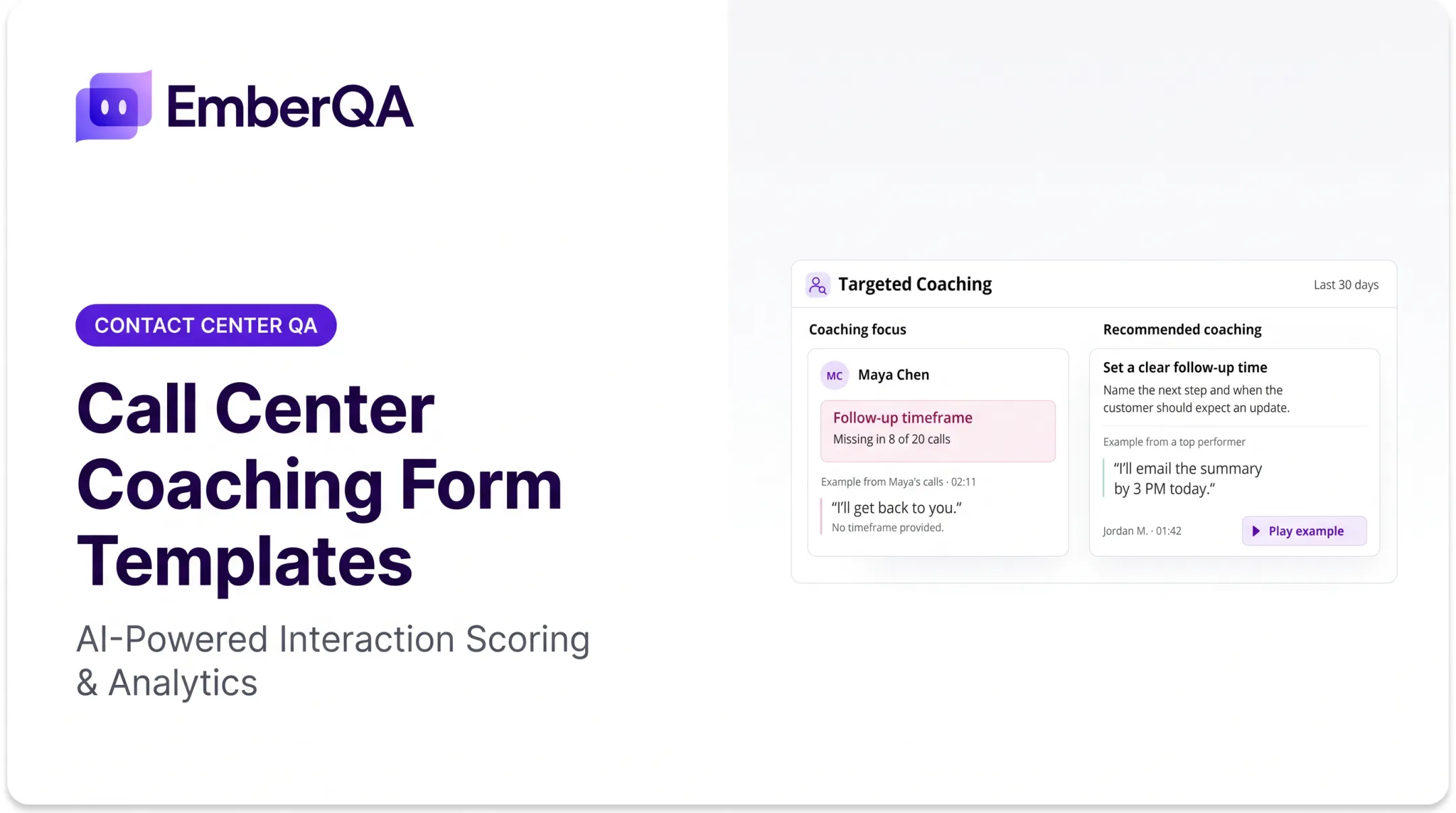
Vague feedback doesn't change behavior. "Improve empathy" tells an agent nothing. "Acknowledge the customer's concern before jumping to troubleshooting, like at the 2:15 mark on this call" gives them something to actually do differently.
Look for patterns before treating one low score as a verdict:
- Is the gap specific to one agent, or showing up across a whole shift?
- Does it cluster around a particular call type or client program?
- Could it be an evaluator inconsistency rather than an agent skill gap?
That pattern-spotting is exactly where manual review runs out of steam. A manager scanning five calls a month per agent simply can't see a trend that only shows up in 3% of interactions.
Close the Loop
A coaching workflow that actually works follows five consistent steps:
- Record the coaching action and the specific behavior it targets
- Assign shadowing or training if the gap is skill-based
- Set a follow-up date
- Review later calls for evidence of change
- Document whether the intervention worked
This is where EmberQA's Pro tier adds structure. Recurring missed-metric insights flag consistent gaps across agents automatically. Improvement plans set a metric target and monitoring period, so managers can track daily progress instead of waiting for the next spot-check.
Capture Wins and Protect the Process
Coaching is only half the job. Strong calls contain repeatable behaviors worth capturing for training material. Validate that those moments align with policy and customer outcomes before you add them to your library.
Handle scores with the same care you expect agents to show customers:
- Be transparent about how scores get used
- Protect customer data in every review workflow
- Give agents a way to dispute a score before it factors into any high-stakes decision
When to Move Beyond Manual Evaluation Forms
Spreadsheets and static forms aren't obsolete. They're the right tool for piloting a QA process, testing new criteria, or evaluating a small call volume before you scale anything up.
The trouble starts when volume outpaces capacity. Watch for these signs:
- Coverage stuck at a tiny fraction of total calls
- Feedback arriving weeks after the call happened
- Scores that vary wildly depending on who's evaluating
- Managers spending hours on data entry instead of coaching
- No visibility into trends across teams or client programs
ECA ran into exactly this. Managers could get through only a handful of calls per agent each month, and everything else went unreviewed. Useful feedback sat buried in recordings nobody had time to revisit.
After building a clear rubric covering greetings, professionalism, hold management, verification, message accuracy, tone, and pacing, ECA used EmberQA to score every call against it. Coverage rose from under 1% to 100%. Every call met the same standard, and agents got feedback tied to specific moments instead of a manager's general impression.

That's the role automation should play: an extension of the rubric you've already built, not a substitute for judgment.
Reserve human review for ambiguous, sensitive, or high-risk calls where context matters. Let automated scoring handle consistent coverage everywhere else.
Frequently Asked Questions
What is the 5-point rating scale for performance?
A common version runs from 1 (unsatisfactory) to 5 (outstanding), with meets-expectations sitting in the middle. Each level needs a behavior-based description specific to your organization. Generic labels alone invite inconsistent scoring.
What should I write in a customer service performance review?
Cite specific strengths and observed behaviors, note the customer or process impact, and name one or two improvement priorities. Back each point with call evidence and a measurable next step, not general impressions.
What should be included in a call monitoring evaluation form?
Cover interaction metadata, opening and verification, communication, problem-solving, compliance, documentation, and outcome. Add a score, evidence-based notes, and one specific coaching action.
How do you score a call monitoring evaluation form?
Apply your defined rating scale consistently, account for not-applicable items using a pre-set rule, and weight criteria by business risk. Review critical failures separately. They shouldn't be averaged into the overall score.
How often should call monitoring forms be updated?
Review the form whenever products, policies, workflows, customer expectations, or regulations change. Run periodic calibration and form audits in between to catch scoring drift before it becomes a pattern.